The “Wedding” Project! Building the Schedule? – PART 3


Hi,

In this blog post I will start to Create the schedule, and I will show you how can get in trouble when you do it. If you want to track this Blog post, and next few one, you should download my sample mpp file. I will give you a link at the end of this post.

My first task is “Decide the Initially Budget and size and Style of the Wedding. Decide who pays for what. After you know your budget You can determine your guest list! After that you can do the rest.

Here are the Problems.

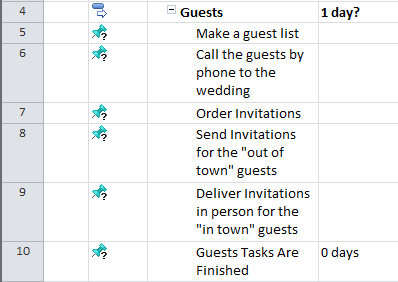
The first task in all Summary task can start when Task “Call the guests by phone to the wedding” is finished. Why? Well, simply because after that you know how many people will come to your wedding, and you have enough information about, for example, how big should Restaurant be, how many bottles of wine you have to order, how many rooms you must reserve for your “out of the town” guests, etc.

image

Where is the Problem? If you decide to put all those tasks (Find a Restaurant, Find a wedding chapel, Find a Hotel Near the Restaurant,….) immediately after the ““Call the guests by phone to the wedding” task, you should ask yourself: “There are so many tasks that will start at the same day (03.08.2011)! Who should do those task?” Suppose that the Bride and The Groom decide to do all those tasks by themselves. Is it possible to do all those task in few days? NO IT IS NOT! For now, I will leave this schedule as it is, and after I build the whole schedule, and when I put (assign) resources to all those Tasks, I will see the “Over allocation” and THEN I WILL FIX IT! So, once again, I made those tasks wrong, by PURPOSE, just to show you in the future how can you correct wrong plan in MS PROJECT 2010.

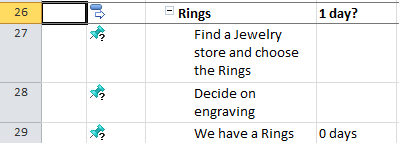
Another Problem is with the Rings. I forgot the Task: “Pick up the Rings”. After you find a jewelry, and you decide on engraving, the jeweler will need some time to make those rings (this is often situation in Croatia), and to engrave those Rings.

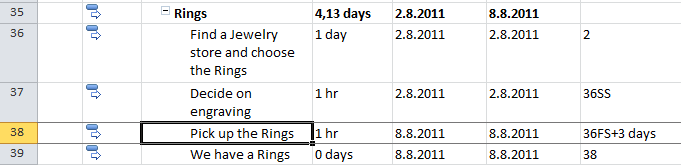
Please look at tis picture:
image 

Task no 36. “Find a Jewelry store and choose the Rings” have one day duration. Task 37. “Decide on engraving” should start in “parallel” with task 36. Why? Well, I can make them with the finish to start relationship (which means that I will first have to finish task 36, and after that start with task 37), but it will be silly, because it will means: “When you finish with finding a Jewelry store and choose the Rings, GO HOME, and COME BACK NEXT DAY TO SPEND 1 HOUR ON DECIDING ON ENGRAVING”. Instead of that I make those two tasks as Star to Star, which means, when you start with task 36, you can start with task 37. But, this is still not correct 100%. The best way is to make 1 task instead of two. So I will delete Decide on engraving task and I will marge it with task 36. “Find a Jewelry store and choose the Rings”

image

and then

image

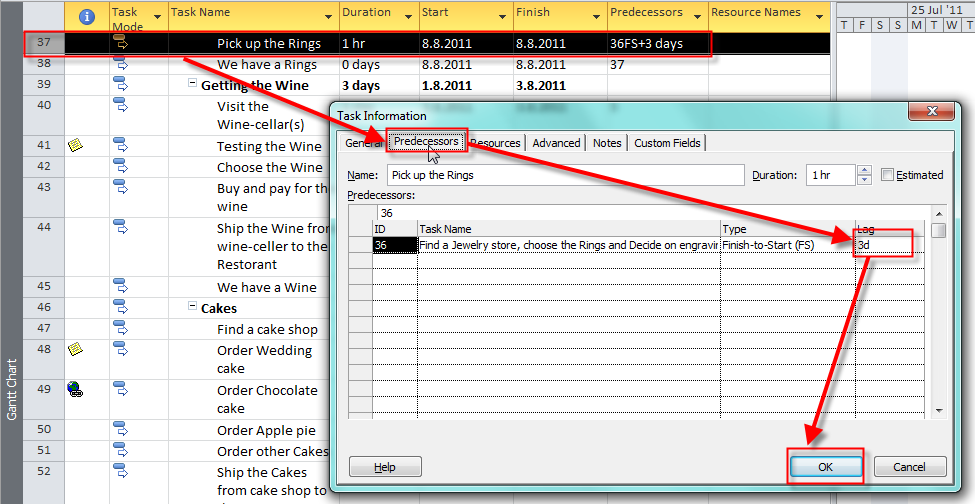
Everything is fine now. Now look at the task 37. Pick up the Rings. It has 1hour duration but in the Predecessors column you can see 36FS+ 3 days. 36 FS means that task 36 is a Predecessor and it has finish to start relationship. +3 days is LAG. Lag is also known as “waiting time”. In my example you can not pick up those Rings when you find the Jewelry store. you have to wait for some time before those rings will be ready. How do I know how much time do I have to wait!? By experience. Do not forget, that we are still in a Planning phase. When we will find a Jewelry store, and when we will decide on rings, then we will know how much time do we need. Until then that is only estimation (like everithing is Smile)

Where to put the Lag time? Double click on the task:
image

Now, the another problem!

image

Transportation! How long will take for the transportation tasks? It depends on the Location of the Hotel, wedding Chapel, and Airport? So I put 1 hour for now, but after I will know where those locations are, I will have to change those values. Another problem I With Predecessors! when do we have to make those transport? Well, to the hotel from the airport one day before the wedding. From the hotel to the wedding chapel, and then to the Restaurant at the day of the wedding. And then, after the wedding back to the hotel, and then they after the wedding, back to the airport.

If you can recall your memory, you already know that the wedding will be on Saturday. But which one? That is what I do not know yet. After I will find it out, I will make a correction to those tasks. The same problem is with those tasks:

image

and:

image

The “Wedding” Project isn’t so easy, after all, is it?

Here is the Link to the sample file: http://dl.dropbox.com/u/35142216/The%20wedding.mpp

I will continue with this subject in my next Post.


Until then,

Regards, and do not hesitate to give me any comment you want!
Posted in MICROSOFT PROJECT, Microsoft PRoject 2010, MS PROJECT 2010, PMI, PRoject Management | Tagged , , , , , | 3 Comments

The “Wedding” Project! Building the Schedule? – PART 2


Hi,

this post might be very boring! Because I am using the “Wedding” project I will put duration for each and every task! There are 100 task and I had to explain why I put those duration for each task. But, you know what? I won’t do it! I will show to you how can you put those duration to the tasks, and I will give you a link to my “Wedding” Project so, if you are interested in watching this example, just download it!

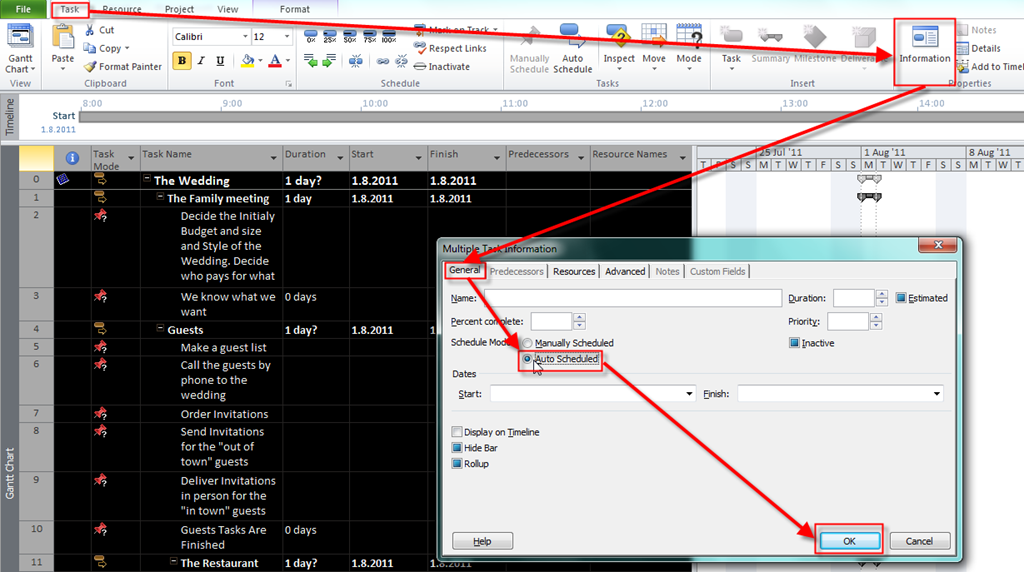
First I decided to change all task from manually schedule mode to auto schedule mode in MS PROJECT 2010. And I can do it with single step, instead of repeating 100 times the same thing for each task.

First I will select all my tasks:

image

and then:

image

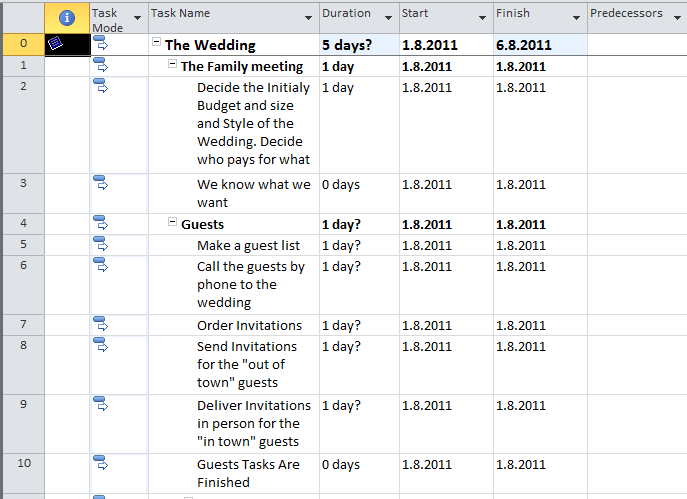
and I will get:

image

All tasks are in auto schedule mode! They have 1 day duration, by default. What does the question mark means? It means that duration is estimated. I know what is on your mind now. You think: “But every duration during the Planning phase is estimated. We will know the exact information AFTER the work is done (so called ACTUALS)!”. And that is true! This question mark you might consider as: “estimate of a duration estimate”.

If you do not want to turn this future off follow these steps:

image

and then:

image

I keep these feature always on.

When you are adding the new task in auto schedule mode, you will have a default 1 day duration with question mark. But if you put manually duration in a duration field these question mark will disappear. If you want, for example, to change the default duration from 1 day to 6 days, but you still not confident with this estimation, and you want to keep the question mark put 6?, and you will get:

image

If you want to see how did I estimate durations for my “”Wedding” Project, here is the link:

http://dl.dropbox.com/u/35142216/The%20wedding.mpp

In my next Post I will set up dependencies, and I will show you where are the mistakes in my task list.

Give me any comment you like.


Regards!

Posted in MICROSOFT PROJECT, MS PROJECT 2010, PMI, PRoject Management | Tagged , , , , , | 1 Comment

The “Wedding” Project! Building the Schedule? – PART 1

Hi,

I received very interest comment for my latest post: “Very refreshing. Having said that, I am sorry, but I do not give credence to your entire plan, all be it stimulating none the less. It seems to me that your comments are generally not completely validated and in fact you are generally your self not really thoroughly convinced of your argument. In any case I did appreciate examining it.”

I say: “THANK YOU A LOT!” for your comment.

The answer is: “Thanks for your comment. I am just starting to building the Plan for my “Wedding” Project. I want to show how difficult it is. In my next blog posts I will continue to build my plan, and I will show the mistakes. I did some mistakes in this stage of Planning phase by the purpose. Anyway, whenever you have any comment, please write it down. I appreciate it!”

Obviously I have to give some further explanation. With my blog posts I was started with Planning phase “from the scratch”. In real life, in every Project, in early phase of planning, there are mistakes. In my last posts I put some Task, Resource, and Project Calendars. I will now continue to make my plan for the Project. I will building the schedule, define and assign resources, and add the costs and budget. After that I will show you where the mistakes are made, and I will explain how to correct them. Then I will save the Project Plan as a Baseline, and the work will start. Of, course I will track “actuals” vs. “planned” values.

This Blog post will be short, and there will be no samples. Why? Because before making a schedule you have to know the theory! After that we will build the schedule in MS PROJECT 2010.

Building the schedule means:

  1. Enter task durations
  2. Identify the relationship, or dependencies, among task
  3. Schedule certain tasks to achieve specific dates when necessary

You can build your schedule before you know your resources (it means, EHO WILL DO THE WORK?) or, if you have known resources and their availability, after you put them in MS PROJECT 2010, and set up their calendar (if it is different from Standard Calendar in MS PROJECT 2010) you can build your schedule.

For our “Wedding” Project I will first estimate duration for all my Tasks. How can I do it?

In the Duration Field you can put these units of time:

  • 1d or just 1 (or any number you like)– unit is days (default value)
  • 1h (or any number you like)– unit is hours
  • 1m (or any number you like)– unit is minutes
  • 1w (or any number you like)– unit is weeks
  • 1mo or mo (or any number you like)– unit is months

That was easy. I will show you duration of my Tasks in the “wedding” project in my next blog post. But, the question is: “How do I know the duration of my task?”. It can be 1 day, or 1,5 day or 5 days?

There are many ways to establish Task duration:

  • Previous Projects. It means, that you have the same or almost the same task in your previous Projects so you already know the Duration
  • Team knowledge. If you already have your team (e.g. Resources) and you know who will do what, they can give you their estimated duration for their tasks on the Project
  • Expert judgment. If you do not have a team you can obtain durations for some other specialists in the field (for example consultants, accountants etc.)
  • Industry standards. For projects tasks typical to an industry or discipline (like Construction Projects), you can find how much time do you need for your Tasks

Be very careful. If you have the Resources assigned to your Project, and they give you estimated Task Duration you should know those person very well! Why? Because, they can be over optimistic, or over pessimistic, more or less experienced so they can do the wrong estimation.

What does it mean? It means that if you do not have proper resources for your project, or you do not know them well, estimations can differs a lot from real time needed for your tasks.

And last, but not least, you should always have a proper Resources for your Project.

Here is the funny picture about resources from internet. I hope that you will not be offended by this picture.

image

In my next post I will start to build the schedule for my “Wedding” Project!


Have a great weekend!

Posted in MICROSOFT PROJECT, Microsoft PRoject 2010, MS PROJECT 2010, PMI, PRoject Management | Tagged , , , | 2 Comments

MS PROJECT 2010–The “Wedding” Project. Sample!


Hi,

I forgot to mention. If you want to try to work on my “Wedding Project”, here is the link: http://dl.dropbox.com/u/35142216/The%20wedding.mpp, and you can download everything what was (and is) on the Blog.


Regards,

Posted in Microsoft PRoject 2010, MS PROJECT 2010, PMI, PRoject Management | Tagged , , | 6 Comments

The “Wedding” Project! How to set up Calendars in MS PROJECT 2010, and why? – PART 4


Hi,

The last Calendar type in MS PROJECT 2010 is the Task Calendar. Remember this: If you have the Project Calendar, and the Resource Calendar (or Calendars), and the Task Calendar, TASK CALENDAR HAS PRECEDANCE!

Why do you need a Task Calendar. I will give you an example on our “Wedding” Project. We do not know when will we have a wedding. We are still in a Planning phase. But what we DO KNOW that the wedding will start at Saturday, and it will finish on Sunday. We do not know WHICH Saturday and Sunday, but we know that the wedding will be on this two days.

When you need specific Task Calendar, DO NOT use and modify standard Calendars. Create your own, instead. Why? Because if you modify working time on the Standard Calendar, and you use it with different tasks and different resources, you can get unpredictable results. Here is an example. If I modify standard Calendar in MS PROJECT 2010 and if I put the work time only at Saturday and Sunday, all my tasks will be scheduled to be conducted at these days.

I will now create the two brand-new calendars, and I will name it: “Wedding Saturday” and “Wedding Sunday”:

image

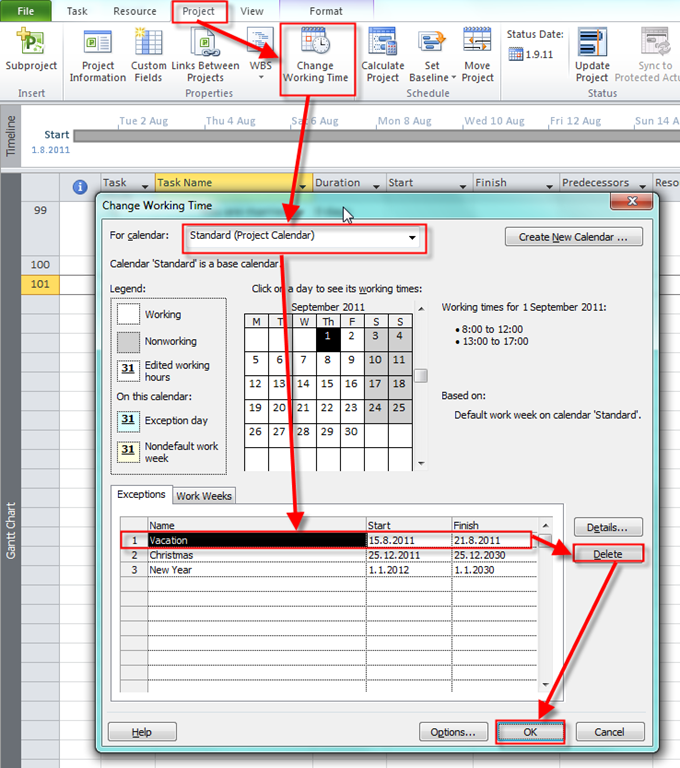
No I will remove all exceptions from my Calendar:

I will select all Exceptions and I will click on the Delete Button:

image

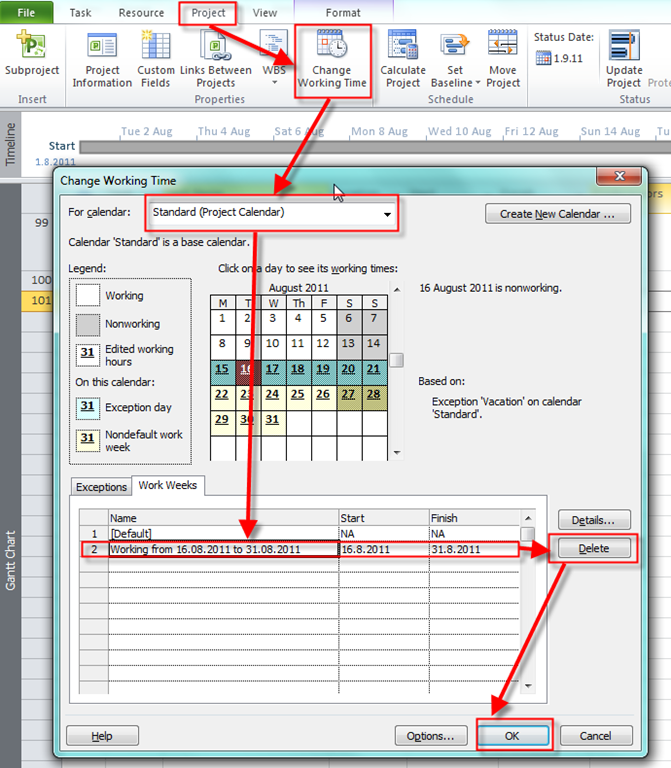
Now, I will set up Work Weeks. First I will delete the Specific work from 16.08.2011 to 31.08.2011. This specific work came from my previous posts, about Calendars, remember?:

image

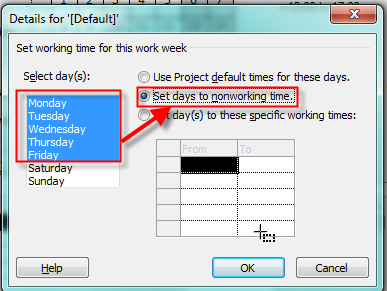
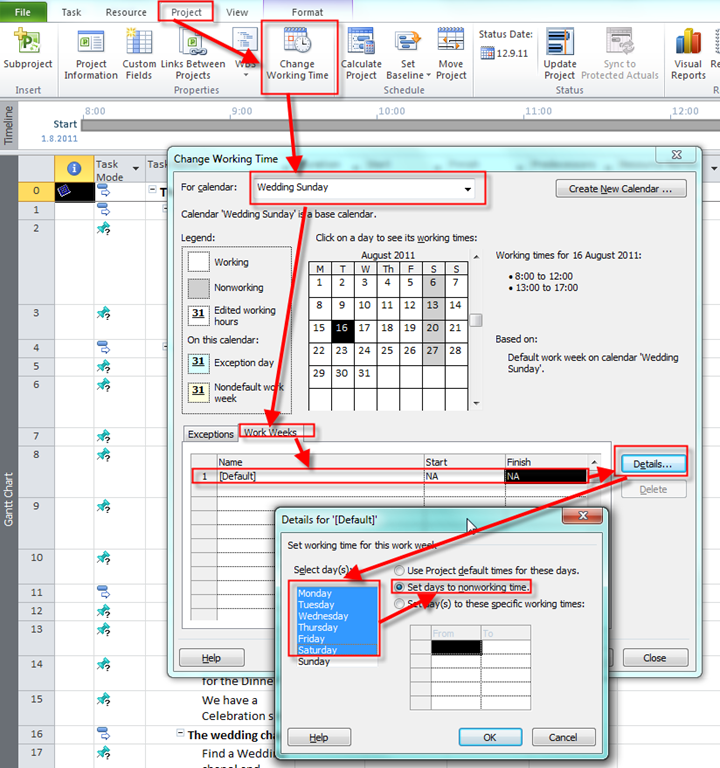
Finally I will set up working and nonworking days for my Calendar:

image

and then:

image

DO NOT CLICK ON THE OK BUTTON! If you try you will get:

image

Why? Because I set up nonworking days from Monday to Friday, and Saturday and Sunday are nonworking days by default, it will means that you have Calendar without single working day, and that is seamless.

You can see that there will be no activities from Monday to Friday. But, on Saturday I will set up working time for 08:00 to 24:00 (e.g. 00:00, you can not put 24:00):

image

O.K. When will the wedding finish? At Sunday. But if it will start on Saturday it will keep going on Sunday. So I will make Wedding Sunday Calendar, as a copy of Wedding Saturday Calendar:

image

I will set up working time as a whole day:

image

and then:

image

That is it!

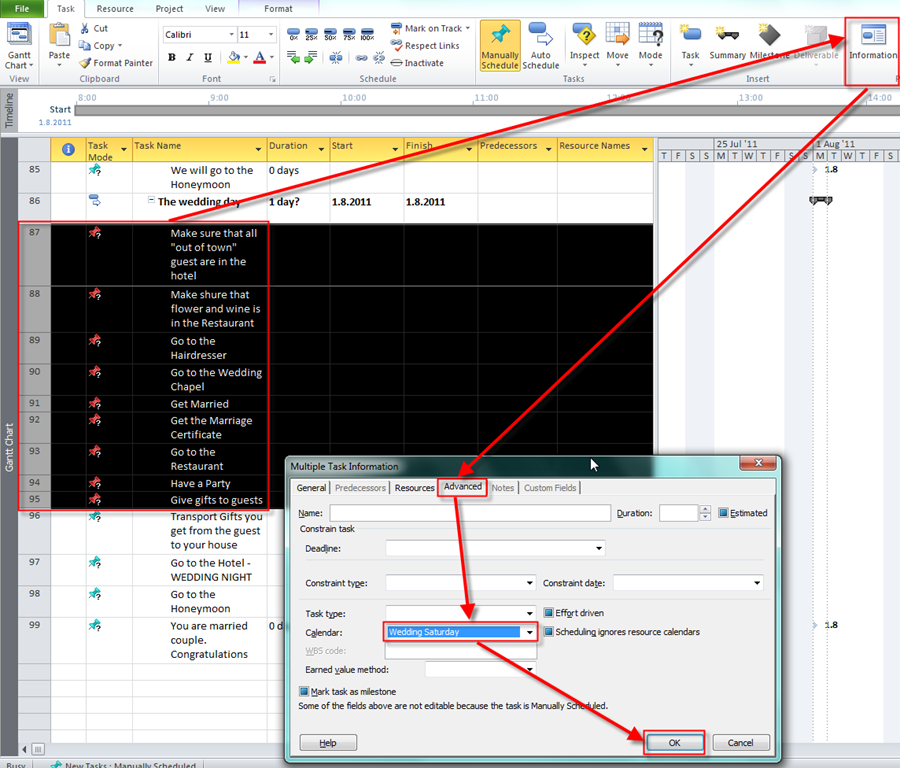
Now I will assign specific Calendar to the Specific Task(s).

image

and I will get:

image

You will notice that I made a mistake, but I did it purposely, and I will correct it when I will establish a schedule, later in my project (not in this post, of course). What is the Mistake? Well, look at a “Have a party” Task. The wedding ceremony will finish, for example, at 18:00 at Saturday, and then the party will start. But it will certainly not finish at Saturday. So this is the mistake. But, as I said, I will correct the mistake latter.

Now, suppose that I have a “Wedding couple” as a Resource with Standard Calendar:

image

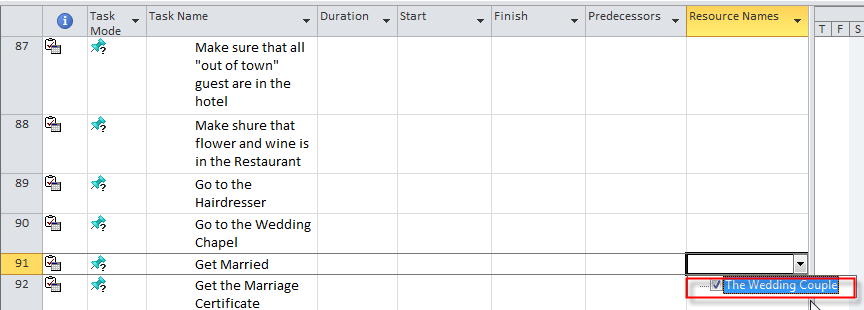
I will assign that resource to the “Get Married” Task:

image

If I want to move out of this field I will get a warning message:

image

WHY? Well our “Wedding Couple” Resource has a Standard Calendar assign to them, and it Means they are available only at working days (Monday to Friday). One the other hand, the “Get Married” task has a “Wedding Saturday” Calendar and it will be conducted at Saturday. So we have a conflict, because our “Wedding Couple” are not available at their own wedding!!! Smile . How to solve this conflict? Easy!

Double click on the Task and then choose:

image

With “Scheduling ignores Resource calendars” you are avoiding those types of conflicts in MS PROJECT 2010, because MS Project assume, that any resource will be available to my task if it has its own Calendar!


Best Regards!

Posted in MICROSOFT PROJECT, Microsoft PRoject 2010, MS PROJECT 2010, PMI, PRoject Management | Tagged , , , | 6 Comments

The “Wedding” Project! How to set up Calendars in MS PROJECT 2010, and why?–PART 3


Hi,

if you reed my last post you already know that we have set up our project calendar, and exceptions.

Here they are:

image

and:

Working time was set as:


Now I will show you how painful MS PROJECT 2010 can be if you do not understand how does it work! I will add two resources in the Resource sheet. Remember, this post is NOT about Resources and how to manage them. I will write about Resources after I will establish the Schedule for my “Wedding” party. This post is about Resource Calendars:

image

For the Resource I want to set up Calendar with:

  • Vacation (nonworking time) from 01.08.2011 to 10.08.2011

image

  • working time from 08:00 to 14:00 (working days) e.g. 6 hours per day

image

I will now, just for example, put a Auto Scheduled Task which will start (by default) at 01.08.2011 (Project start date), and will have 20 days Duration. I will get:

You know why the Start date is 01.08.2011 and the End date is 08.09.2011. If you don’t, read my previous Blog: “The “Wedding” Project! How to set up Calendars in MS PROJECT 2010, and why?–PART 2”

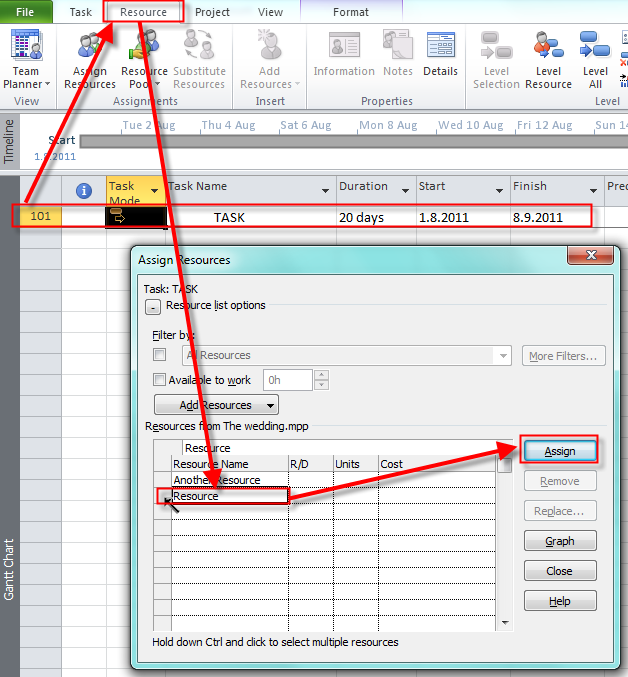
OK. I will assign The “Resource” to the Task:

image

and I will get:

image

Duration is still 20 days, Start date is the Project start date, and the end date is 23.09.2009. How is it possible?

We need 20 days X 8 hours per day = 160 hours to complete the Task, because I told that one working day have 8 hours. Now I will switch to the Resource Usage View:

image

As you can see: Our resource will work 6 hours per day, and will start at 11.08.2011. Why? Because he or she is on vacation from 01.08.2011 till 10.08.2011.

We have to work 160 hours to complete the Task. And or resource will work only 6 hours per day. It means:

  • From 11.08.2011 (Thursday) to 12.08.2011 (Friday) = 2 days X 6 hours / day = 12 hours
  • From 15.08.2011 (Monday) to 21.08.2011 (Sunday), there are no activities on the Task because of Project Calendar Exception (Vacation, remember???)
  • From 22.08.2011 (Thursday) to 16.09.2011 (Friday) = 4 weeks X 5 days X 6 hours / day = 120 hours
  • From 19.09.2011 (Monday) to 22.09.2011 (Thursday) = 4 days X 6 hours / day = 24 hours
  • 23.09.2011 (Friday) = 4 hours

And it makes: 12+120+24+4=160 hours!

OK. Now I will REMOVE (REASSIGN) the Resource from my task and after that I will add the Resource and the Another Resource. It is very IMPORTANT that you do not get the same result if you assign multiply resources to the task in one step, or if you assign the resource to the task, and few minutes later you assign another Resource to the same Task. I will explain how and why is this different in one of my future posts, but for now I will first remove the Resource from the Task!

image

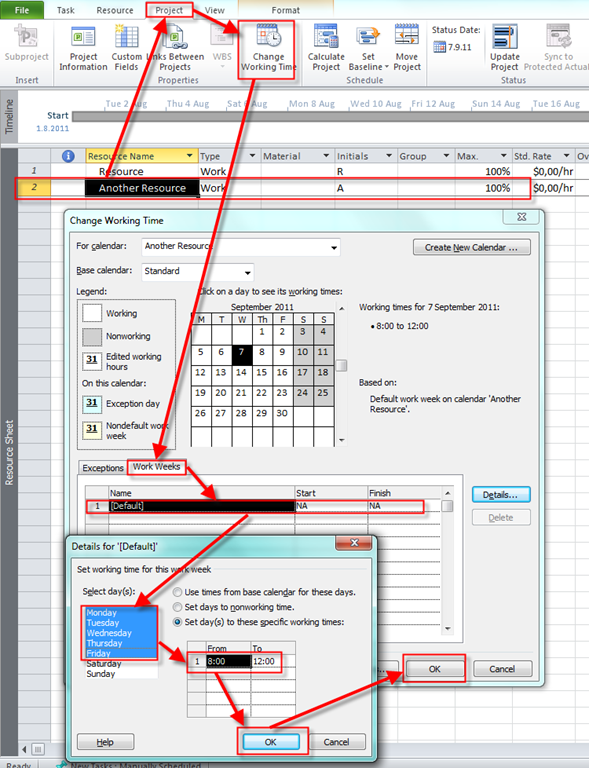
I will set up the Calendar for the Another Resource:

image

So the Another resource will have time from 08:00 to 12:00 (working days) e.g. 4 hours per day. Notice, that this Resource has NO EXCEPTIONS (no Vacations).

I will now assign both, the Resource, and the Another Resource to the Task, and I will do it directly from the Gantt chart:

image

and I will get:

image

Now the Task has 26.5 days duration, and the End  date is 30.09.2011. HOW?

Well, I assign both resources for the task at the same time. It means that both resources should work 160 hours! I know that is complicated but that’s how MS PROJECT 2010 works. Of course, if you change the task type, you can get different result, but we are taking one step at the time.

Because both Resources must work 160 hours on the task, they will work according to the Project Calendars, and exceptions, and Resource Calendars and Exceptions.

Remember this: If you have the Project Calendar and the Resource Calendar (or Calendars), RESOURCE CALENDAR HAS PRECEDANCE!!!!!!

So how will the resources work. The Resource will work the same as it was explained:

  • From 11.08.2011 (Thursday) to 12.08.2011 (Friday) = 2 days X 6 hours / day = 12 hours
  • From 15.08.2011 (Monday) to 21.08.2011 (Sunday), there are no activities on the Task because of Project Calendar Exception (Vacation, remember???)
  • From 22.08.2011 (Thursday) to 16.09.2011 (Friday) = 4 weeks X 5 days X 6 hours / day = 120 hours
  • From 19.09.2011 (Monday) to 22.09.2011 (Thursday) = 4 days X 6 hours / day = 24 hours
  • 23.09.2011 (Friday) = 4 hours

And it makes: 12+120+24+4=160 hours!


The Another Resource will work:

  • From 01.08.2011 (Monday) to 12.08.2011 (Friday) = 2 weeks X 5 days X 4 hours / day = 40 hours
  • From 15.08.2011 (Monday) to 21.08.2011 (Sunday), there are no activities on the Task because of Project Calendar Exception (Vacation, remember???)
  • From 22.08.2011 (Monday) to 30.08.2011 (Friday) = 6 weeks X 5 days X 4 hours / day = 120 hours

And it makes: 40+120=160 hours!

If you think you are suffering, wait until my next post.


Until then,


Best Regards!

Posted in MICROSOFT PROJECT, Microsoft PRoject 2010, MS PROJECT 2010, PMI, PRoject Management | Tagged , , | 3 Comments

The “Wedding” Project! How to set up Calendars in MS PROJECT 2010, and why?–PART 2


Hi,

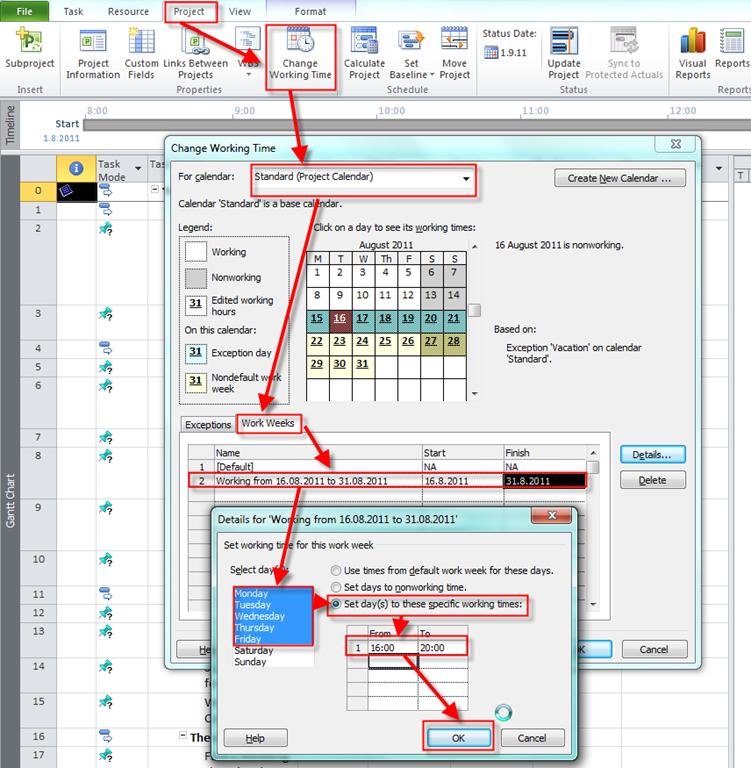
In my previous post I have explained how to use the Project Calendar, and how to make an exception (Vacation, New Year etc.). But what if you have different working times over the period. For example, our “Wedding” Project has working time from Monday to Friday from 08:00 to 12:00 and from 13:00 to 17:00. And it will start at 01.08.2011. Suppose that we want to keep that working time from 01.08.2011 to 15.08.2011, and then from 16.08.2011 to 31.08.2011 we want to work from 16:00 to 20:00, and then from 01.09.2011 go back to old working time.

I’ll show you how to do it in my “Wedding” Project, but this is the Example, so I will delete those working times later, because I will not need them in the future

Here it is:

image

Notice that you CAN NOT change the Default row.

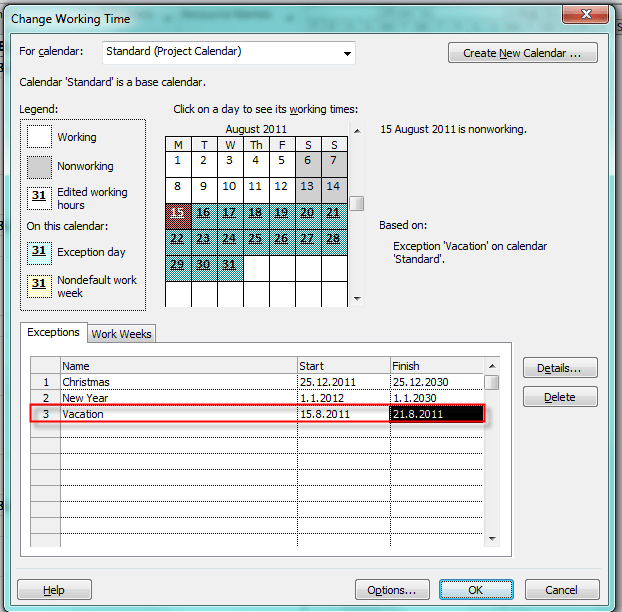
Now be very concentrate. If you read my previous post you know that I made an exception in the Project Calendar for my Vacation time:

image

I will now, just for example, put a Auto Scheduled Task which will start (by default) at 01.08.2011 (Project start date), and will have 20 days Duration. I will get:

image

WOW! I have task with 20 days Duration, it will start at 01.08.2011 and it will be finished at 08.09.2011????

Well, now you understand why is SO IMPOTRANT to understand MS PROJECT 2010 calendars. Here is the explanation.

First, when I told that my task will have a 20 days duration, MS PROJECT 2010 has converted 20 days into 20 days X 8 hours per day = 160 hours.

We know that one day has 8 hours from here: On the File Tab click Options, and then Schedule and you will see:

image

The Task will start at 01.08.2011 (The Project Start date). OK. We need 160 hours. And we will get them:

  • From 01.08.2011  (Monday) to 05.08.2011 (Friday) = 5 days X 8 hours / day  = 40 hours
  • From 08.08.2011 (Monday) to 12.08.2011 (Friday) = 5 days X 8 hours / day = 40 hours
  • From 15.08.2011 (Monday) to 21.08.2011 (Sunday), there are no activities on the Task because of Calendar Exception (Vacation, remember???)
  • From 22.08.2011 (Monday) to 26.08.2011 (Friday) = 5 days X 4 hours / day = 20 hours. WHY? Because working time from 16.08.2011 to 31.08.2011 is from 16:00 to 20:00 and it means only 4 hours per day
  • From 29.08.2011 (Monday) to 31.08.2011 (Wednesday) = 3 days X 4 hours / day = 12 hours. WHY? Read one sentence above Smile with tongue out
  • From 01.09.2011 (Thursday) to 02.09.2011 (Friday) = 2 days X 8 hours / day = 16 hours. WHY? We are on the old working time!
  • From 05.09.2011 (Monday) to 08.09.2011 (Thursday) = 4 days X 8 hours / day = 32 hours. WHY? You know very well why Smile with tongue out

And it makes 40+40+20+12+16+32= 160 hours!

What will happens if I remove this working week from 16.08.2011 to 31.08.2011 from my Project Calendar?

image

I will get:

image

The Finish date is 02.09.2011.

  • From 01.08.2011 (Monday) to 05.08.2011 (Friday) = 5 days X 8 hours / day = 40 hours
  • From 08.08.2011 (Monday) to 12.08.2011 (Friday) = 5 days X 8 hours / day = 40 hours
  • From 15.08.2011 (Monday) to 21.08.2011 (Sunday), there are no activities on the Task because of Calendar Exception (Vacation, remember???)
  • From 22.08.2011 (Monday) to 26.08.2011 (Friday) = 5 days X 8 hours / day = 40 hours. WHY? Because I remove working time from 16.08.2011 to 31.08.2011 which was from 16:00 to 20:00 and only 4 hours per day
  • From 29.08.2011 (Monday) to 02.09.2011 (Friday) = 5 days X 8 hours / day = 40 hours. WHY? Read one sentence above Smile with tongue out

And it makes 40+40+40+40= 160 hours!

Now, I will remove my Vacation from exception from MS PROJECT 2010 Calendar:

image

and I will get:

image

The Finish date is 26.08.2011.

  • From 01.08.2011 (Monday) to 05.08.2011 (Friday) = 5 days X 8 hours / day = 40 hours
  • From 08.08.2011 (Monday) to 12.08.2011 (Friday) = 5 days X 8 hours / day = 40 hours
  • From 15.08.2011 (Monday) to 19.08.2011 (Friday) = 5 days X 8 hours / day = 40 hours
  • From 22.08.2011 (Monday) to 26.08.2011 (Friday) = 5 days X 8 hours / day = 40 hours

And it makes 40+40+40+40= 160 hours, again.

At the end of this post, do I have to emphasize that you should be EXTREMLY CAREFUL when you are changing calendars in MS PROJECT 2010, or working time???

If you think that this is complicated you are hitting the target. BUT, the real pain begins with Resource calendars, and the Task Calendars.

In my next post I will start with them! For the example I will leave Exception for the Vacation and 4 hours working days from 16.08.2011 to 31.08.2011, to make the whole thing more complicated.


Until my next post,

Best Regards!

Posted in MICROSOFT PROJECT, MS PROJECT 2010, PMI, PRoject Management | Tagged , , , | Leave a comment

The “Wedding” Project! How to set up Calendars in MS PROJECT 2010, and why?–PART 1


Hi,

As you know, from my previous posts, working time in MS PROJECT 2010 is set up in a Backstage view:

and it says: When you put task duration in the Duration field in DAYS it will multiple days with 8 hours per day. The task will start at 08:00 and will finish at 16:00. When you put task duration in the Duration field in WEEKS it will multiple weeks with 40 hours per week. Finally, when you put task duration in the Duration field in MONTHS it will multiple months with 20 days per month and with 8 hours per day.

Defaults for MS PROJECTS 2010 are:

  • Weeks starts on: Monday
  • Fiscal year starts in: January
  • Default start time: 08:00
  • Default end time: 17:00
  • Hours per day: 8
  • Hours per week: 40
  • Days per month: 20

It means that 1 day of duration is work from 08:00 till 17:00 with 1 hour of lunch break

You know that if you want from MS PROJECT 2010 to calculate start and end date you have to be in auto scheduled mode.

in MS PROJECT 2010 there are three types of Calendars: Project Calendar, Resource Calendar and Task Calendar.

I will explain when, how, and why to use those types of calendars. I will be very detailed. I do not know if will take me 2, 3 or 5 posts to explain everything about Calendars in MS PROJECT 2010, but I do not care. I will write, and write, and write until I will not cover EVERYTHING about the Calendars. WHY? Take me seriously in this: “IF YOU DO NOT UNDERSTAND HOW TO WORK WITH CALENDARS IN MS PROJECT, YOU WILL NOT BE ABLE TO GET THE EXPECTED RESULTS, AND YOU WILL HATE THE MS PROJECT 2010, BECAUSE YOU WILL THINK THAT IT DOES NOT WORK PROPERLY!”

The introduction of this subject can be found in my post: https://ntrajkovski.wordpress.com/2011/04/12/scheduling-problems-in-ms-project-2010-2/

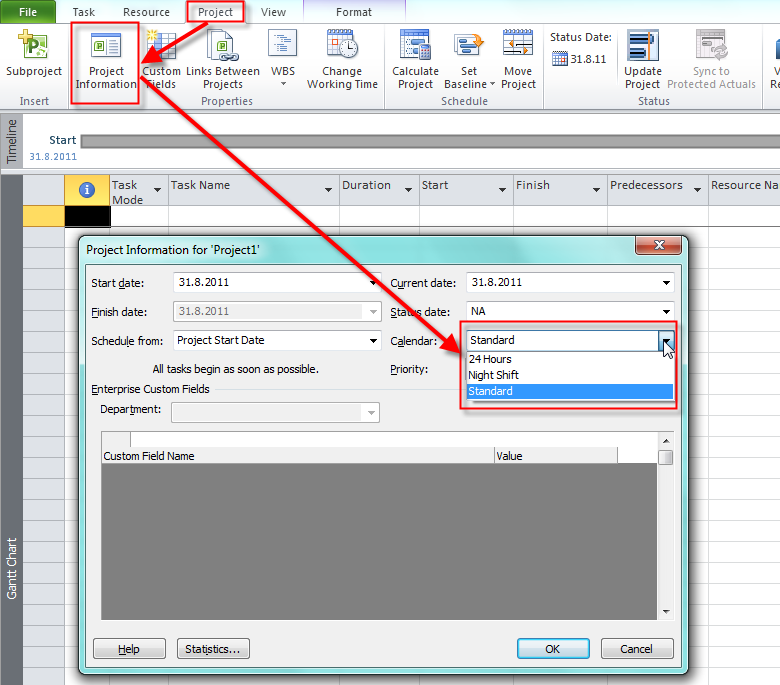
There are three “built in” Calendars in MS PROJECT 2010: Standard, Night Shift and 24 hours. You can see them here:

image

For the Project, Resources and all Tasks, Standard Calendar is Default.

Default working time for the Standard Calendar is from Monday to Friday, and from 08:00 to 12:00, and From 13:00 to 17:00. You can see it here:

image

Default working time for the Nigh Shift Calendar is from Monday to Friday, and from 23:00 to 03:00, and From 04:00 to 08:00.

Default working time for the 24 Hours Calendar is from Monday to Sunday (the whole week) , and from 00:00 to 00:00.

You can create your own Calendar or change one of the Default Calendars.

OK. Now back to our “Wedding Project”. We do not want to work on Christmas, and New Year. So we have to change our Calendar:

image

after you will click on the Details button you will get:

image

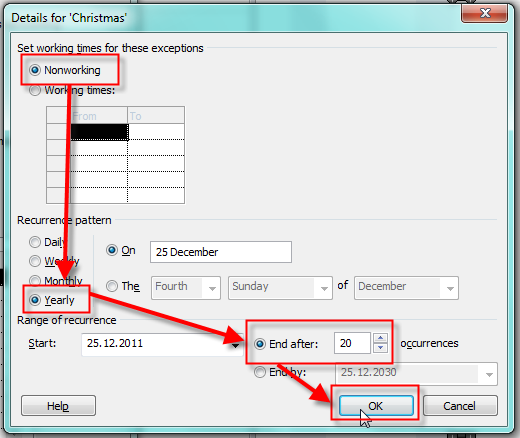
I told that Christmas is so called “Recurring” exception, and that it is Nonworking day and that it recur every Year. I put 20 in the number of occurrences, so I do not have to be worried for next 20 years about Christmas, and my “Wedding” Project will be finished much, much earlier than 20 years from now (I hope Smile with tongue out)

I will do the same thing for the New Year!

If you remember, my Project is about to start at 01.08.2011. Since I want to take a control over every task, I must be available for my Project all the time. No, suppose that I am going on vacation from 15.09.2011 to 21.08.2011. I will make this as a “one time” exception, because I do not want any activity while I’m on my vacation.

image

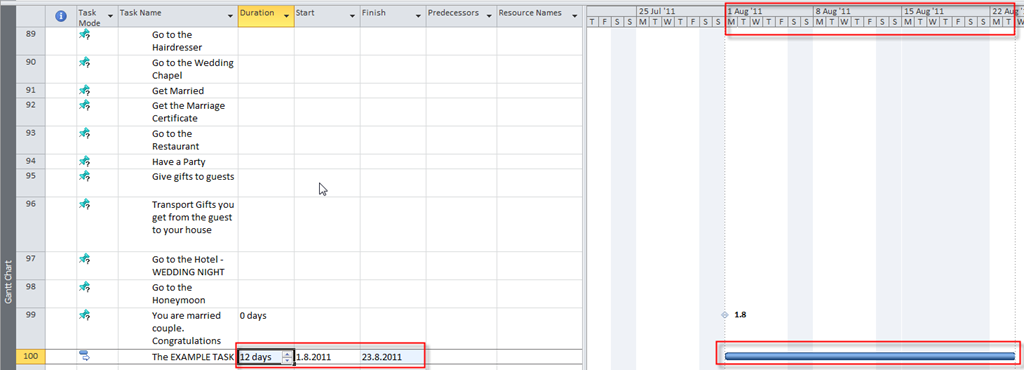
What do I get? Well, there will be no activity during this period! I will give you example. I will add a brand-new task in my “Wedding” Project in auto schedule mode, and I will tell that it will have 12 days duration and I will get:

image

As you can see, the Start date is 01.08.2011 (The Project Start date). The Finish date is 23.08.2011. Why? From 01.08.2011 (Monday) to 05.08.2011 (Friday) we have 5 working days. From 08.08.2011 (Monday) to 12.08.2011 (Friday) we have 5 working days, as well. From 15.08 (Monday) to 21.08.2011 we have no activity, because in my Project Calendar I made an exception (Vacation)! And I need another 2 day to complete my Task. So the activity on that task will continue at 22.08.2011 (Monday) and finish at 23.08.2011 (Tuesday), e.g. 2 days.

You can make this Vacation exception with using Work weeks:

image

Now if you add the same EXAMPLE TASK with 12 days duration you will get the same Result!

Because this is an EXAMPLE TASK I will delete it!

That’s all for now. I will continue in my next post.


Until then,

Best Regards!

Posted in MICROSOFT PROJECT, Microsoft PRoject 2010, MS PROJECT 2010, PMI, PRoject Management | Tagged , , , | Leave a comment

The scope is done! What should I do next? The “Wedding” Project!


Hi!

I have made the Scope for my “Wedding” Project in MS PROJECT 2010. I have task groups (called “summary task”), and each group have a milestone at the end. Those groups are not order logically, and it means that I put them as they cross my mind.

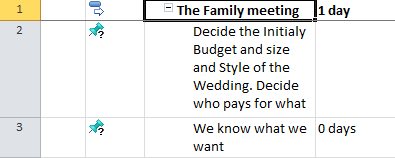
First group is The “Family meeting”:

image

Why? Because you must decide what kind of wedding do you want? Let me ask you a question. Can you have a wedding which will cost you only 50$? The answer is YES, YOU CAN! How? Well, simply you should go to the wedding chapel with the best man and/or best woman, and get married. You should only pay to the local authority some fee, and that is it. You will have no wedding reception, party and honeymoon. Another question is: “Can you have a wedding which will cost you, for example, $1.000.000? Again, the answer is YES, YOU CAN. You can have a glamorous wedding, with 350 people, and you can serve only the most expensive champagne, shrimps, lobster and after the wedding reception you can go to the very, very expensive honeymoon. So, in this group you should decide what kind of wedding you really want. Notice the milestone”: “We know what we want”

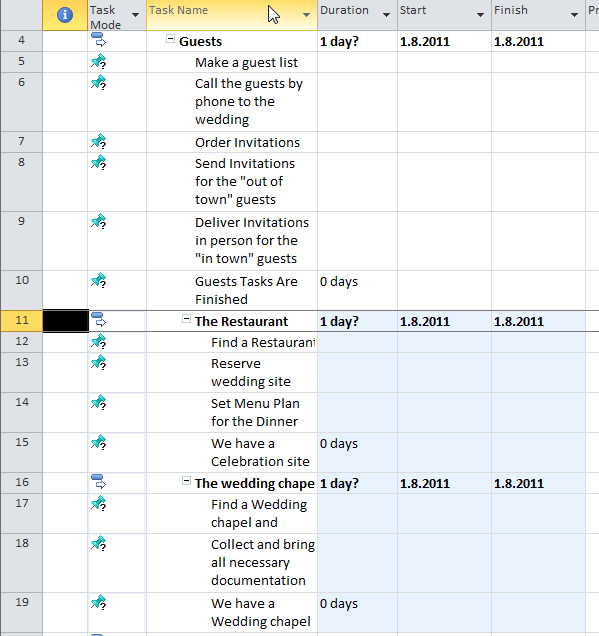
Here is the “Guests” group:

image

In this group I will make a list of my preferred guests. After that I will call them by the phone. Why? Because, I want to know how many of them will accept the invitation, and I have to tell them when the wedding will be. I can skip this “Call the guest by phone to the wedding” Task, and I can make assumption that all my preferred guest will accept the invitation. But, this is, from my point of view, the HUGE RISK? Why? Well, suppose that I have 150 people in my Guest list. If I assume that all of them will come to my wedding, I will reserve the Restaurant for 150 people. Now suppose that I have 50 people from “out of town”. I will have to reserve the hotel for them. And now, suppose that only 35 people come to my wedding? What a disaster will it be, can you imagine? To avoid that risk I will first call them, and I will know how many people will I actually have on my wedding. Then if someone quit just before wedding (because of some disease or something else) I will have less problem, because there is a small probability that many of them will be sick at that moment.

Here is the “Accommodation” group:

image

In this group I have tasks for the accommodation for my “out of town” guest, and for the Wedding night.

Here is the “Transportation” group:

image

In this group I have tasks for the transportation for my “out of town” guest.

Here is the “Rings” group, and I think I do not have to explain this group:

image

Since we will bring our own wine, and cakes to the restaurant here are two groups:

image

Now, we need to find the Restaurant for our wedding reception. In Zagreb,Croatia, you must reserve the Restaurant almost one year before the wedding day, believe it or not!

image

Now, I’ll show you the “wedding chapel” group, “the “music”, the “Flowers” and the “Gifts” group:

image

I think there is no need for any further explanation about this groups.

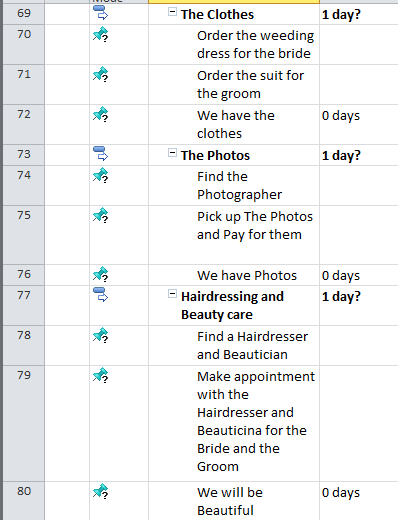
I also have the “Clothes” group, the “Photos” group, and the “Hairdressing and Beauty care” group:

image

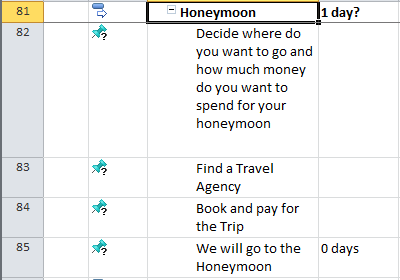
Last two groups are the “Honeymoon” group,

image

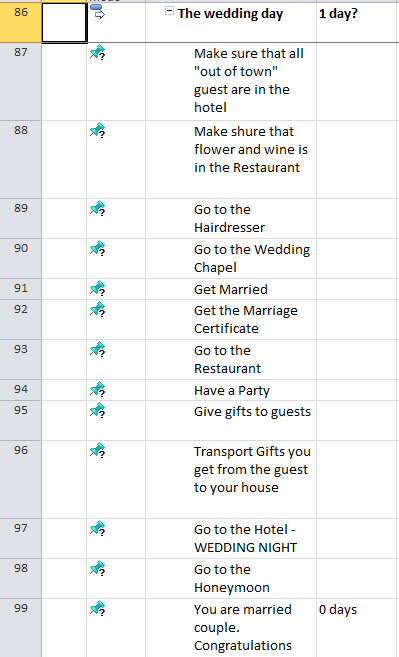
and the “Wedding day” group:

  image

You will see in some next post how will we set duration for this group. It has to be hour by hour planned.

From now on, you have two possibilities. You can download mpp file and follow me with that file, or you can try to add the tasks manually.

You can download my MS PROJECT 2010 “Wedding” project from here:

http://dl.dropbox.com/u/35142216/The%20wedding.mpp

Finally, I will Sequence my “Wedding” Project. I want move my “Restaurant” group, and “Wedding chapel” from the current Position to the new one, just below the “Guest” group. Firs I will select Tasks I want to move. I will select first task (or task group) with ID 45. I will click on the row heading (left part of the screen) and after that I will hold the SHIFT KEY and I will click on the “We have wedding chapel” with ID 53:

image

After that move your cursor to the row ABOVE you want to move that tasks:

image

and you will get:

image

Be careful. When you move tasks like it was just described, those moved tasks has a new ID number. And if you integrate MS PROJECT with some other application and if you are using that ID, you can get in the trouble!

I have finished my scope for the “Wedding” project. What is next? Resources or Scheduling? I will first develop a schedule. I will put duration on my tasks. But before that I will set up my Project Calendars. How to estimate duration, how to manage it, and how to set up calendars with MS PROJECT 2010 is the subject of my next post.

Until then,

Best regards.

Posted in MICROSOFT PROJECT, Microsoft PRoject 2010, MS PROJECT 2010, PMI, PRoject Management | Tagged , , , | 1 Comment

Develop a Scope for my Project! Should I choose Manually or Auto scheduled Tasks?


Hi,

After three posts about Risk we are back again with our “Wedding Project”.  I have started with adding Task (directly or with exporting from Excel). We are still in a Planning phase of my Project.

You should always start with entering task first. You should ask me: “But what if I know all, or almost all my resources or costs? Why not to put them in my Resource sheet first, and then put the Tasks?”.  Go on! Put them if you know them. But to determine how long will your Project take, and how much money do you have to spend you must know all of your tasks. So, even if you have you resources in your resource sheet in MS PROJECT 2010, you should enter your tasks “first” and then you can assign the Resources to them. You see, with “Enter your tasks first” I didn’t mean physically, but logically FIRST.

In every Project you should have an answer to the three questions: “WHAT? WHEN? WITH WHOM?”

First you have to know WHAT you have to do, it means Scope of your Project. After that you can have two different approaches: to develop the Schedule first (WHEN?), and then develop your human and material resource plan (WITH WHOM?), or vice versa. Which approach is better? It depends of your Project, and with that I mean what is the constraint of your Project! If you have limited resources, you should first develop the human and material resource plan, and then develop the Schedule. And you will see how much time do you need to finish your Project with that limited Resources. On the other hand, if you have limited time, you should first develop the Schedule, and after that develop the human and material resource plan. And you will see how many people (and how experience they should be, and how expensive), and material do you need on your Project to hit the deadline!

If you are limited with budget, than after you answer the magic three questions, you will see if your Project is over the Budget. And if it is, you should cut the scope, or cut the resources (and the Project will need additional time to finish), or you should cut the quality, or something else. Remember this: IF YOU HAVE TO CUT SOMETHING OUT FROM YOUR PROJECT AND YOU ARE THE PROJECT MANAGER, OR TEAM MEMBER, DO NOT MAKE THAT DECISION BY YOUR OWN! You should prepare the solutions (cutting the scope, cutting the resource, quality etc.), and then you should let your customer, or sponsor, or upper management to make a DECISION! GOT IT? If you will make decision by your own, that is called: BAD PROJECT MANAGEMENT! Why? Because you do not know what is allowed to cut, and what is not. For example, in our Wedding Project, if you are short with money, who can decide if you will buy less expensive drinks, or you will buy more expensive drinks but not 100 bottles, as was planned, but only 20 instead? Project Manager? NO WAY!

What if you do not have the answers for the three magic questions? What will it mean. IT means:

  • I do not have an answer on WHAT! It means: I can do ENYTHING I WANT and I have UNLIMITED BUDGET
  • I do not have an answer on WHEN! It means: I have UNLIMITED TIME, so it means my Project can last forever
  • I do not have an answer on WITH WHOM! It means: I can take any person in the world for my Project, and I can take as many People and Material as I need.

And this is fairy-tale!

Scope, Time and Resource in a Project are known as a “Triple Constraint”, and they make a Triangle:

image

You can change maximum two edges of a triangle, and the third one is out of your control. For example, if you change Scope and Resources your Time will increase or decrease!

O.K. When you are adding a new task in your project it is by default in Manually Scheduled mode. An this is brand-new feature in MS PROJECT 2010.

When you enter the task name, without any other information, on the Gantt chart you will see nothing.

image

Manually scheduled Tasks are marked with a pushpin icon. To determine duration, start and end date you should enter two of these three fields, and MS PROJECT 2010 will calculate the third one. Until manually scheduled Task does not have all those fields (duration, start and end date) filled, this Task is called as: “PLACEHOLEDR TASK”, and it has a question mark behind the pushpin icon. When you fill those fields (two of them) the question mark will disappear.

You can put in duration, start and end date whatever you want! For example, in Duration of Visit the Wine-cellar Task you can put: “I have to check with my Wife”

If you want a further information about manually scheduled task read my post: https://ntrajkovski.wordpress.com/2011/07/11/scheduling-summary-tasks-manually-in-ms-project-2010/

The main question here is when to use manually or auto scheduled Tasks, and why.

The answer is simple! When you do not have a reliable information about your task, then use Manually Scheduled Task. You can mix manually and auto scheduled task in a schedule (see my post: https://ntrajkovski.wordpress.com/2011/06/07/linking-manually-and-auto-scheduled-tasks/)

But, FROM MY POINT OF VIEW, as soon as you have a reliable information about duration, and you link these task with some other task, change the mode from Manually to Automatic! In my Projects, when I am done with planning (meaning I know all the tasks, Resource and Schedule), I have NO MANUALLY SCHEDULED TASKS! Why? Because I want MS PROJECT 2010 to make all the calculations for me. If you still want to keep some (or all) task in manually scheduled mode, you will have to keep your eye on each and every task, and if you are in a Project with hundreds or even thousands of task you will most probably forget something, and you will get in the trouble.

If you have a Project which will last 27 months for example, and you will do it in the phases, then of course, phases that will come later in your Project (in a few months, for example) can be in manually scheduled mode until, for example, 20 days before it will begin!

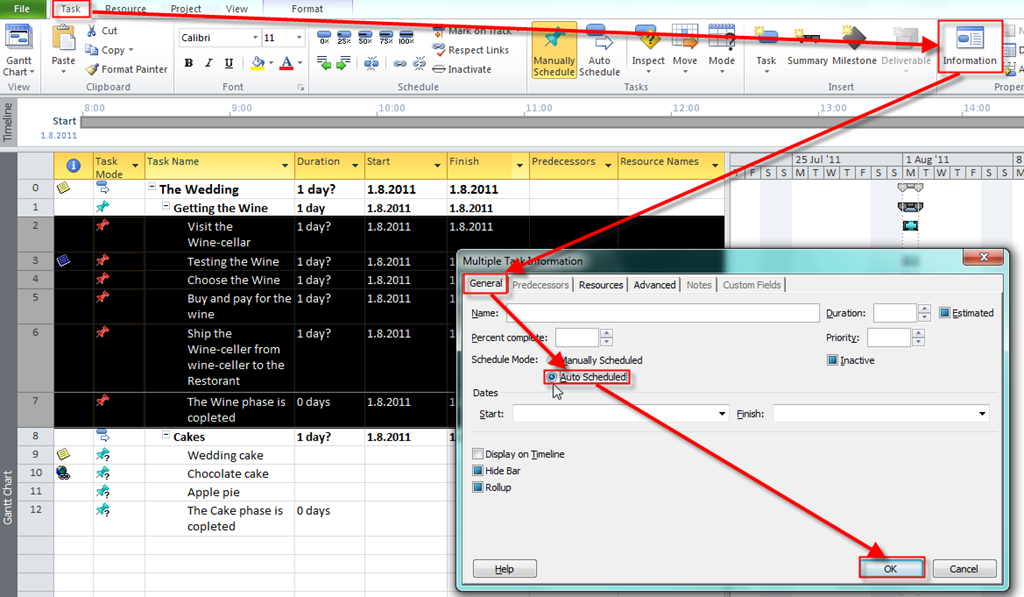
You can change the task mode for multiple task in this way:

Select the tasks:

image

then click on:

image

or:

image

Finally if you want this MS PROJECT file with the wedding project you can download it from: http://dl.dropbox.com/u/35142216/The%20wedding.mpp

Best Regards!

Posted in MICROSOFT PROJECT, MS PROJECT 2010, PMI, PRoject Management | Tagged , , | 1 Comment