Effort and non effort driven Tasks in MS PROJECT 2013


Hi,

here is the question from my Blog reader:

“Nenad:
Thanks very much for the posting!
Do you know if there is any way of setting up a different default for this operation? More specifically, suppose that I have many tasks assigned to “John” and I want to reduce the project time by hiring another person (it could be “Mary”) to share the work with John. If I simply add Mary to all tasks, MSP would assume that all I want to increase the amount of work all those tasks need – which is not the reason I’m adding Mary.
Would I have to add Mary one task after another, changing each one individually to “Reduce duration so the task end sooner, but requires same amount of work (person-hours)”? Or is that a way of adding Mary to all tasks with the “Reduce duration…” option?”

I wrote about that in one of my previous posts, but I will explain this issue again with MS PROJECT 2013.

First of all, where is the difference between Effort Driven, and Non Effort Driven Tasks in MS PROJECT 2013?

Effort driven Tasks are those which will (if you do not change it manually), reduce duration if you assign additional Resource to the Task. For example, if you have PAINT THE WALL Task, and it has duration = 4 days, and you have only one Resource assign to that task, when you add new Resource to that Task, duration will be 2 days!

On the other hand, Non effort driven Tasks are those which will not (if you do not change it manually), reduce duration if you assign additional Resource to the Task, but it will increase total amount of work (hours). For example, if you have READ THE BOOK Task, and it has duration = 4 days, and you have only one Resource assign to that task, when you add new Resource to that Task, duration will still be 4 days, but the total amount of work for that Task will be 4 days * 2 Resources * 8 hours/day = 64 hours.

Let me show you that. I have those two Tasks here:

image

and I have two Resources:

image

I will Assign John to the Paint the wall Task, and Mary to the Read the Book  Task, and I will get:

image

Let’s see where can we find if the Task is or is not effort driven:

image

Now I have Paint the wall as effort driven Task, and Read the Book, as Non effort driven Task.

Now I am going to assign Mary to the Paint the wall Task:

image

and I will get:

image

Now let’s see Read the Book Task:

image

You can see that the Task in Non effort driven, and that Mary will spend 32 hours of work (4 days * 8 hours per day).

I will add John to that Task:
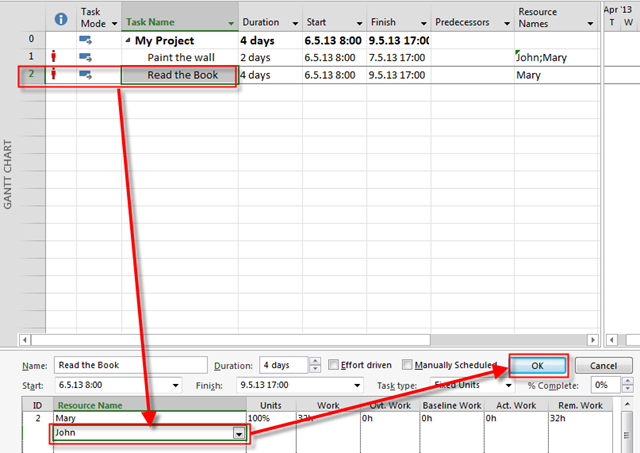
image

and I will get:

image

You can see that Duration is same, and John will spend additional 32 hours on that Task, so it takes total of 64 hours for that Task.

But what if you always want shorter Task duration, after assigning additional resource, so you do not have to make each Task effort driven manually. You can do it here: File->Options, and than:

image

That’s it! Regards!

Posted in MICROSOFT PROJECT, Microsoft PRoject 2010, Microsoft Project 2013, PMI, PRoject Management | Tagged , , , | 4 Comments

My arm is broken! :-(


Dear Blog Readers,

Just an notice, that I broke my arm last Friday, so I will write my post a little bit “slower”!

I hope that I will make a Post ‘till middle of the next week!


Regards!

Posted in MICROSOFT PROJECT, Microsoft PRoject 2010, Microsoft Project 2013 | Tagged , | 4 Comments

Resource Pool and Local Resources in MS PROJECT 2013


Hi,

I have a question from one of my Blog readers:

“Hello, Nenad. First, I’d like to thank you by your posts. They are very helpful. Now, to my question. I have a central team coordinating and working in some local projects with local teams. I have one project file for each local project and one master file for them all, plus the central tasks. I have a pool for all resources, but is is getting crownded. I’d like to keep only the central team on the pool and have the local teams on each project file. I tried but each time I created a resource in the local file, it was also created in the pool. Do you know how to do it? Best regards.”

This Post will be Short one, and I will show the answer with MS PROJECT 2013.

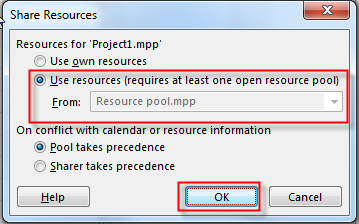
Let’s suppose that we have one Resource Pool and three Projects. Here is The Resource Pool:

image

and Resources in this pool:

image

Remember, that Best Practice is that Resource Pool should not have any Tasks, just Resources.

Now I will create three Projects:

image

image

image

Now, I will assign John and Mary to all Tasks in all Projects. I’m going to show you how to do it in First Project, and I will do the same thing for Second, and Third Project:

image

and then:

image

and I will assign John and Mary to all Task in the First Project:

image

After I do the same thing for the Second and Third Project I will have:

image

The resources are over allocated, but forget this for now, because it is not the subject of this post!

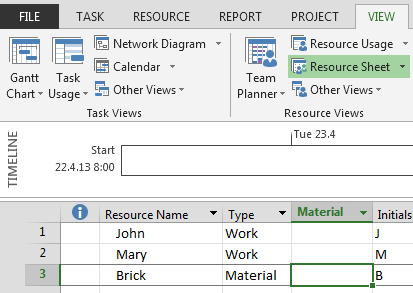
Now I am going to add new Resource, for example Material Resource called Brick in my Second Project:

image

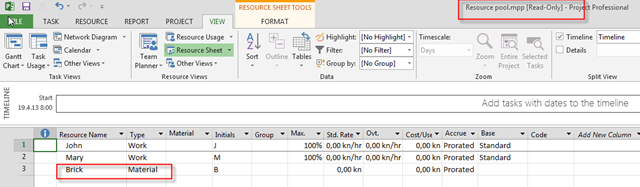
Now let’s look at the Resource Pool:

image

So, the answer in NO, you can not have both Local and global Resources by using Resource Pool 😦

Regards

Posted in MICROSOFT PROJECT, Microsoft PRoject 2010, Microsoft Project 2013, Microsoft Project Server 2010, PMI, PRoject Management | Tagged , , , , , | 2 Comments

How to apply different pay rates for Material Resources in MS PROJECT 2013?


Hi,

again, my Blog reader has a problem:

Hi dear
first I would like to say thanks for your above post, after that I would like to share one question with you which I have in mind, it is also something about cost calculation that’s why I am asking here:
How to set up different pay rate units such as ($/m, $/m2, $/m3, $/ton and so) … and that’s it. you know in most construction projects like building, roads, tunnel, canal even dam constructions cost of much of items such as excavation, drainage and so will calculated based on different pay rates as indicated above. for example if I want to setup cost of “excavation” task how I suppose to do that, if I have to setup unit pay rate of this task in resource sheets ? so which kind of resource I suppose to assign (work, material or cost resource) and how I use different pay rate ? or if I suppose to setup this kind of cost in different place, where is that place ?

with thanks and respect

OK! I’ll do it in MS PROJECT 2013!

First thing first.

I will add two Tasks in MS PROJECT 2013:

image

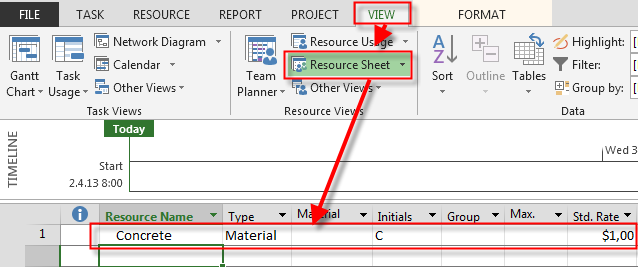
Now I will add Concrete as Material Resource in My Project:

image

Now let’s say that this $1 is price per m3, and price per ton is $10 (just for example!)

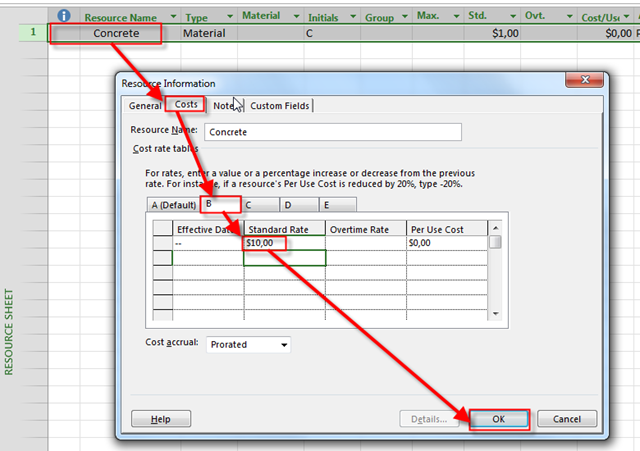
I will put this $10 here:

image

Now suppose that for Task 1 I want to assign 10 m3 of Concrete, and for Task 2, 20 tons of concrete.

First for Task 1:

image

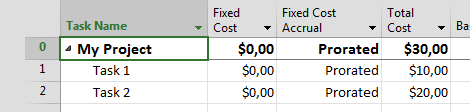
I will do the same thing for the Task 2 (with 20 in Units Field, and if I look at the Cost Table I’ll see:

image

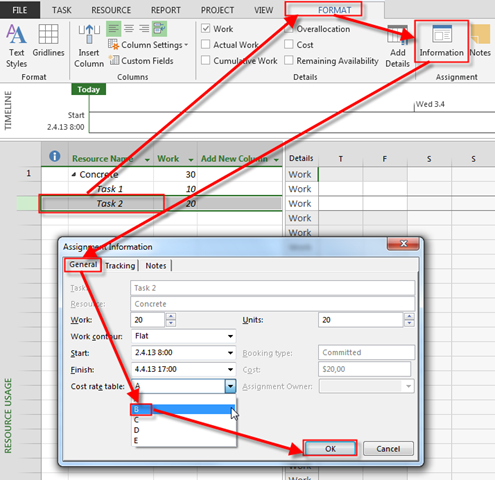
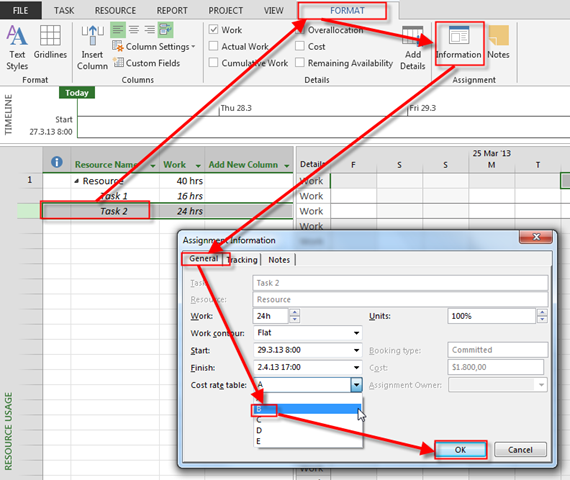
Now, I need to change pay rate for Task 2. I will go to Resource Usage View:

image

Let’s look at the Cost Table again:

image

You can see that for Task 1 there is 10 m3 of Concrete with 1$ Price, and that makes Total Cost = 10*1=$10. For the Task 2 there is 20 tons of Concrete with 10$ Price, and that makes Total Cost = 20 * 20 = $20!

Piece of cake.


Regards!

I

Posted in MICROSOFT PROJECT, Microsoft PRoject 2010, Microsoft Project 2013, MS PROJECT 2010, PMI, PRoject Management | Tagged , , , | 4 Comments

Calendars and Moving Tasks to non working days in MS PROJECT 2013!


Hi,

again I have a question from my Blog Reader:

“I liked your article and thought you may have an answer to a question I have.
In Project 2010 with tasks set to Auto schedule if you schedule the start date for a task that has a resource assigned to start on a Non-working day, the planning wizard prompts you to either allow it to move it to the next working day or to change the day to working. The issue is that it changes the base calendar day to working and not the resource calendar. Do you know why or any setting that I need to alter so it changes the Resource calendar and not the Base Calendar. You can over come this by changing it to manual after you have manually changed the resource calendar day to working, but this takes time.

Any suggestions gratefully appreciated.”

Let’s go, with MS PROJECT 2013!

First I will create two Tasks:

image

and then two Resources:

image

Now I will assign John to Task 1, and Mary to Task 2:

image

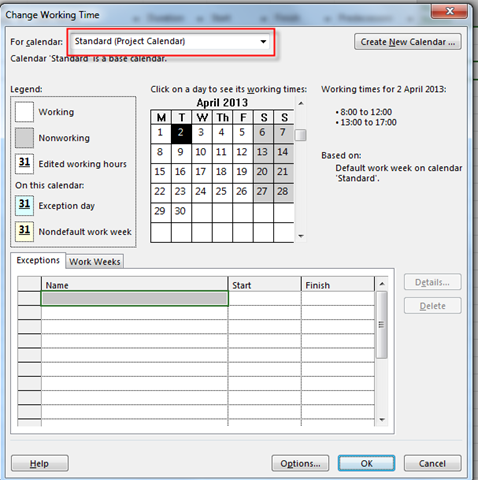
Now I will show you the Standard Calendar:

image

as you can see, there are no exceptions for this Calendar.

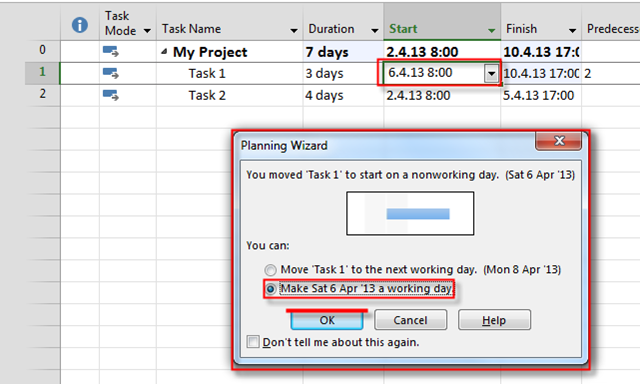
Now, I am going to set Start date for Task 1, and Task 2. Task 1 will have 06.04.2013 (Saturday) as Start date, and Task 2 will have 07.04.2013 (Sunday)  as Start Date:

image 

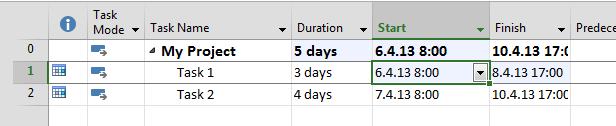
After setting Start date to the Task 2, I will get:

image

Let’s see a Base Calendar:

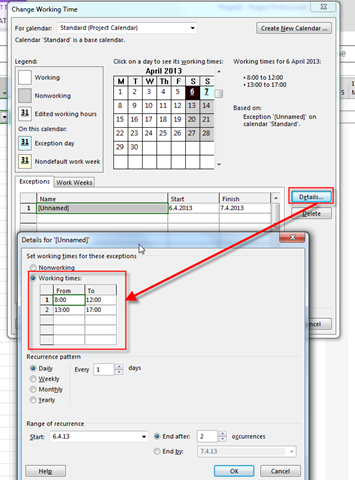
image

You can see that MS PROJECT 2013 made an exception for those two non working days as working days!

Well, that can be a trouble, because all new / existing Task will have those two days as working days.

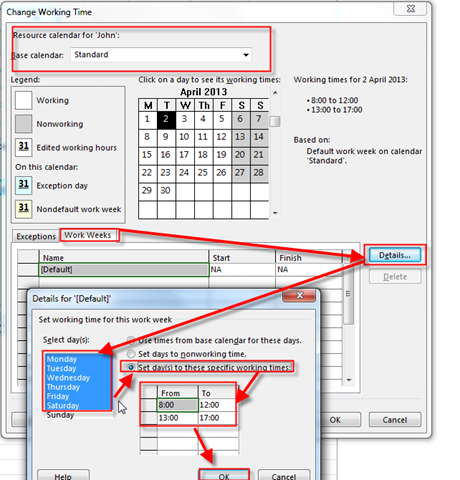
But, if you want to make those two days only for particular Resource (let say John, or Mary), that you should modify John’s calendar!

Let’s look our Project as it was at the Beginning:

image

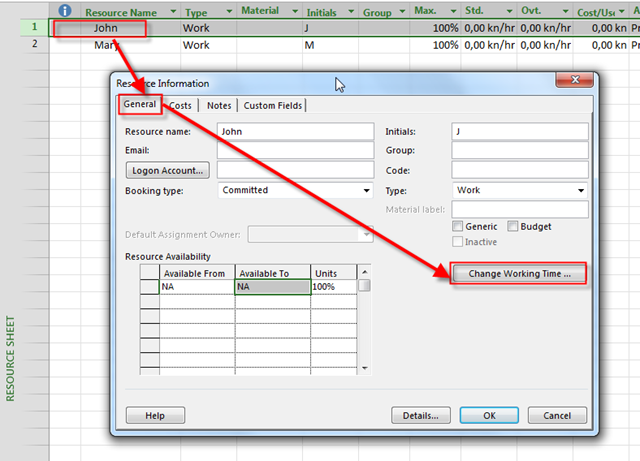
I want John to work at every Saturday, and Mary, at every Sunday!

image

and:

image

I’ll do the Same for Mary (I am not going to place this picture Again :-P)

Now, I am going to set Start date for Task 1, and Task 2, again. Task 1 will have 06.04.2013 (Saturday) as Start date, and Task 2 will have 07.04.2013 (Sunday) as Start Date:

image

So, there is no exception for Base Calendar.

To conclude, if you want to make non working days to working days for particular resources, you can make your own Resource Calendar, or modify existing Calendar for particular Resources!


Regards,

Posted in MICROSOFT PROJECT, Microsoft PRoject 2010, Microsoft Project 2013, MS PROJECT 2010, PMI, PRoject Management | Tagged , , , , , | 11 Comments

How to assign 0$ costs for some Task with the same Resource in MS PROJECT 2013?


Hi,

one of my Blog readers has a problem:

“Good morning, Sir.

I have a slight problem with my project. For some tasks the cost of one resource for tasks is 0$. We have the resource standard rate is 75$/hr for that resource in Resource Center section.
When I tried to create new sample task such as “paint the wall “with the same resource, we assign 1 day of work, and the cost is show up for 600$.

So what is the reason for the missing cost-tasks? and How can we fix it?”

There is a easy way to do it!

First I will make two Tasks for my Project:

image

I will create one Resource:

image

Now I will assign Resource to Task 1, and Task 2.

image

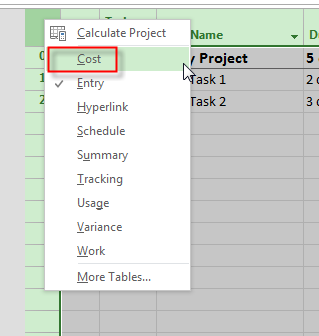
Let’s look at the Cost Table:

image

and:

image

But for the Task 2, I want $0 of costs. Piece of cake!

First I will apply Resource Usage View:

image

and I will get:

image

Now I will apply Table B (with $0 rate) for the Task 2:

image

and, back to the Cost Table:

image

As you can see, Task 2 has Total Cost=$0.

Regards,

Posted in Microsoft PRoject 2010, Microsoft Project 2013, MS PROJECT 2010, PRoject Management | Tagged , , , | Leave a comment

How to show separate costs for people and material in MS PROJECT 2013


Hi,

another question form my Blog Reader: “For a particular task, Can we get the material cost and labor cost separately for that particular day?, and can we display the material resources and work resources separately in the task field?”

In the Task field, NO! Now, how to get Material and Labor cost Separately in MS PROJECT 2013. You can do this by creating custom fields, but this is harder way. I’ll show you the easiest way.

First Let me create two Tasks:

image

and then two work, and one Material resources:

image

Now, I am going to assign John, and 10 Bricks to the Task 1:

image

I will assign Mary, and 20 Bricks to the Task 2, and I will get:

image

Now I will use the Resource Usage View:

image

and I will apply Cost Table:

image

and I will get:

image

Now I am going to group data:

image

and finally I’ll get:

image

Piece of cake, isn’t it?

Regards

Posted in MICROSOFT PROJECT, Microsoft PRoject 2010, Microsoft Project 2013, PMI, PRoject Management | Tagged , , , , | Leave a comment

Resource over-allocation and Gantt chart in MS PROJECT 2013!


Hi,

one of my Blog readers ask me this: “Hello, could you please advice…you all seem to be very experienced with MS. ‘m interested in resource management. I tried to apply MSP and found that I’m not able to see an impact on resources if I make changes in some project tasks. Some tasks are dependent and are shifted with modification of others. But, I need to go to another page to see who becomes overloaded and I would prefer to have the view on resource occupation on the page of Gantt. Is it possible? Thank you so much !! “

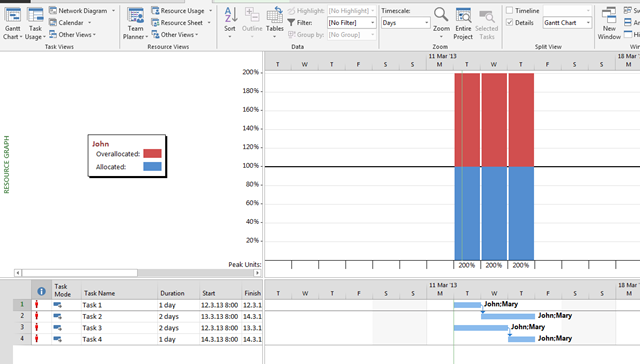
In MS PROJECT 2010, MS PROJECT 2013 Gant Chart is Task Related. I’ll make over allocation by purpose to show you what you can do.

First let me put some Tasks:

image

and some Resources:

image

Finally I will assign Resources to the Tasks:

image

On the First column you can see a “burning man”, which means that some of the resources are over allocated.

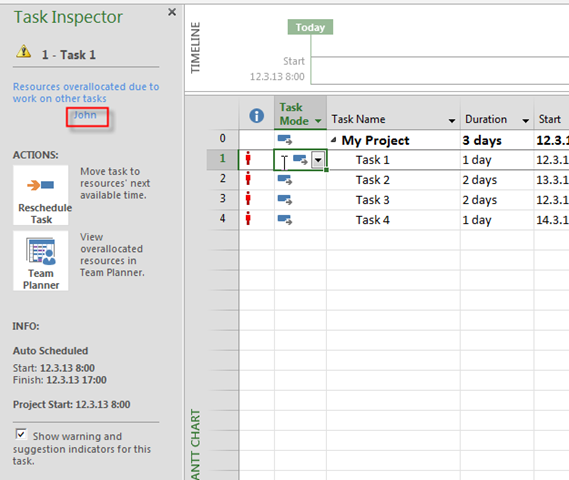
But here you CAN NOT see which resource is over allocated if you do not use The Task Inspector.

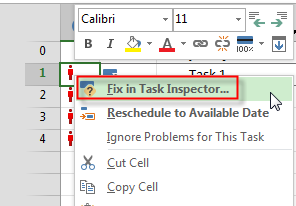
To do so, right click on the Burning man, and you will get:

image

and you will get:

image

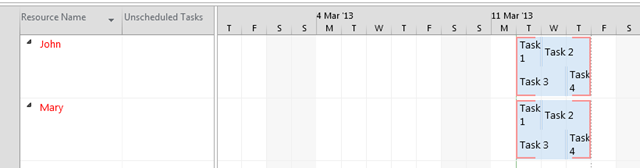
But there is one place with much better View of over allocation – the Team Planner (available only in MS PROJECT PROFESSIONAL 2013, not in Standard version):

image

Here you can see who is over allocated, when, and on which Tasks!

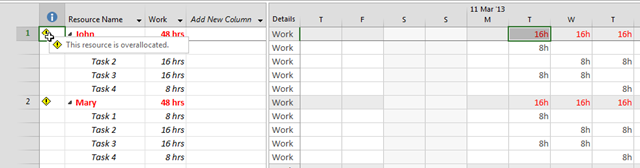
You can use Resource Usage View as well:

image

Here you can see who is over allocated, on which tasks and how much!

The same thing is with Task Usage View:

image

This View shows Task, and Recourses assigned to each Task, and over allocation as well.

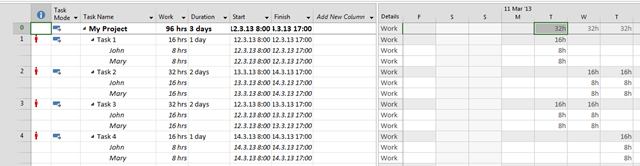
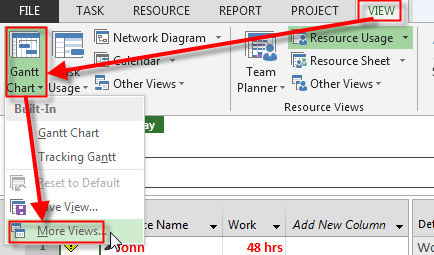
But if you still want to see Gant, and Over allocated Recourses, you can do this:

image 

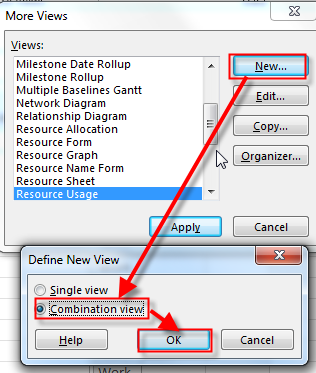
then:

image

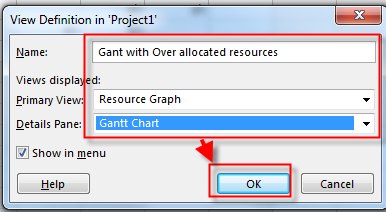
and:

image

and finally:

image

Easy, isn’t it!


Bye!

Posted in MICROSOFT PROJECT, Microsoft PRoject 2010, Microsoft Project 2013, Microsoft Project Server 2010, PMI, PRoject Management | Tagged , , , | 9 Comments

Splitting Tasks again in MS PROJECT 2013


Hi,

I’ve got a question from one of my Blog Readers: “’I’m looking for a more precise method (non-graphical?) to set up the splits. For example I want to split a 10-work-day task halfway through, and have work resume after 12 work days. When I do this graphically, the bars look as though they are very different durations rather than the same length. This happens even when I try to use the pop-up information box to click at the right point in the bar. Additionally, I can’t seem to drop the split segment where I want it, the program only allows drops in one-week increments. I have poked around a lot but can’t find anyplace to review and edit the split details.”

It is a little bit strange problem, at least from my point of View, because I can not reproduce it!

First, I will create a brand new Task with 10 days duration in MS PROJECT 2013!

image

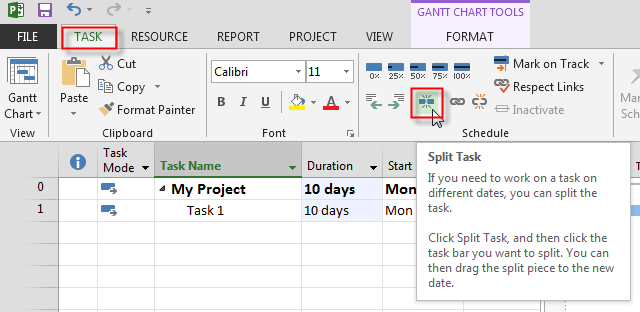
Now, I will split that Task, and the Second part of it will started 12 working days later, e.g. at April, the 3th, 2013:

image

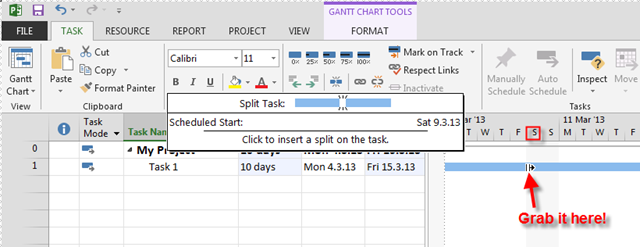
and then:

image 


and move it here:

image

And YES, it seems that the second part is longer than first one. But, in face it is not! Why?

Because this part will start on Wednesday, April the 3th, and will ended after five working days, so graphically it only seems that it will take longer (since there is a weekend, e.g., Saturday and Sunday)!

I will now show you a trick. If you do not want to see “blue bar” on non working days, you can do this:

image

and you will get:

image

You can see that there is no “blue bar”, nor “dotted lines” during the weekend!

And what if you want to split Task in hours instead of days?

Easy! Like in previous picture you should change the Bottom Tier from days to hours, and then you can split the Task!

Hope this helps!


Regards!

Posted in MICROSOFT PROJECT, Microsoft PRoject 2010, Microsoft Project 2013, PMI, PRoject Management | Tagged , , , , | 6 Comments

Task Calendars and Lag in MS PROJECT 2013

Hi,

today I will answer to this question: “You have 2 tasks which own different task calendars (Standard 5day and 7day calendar). They are connected FS and have a lag, lets say 5 days. Which calendar does the lag use?”

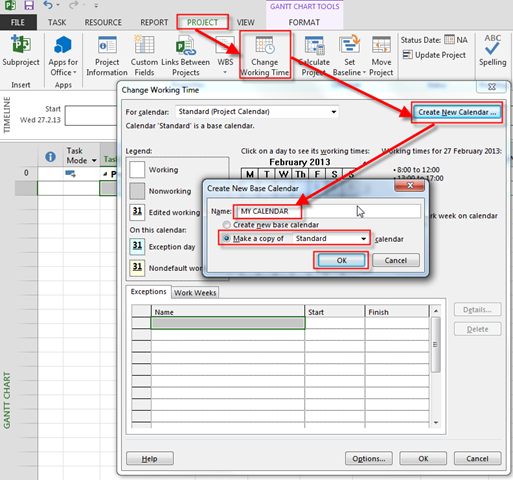
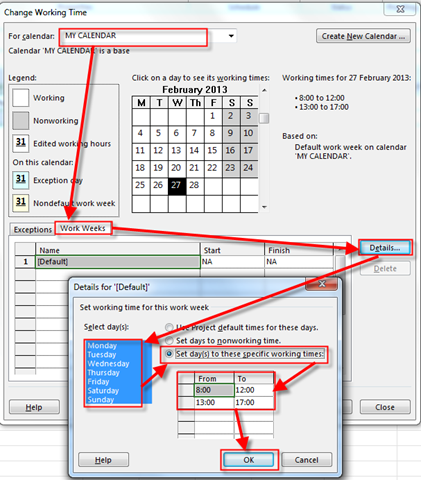
OK! I will show you that in MS PROJECT 2013. First let me create 7-days calendar with MY CALENDAR name:

image

Now, I am going to modify MY CALENDAR:

image

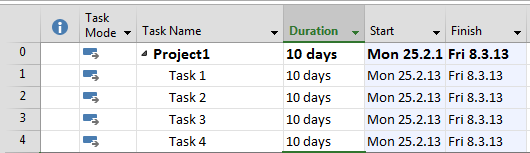
OK! Now I will add four Tasks to My Project with 10 days duration each:

image

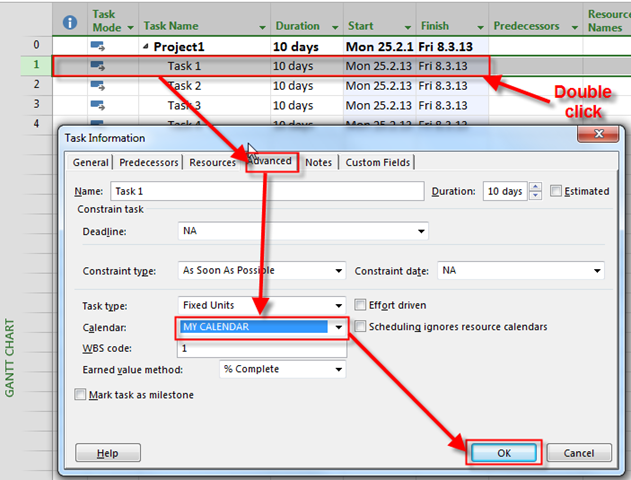
Now I will tell that TASK 1, and TASK 4 have MY CALENDAR, as default Calendar, and TASK 2 and TASK 3 have Standard Calendar as default Calendar. I will show that settings only on TASK 1, and you can do the same thing with other Tasks:

image

Finally I get:

image

As you can see Task 1, and Task 4 will start on Monday, 25.02.2013, and will finish at Wednesday 06.03.2013, because the work will be performed during a weekend. On the other hand, Task 2, and Task 3 will start on Monday 25.02.2013, but will finish at Friday 08.03.2013, because the work will not be performed at weekend.

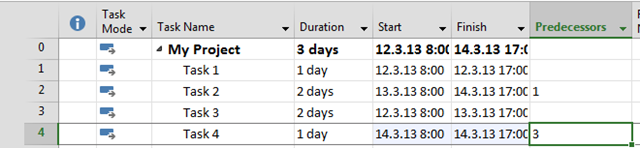
Now I am going to connect Task 1, and Task 2, and Task 3, and Task 4as well, and I will get:

image

Everything looks fine! Notice that Task 2 will start at Thursday 07.03.2013, and Task 4will start at Saturday 09.03.2013.

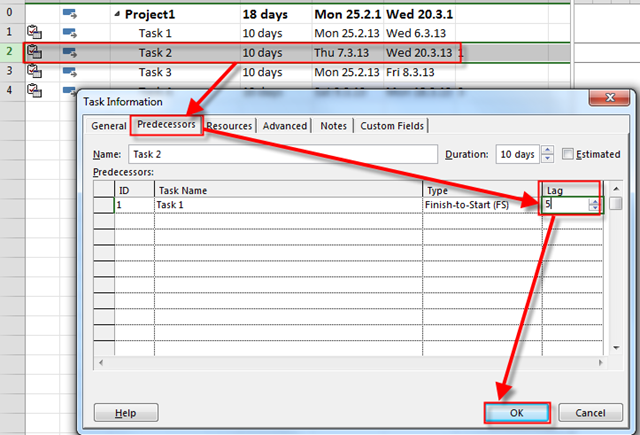
Now to the point! I will put a 5 days lag for Task 2, and Task 4:

image

and I will get:

image

Now, the explanation:

  • Task 1 will finish at Wednesday, 06.03.2013
  • Task 2 will start after 5 days lag, at Thursday 14.03.2013. That is because Task 2 has Standard Calendar, so this 5 days of Lag is only working days (means: Thursday 07.03.2013, Friday 08.03.2013, Monday 11.03.2013, Tuesday 12.03.2013, and Wednesday 13.03.2013)
  • Task 3 will finish at Friday, 08.03.2013
  • Task 4 will start after 5 days lag, at Thursday 14.03.2013. That is because Task 4 has MY CALENDAR, so this 5 days of Lag is working days + weekend (means: Saturday 09.03.2013,  Sunday 10.03.2013, Monday 11.03.2013, Tuesday 12.03.2013, and Wednesday 13.03.2013)

To conclude, MS Project 2013 uses for the lag, the calendar of the successor.

Regards,

Posted in MICROSOFT PROJECT, Microsoft PRoject 2010, PMI, PRoject Management | Tagged , , , | 5 Comments