How to make week shifts in MS PROJECT 2016?

Hi,

Today, I will explain next Scenario in MS PROJECT 2016: Suppose that you have a project team who will work 5 days a week (Monday to Friday), but every third week the whole team will be off. This is common situation with a Teams who are working on Project, but also at Operations in their Company.

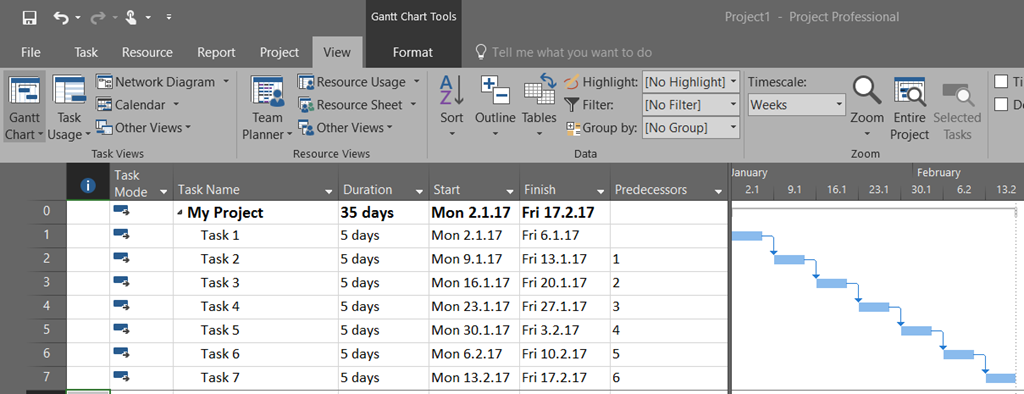
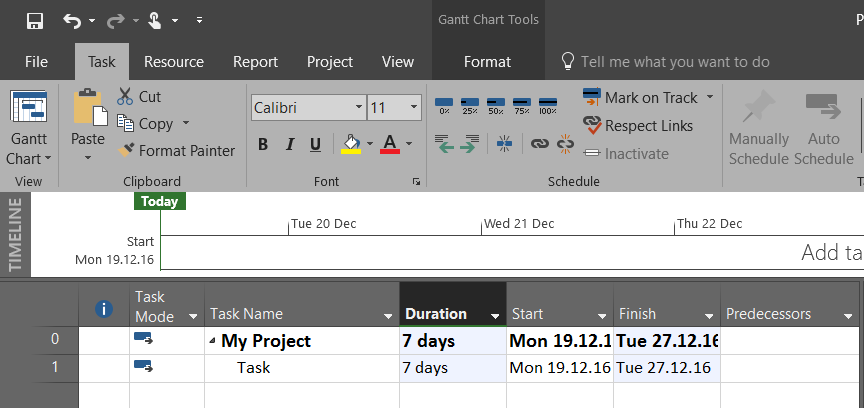
First I will create a simple Project with 7 Tasks, and  each of them will have 5 days Duration:

image

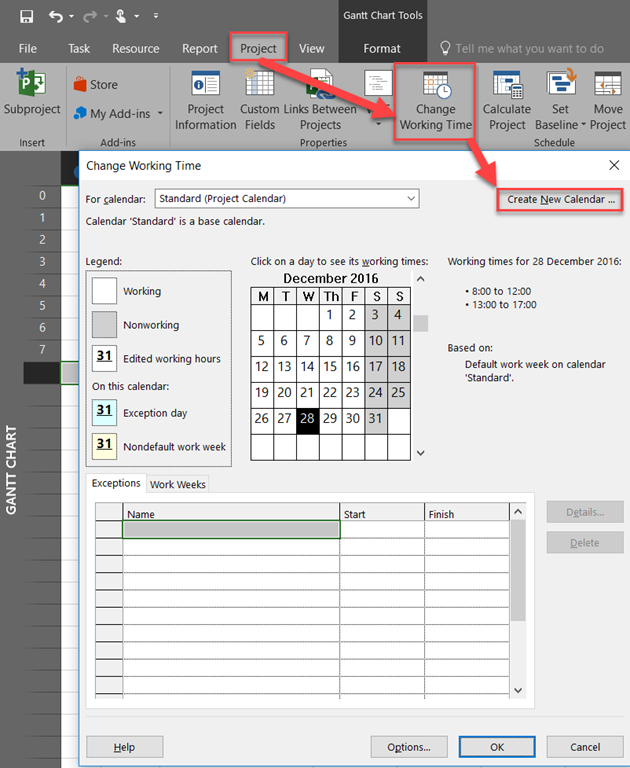
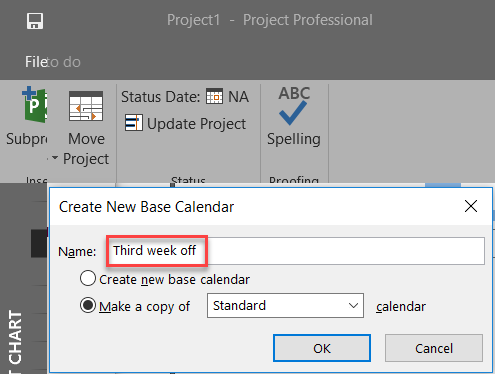
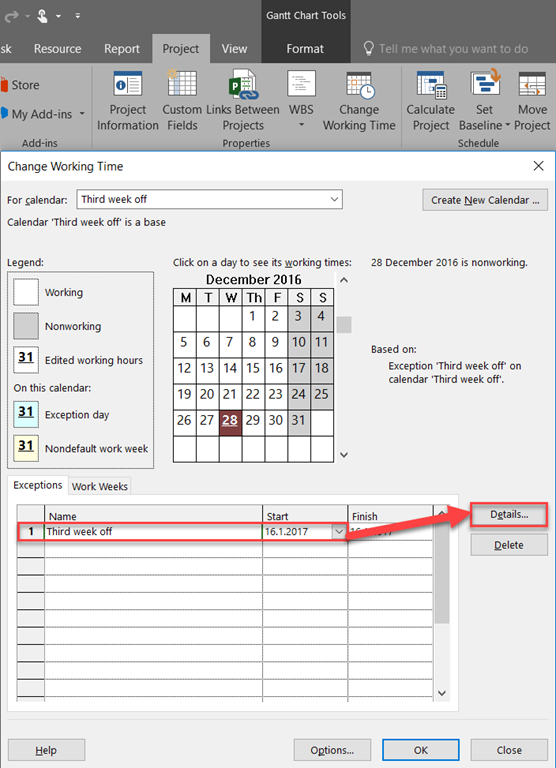
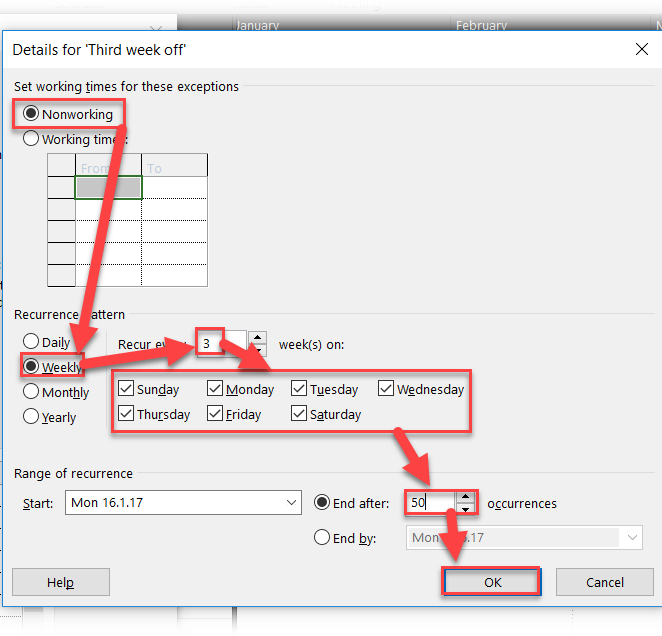
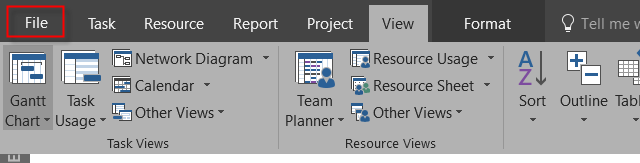
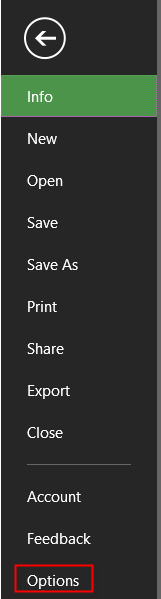
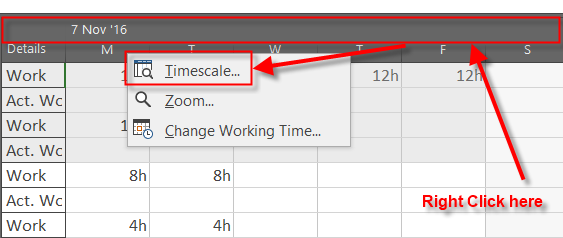
Now, I will crate new Calendar, and I will call it Third week off, and in it I will make every third week as a non working, which is a point of this Post:

image

and:

image

and then:

image

and:

SNAGHTML110e4e6

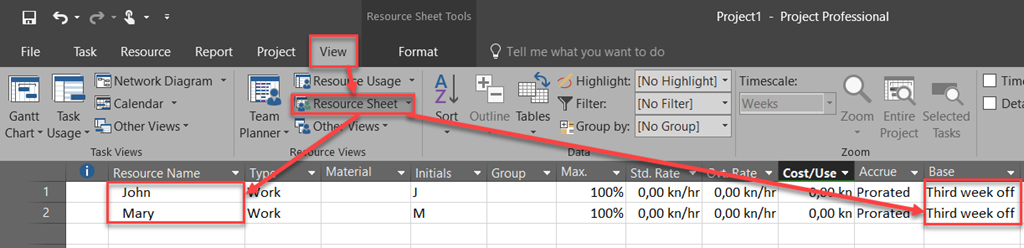
Now I am going to create two Resources, John and Mary, and I will assign this calendar to them:

image

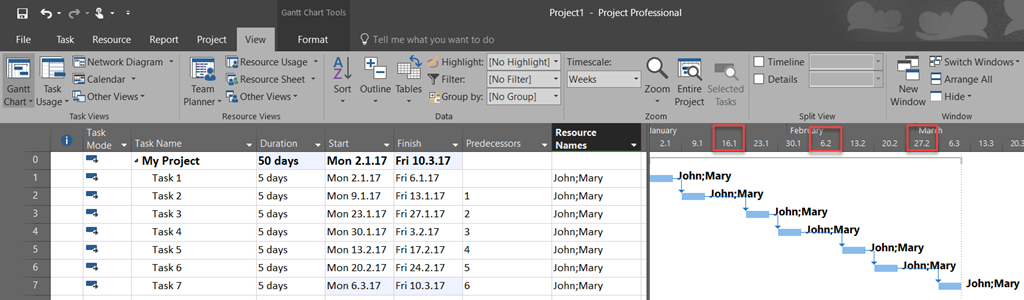
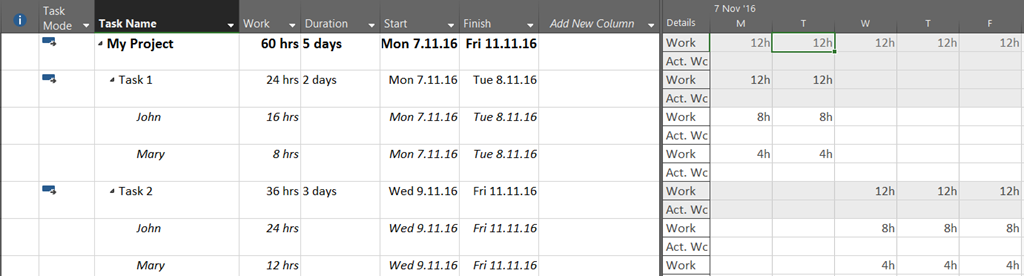
Finally, I will assign those Resources to my Tasks, and I will get:

image

As you can see, every third week is non working week.

Easy, isn’t it.

My dear Blog Readers, this is my last post for this Year. I hope that you will read my post next year as well, and I wish you all the best for the New Year – 2017.

Regards!

Posted in MICROSOFT PROJECT, Micsrosoft Project 2016, PMI, PRoject Management | Tagged , , , , | Leave a comment

When to use Resource Calendars in MS PROJECT 2016

Hi,

after my Post “Different weekends for Resources in MS PROJECT 2016”, there was a lot of discussion, that a problem can be solved with Resource Calendars, and that be will be the best way. Yes, it can be done like that, and no, this is not always the best solution. so I will show when is best to use Resource Calendars in MS PROJECT 2016.

I will show you an example with a very simple – one Task Project:

image

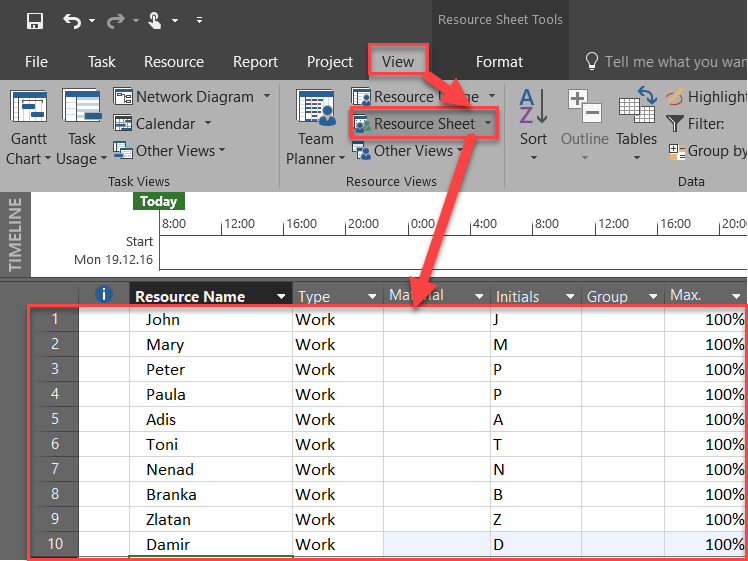
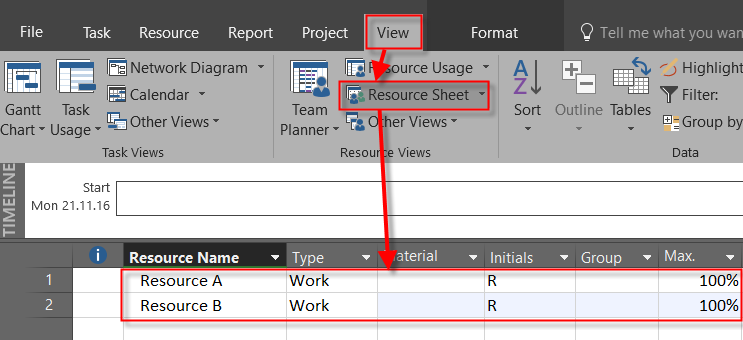
I will create ten different resources:

SNAGHTML6610f250

Now suppose that only I, Nenad, should work on Saturdays. In that case, I will not create Resource Calendar, even I can do it in this way. Why? Because this is an exception which apply only to me, so I will use the easiest way, and that is, I will modify the Standard calendar only for me:

image

and:

image

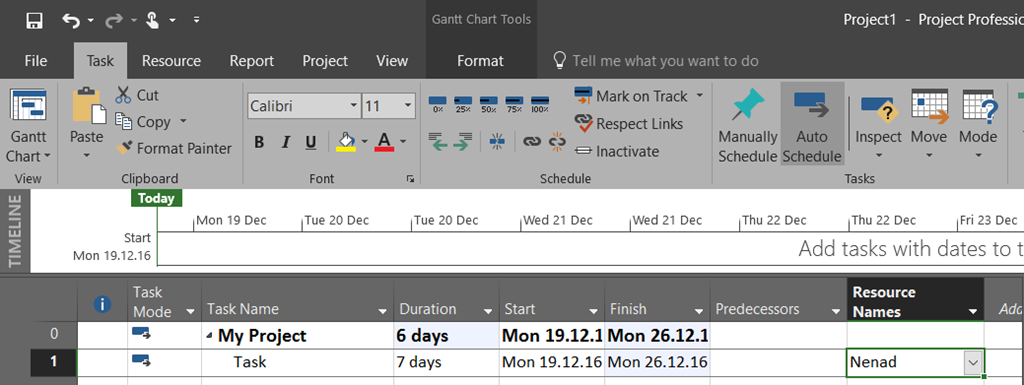
Now I will assign myself to the Task, and I will get:

image

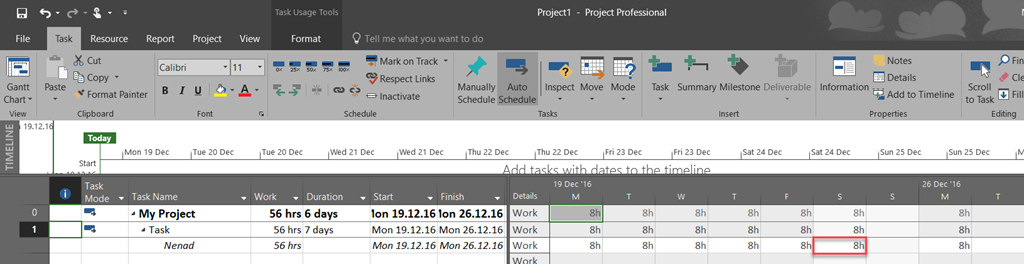
Let’s take a look in a Task Usage View:

image

As you can see, I will work on that Task at Saturday.

Now suppose that not only me, but also John, Mary, Peter and Paula should work on Saturday. What can I do? I have to choices. Repeat steps above for each of these Resources (suppose there are not only 5, but 85 of them), or create Resource Calendar, which I will do. Follow these steps:

image

and then:

image

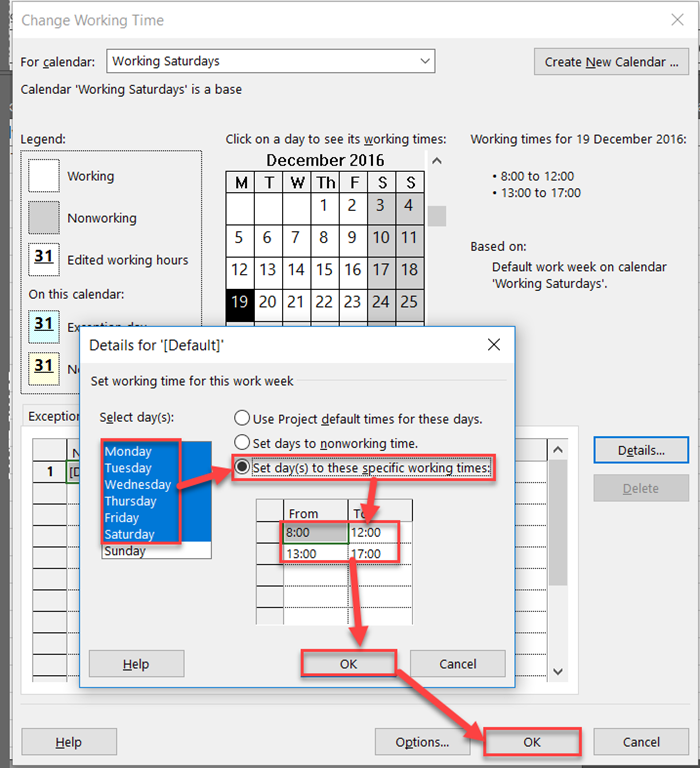
OK. Now I will make Saturdays as work days for this Calendar:

image

and then:

image

Now I will assign this Calendar to Specific (mention above) Resources:
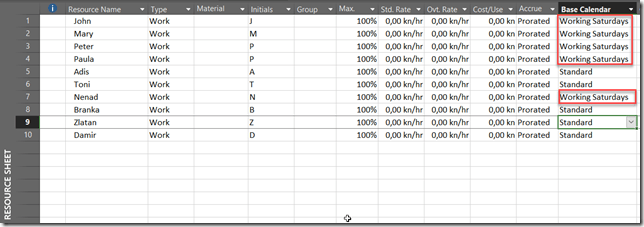
image

Finally I will assign those Resource to the Task, and Adis, as well (who has Standard Calendar):

image

As you can see, only Adis will not work at Saturday.

Now, again, when to use Resource Calendars. From my point of view when multiple Resources share same Working Time, and Exceptions (like days off, Holidays, etc.9. When you have only one or two Resources with same Working time, and/or Exceptions, you can modify Standard Calendar for them. it is shorter way. Of course, when you have only one Resources with different working time you can create Resource Calendar as well, but you don’t have to, and that is not the shorter way. And, for the end, let’s say that Mary, has day off at Wednesday, 12/21/2016. You can now follow steps described in my first example and change Working Saturdays Calendar just for her, or you can create separate Calendar for her (Mary’s Calendar, for example), but again, it is not the shorter way to do it.

So it is up to you which approach will you take.

Regards!

Posted in MICROSOFT PROJECT, Micsrosoft Project 2016, MS PROJECT 2016, PMI, PRoject Management | Tagged , , | 1 Comment

% Work Completed without Resources assigned to Tasks


Hi,

I wrote several Posts about % Work completed field, and how does it change when assigned Resources to the Task. As you know, Work is 0 hours until you assign Resource to the Task. But, is it possible to have Work for the Task and % Work Completed without assigned Resources. The answer is YES, and II ‘ will show you how with MS PROJECT 2016!

First I will create a simple Project with one Task 5 days duration:

SNAGHTML477f7695

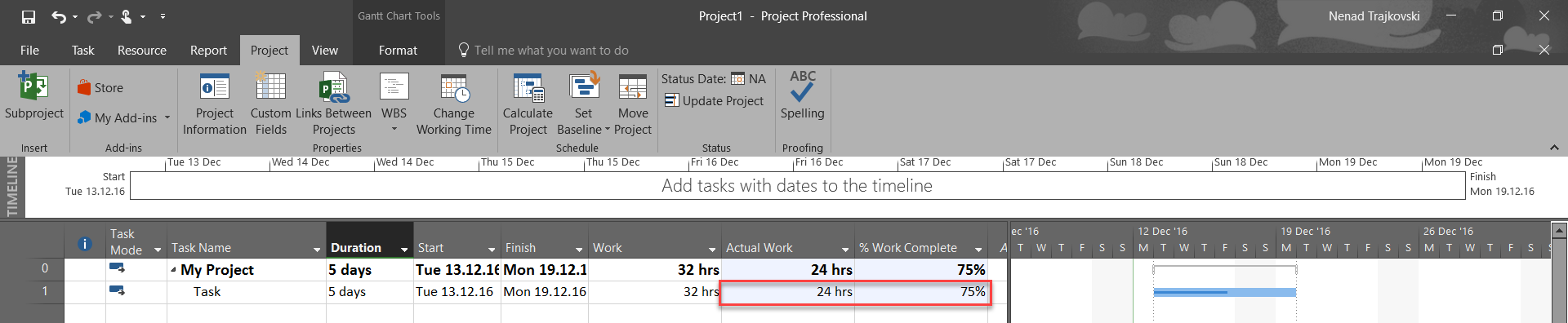
As you can see, I added some extra fields in a Gant Chart View like: Work, Actual work, and % Work Completed.

Now, I will say that Work is 32 hours, and I will put it in the Work field

image

The Magic Formula: WORK = DURATION * UNITS, does not work here, because Units = 0%. Why? Because Units are to come from assigned Resources, and we do not have them. So duration remains 5 days.

Now, let’s say that Actual Work is 24 hours. When I enter it I will get:

image

As you can see % Work Complete is 75% (24 hrs./32 hrs. = 75%)

So, it can be done, but only if you put work on the Task level when you don’t have any Resource assigned to Tasks.

Regards.

Posted in MICROSOFT PROJECT, Microsoft Project Server 2010, MS PROJECT 2016 | Tagged , , | Leave a comment

Different weekends for Resources in MS PROJECT 2016

Hi,

I have a very good question from one of my Blog Readers:

Hi!

How does one fix different holidays for persons on the same activity? That is if X and Y are working on the same Project and Task and while X has weekly off on Sat and Sun, Y has weekly off on Sun only. So how do I fix the working time??”

I will show you how to do this using example above, with MS PROJECT 2016!

First I’m going to Create a brand new Project with one Task, 7 days duration:

image

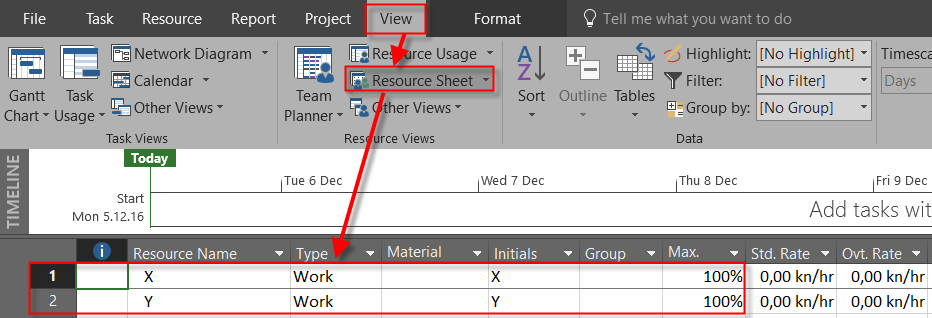
Now I will create two Resources, X, and Y:

image

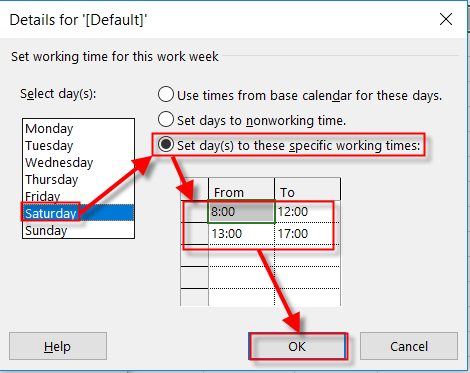
By default, both Resources will work from Monday to Friday, and they are not supposed to work on Saturday, and Sunday. Now I will enable resource Y to work on Saturday:

image

and:

image

Now I will assign both, X, and Y to the Task:

image

As you can see, Duration is now 8 days, because Resource Y is going to work at Saturday. I will show you Task Usage View now:

image

So, both resources will fork 56 hours (7 Days * 8 hours per day = 56 hours). but, Resource X will work from Monday to Friday, and then next Monday and Tuesday. Resource Y will work from  Monday to Saturday, and then next Monday!

So it is easy, isn’t it.

Regards!

Posted in MICROSOFT PROJECT, MS PROJECT 2016, PMI, PRoject Management | Tagged , , | Leave a comment

Milestone with “Finish not later than” constraint and Float Ii n MS PROJECT 2016!

Hi guys,

I have another great question from one of my Blog readers:

“Hi Nenad,

I have another question for you.Suppose you have a task with start date, for example, 7 Nov and 5d duration. Its successor is a finish milestone with constraint ” finish not later than” 18 Nov.

Now I expect to have a float of 5 days, but it isn’t so. Project gives 0d float. Is it a bug?”

No, it is not a bug, and I will show you why in MS PROJECT 2016!

First I will create brand new Project with one Task and one Milestone, and I will make this milestone as Successor of the Task:

image

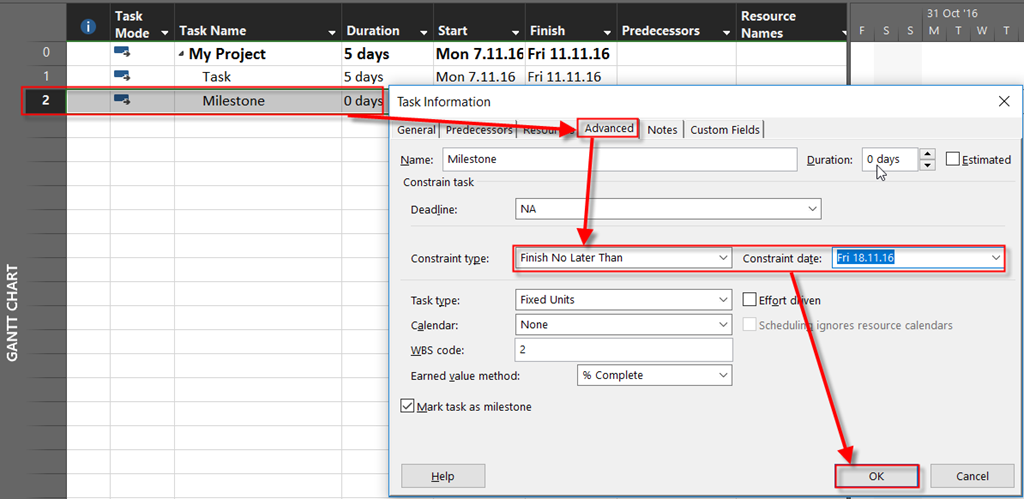
Now, I will put the constraint “Finish no later than” for this Milestone, and the date will be 18.11.2016:

image

and:

image

Now I will show Detail Gantt View:

image

I will apply Schedule table:

image

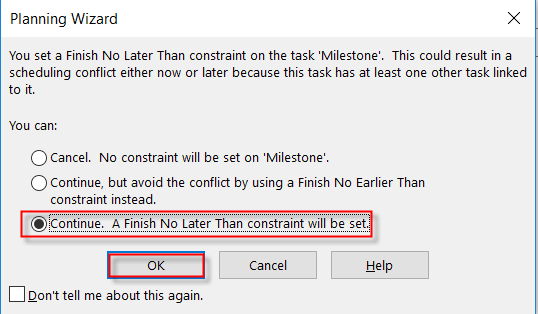
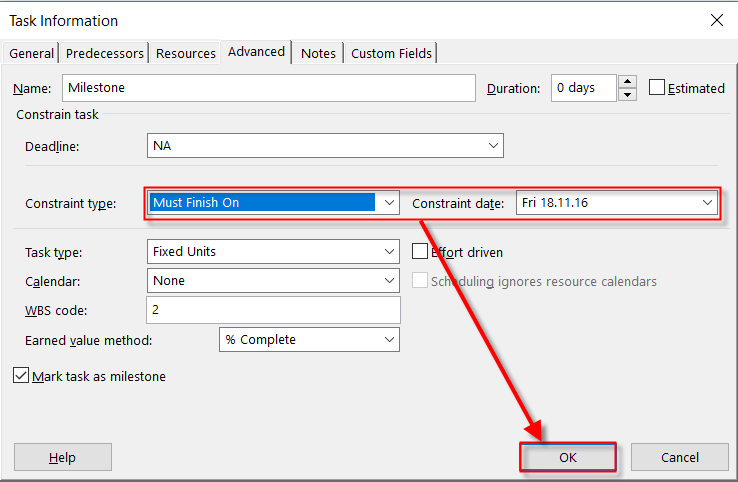
As you can see, Slack (or Float) is zero. Why? Because with constraint: Finish no later than”, Ms Project knows that Task or Milestone should not finish later than specific date, but it can be finished earlier. So, there is no slack here. but, if I put Must finish on on the Milestone, I will get:

image

image

Now, Milestone has fixed date for finish, and it is 18.11.2016, and it should be not finished earlier, so Task has Slack (float) 5 days, e.g it can last 5 days longer!

Hope this clear this issue up!

Regards!
Posted in MICROSOFT PROJECT, MS PROJECT 2016, PMI, PRoject Management | Tagged , , , | Leave a comment

Fixed duration Tasks and over allocation resolution in MS PROJECT 2016

Hi,

I have interesting question form one of my Blog Readers:

“I have below query in Fixed Duration Task.
Step1: created a task “paint the wall” with duration as 10 days (work starts by a Monday). Task is fixed duration
Step2: created a resource “A” (100%) – (8hrs/day)
Step3: assigned this resource in this task.
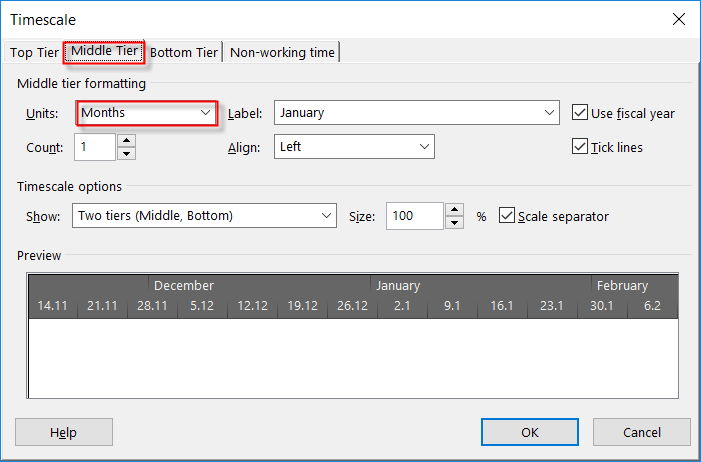
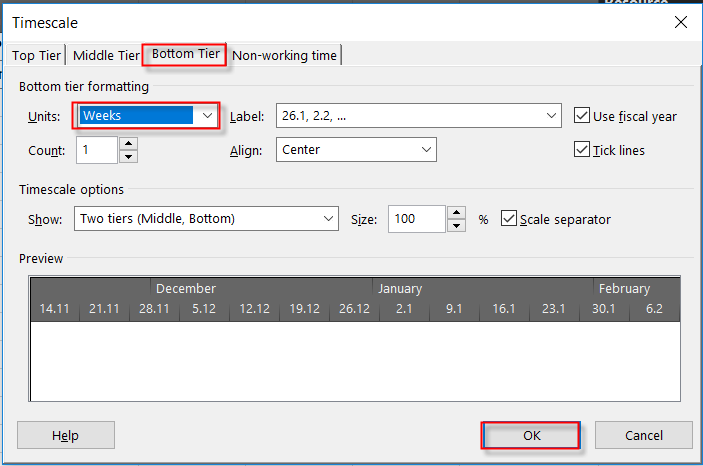
Step4: In task usage, changed the timelines middle tier->months, bottom tier->weeks
Step5: in task usage, entered actual work = 20hr in that task. It gave an warning message. Skipped.
Now it shows 1st week, Resource works 20hrs, and over allocated in next week with 60hrs.
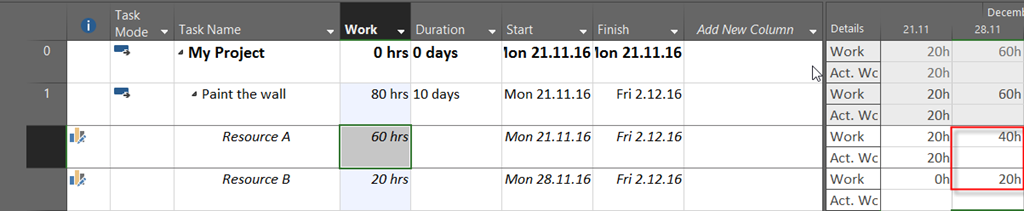
Now, my query is, if i add another resource “B”, i expect that this extra 20hrs in 2nd week should be assigned to this resource “B”.`
I would like the MS project to calculate by itself and assign 40hrs for resource A and 20hrs to resource B.
Please guide on how to achieve this?”

I will show you how to do that in MS PROJECT 2016! I will follow steps from the question.

Step1: created a task “paint the wall” with duration as 10 days (work starts by a Monday). Task is fixed duration

image

As you can see, I make this Task Effort Driven, because I will have to split work between Resources.

Step2: created a resource “A” (100%) – (8hrs/day)

image

As you can see, I have another resource, Resource B, because I will need it for latter steps.

Step3: assigned this resource in this task.

image

Step4: In task usage, changed the timelines middle tier->months, bottom tier->weeks

image

and:

image

Step5: in task usage, entered actual work = 20hr in that task. It gave an warning message. Skipped

image

Now it shows 1st week, Resource works 20hrs, and over allocated in next week with 60hrs.
Now, my query is, if i add another resource “B”, i expect that this extra 20hrs in 2nd week should be assigned to this resource “B”.`
I would like the MS project to calculate by itself and assign 40hrs for resource A and 20hrs to resource B

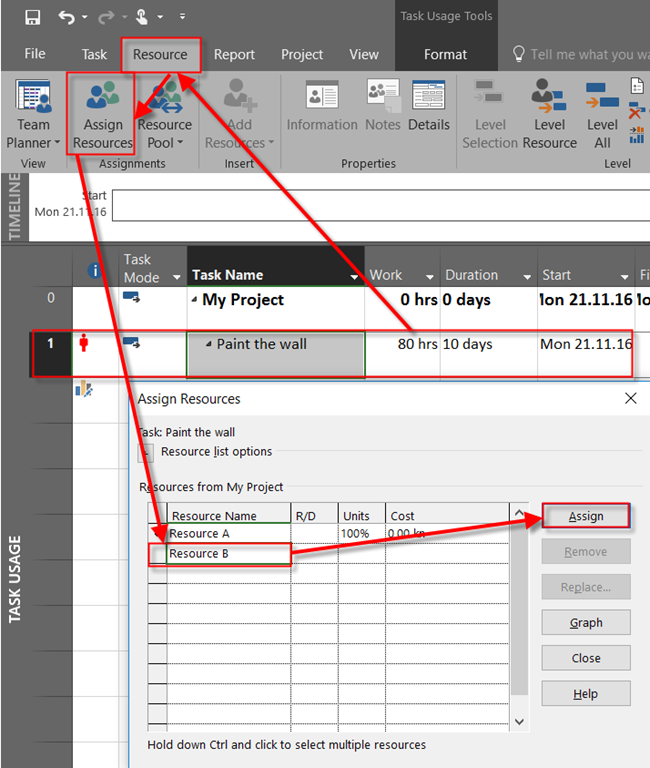
I will assign Resource B on the Task:

image

I will get:

image

As you can see, remaining work among those Resources is divided in 60/40 (36 hours for Resource A, and 24 hours for Resource B). So, Resource A is not over allocated any more, but it is not what we want. We want that Resource A should work 40 hour, and Resource B 20 hours for Task. So I will have to put those hours manually:

image

and I’ve got what I wanted.

So, no, this is not going to happens automatically,  you should do it manually.

Hope this helps.

Regards!
Posted in MICROSOFT PROJECT, Micsrosoft Project 2016, MS PROJECT 2016, PMI, PRoject Management | Tagged , , , | 2 Comments

How to disconnect relation between %Complete and %Work complete in MS PROJECT 2016?


Hi,

I have a question from one of my blog readers:

“Hi,
I just came across your resource tool and am hoping to find some help. I am having trouble disconnecting % Work Complete (Actual work done) from % Complete (what work progress should be, based on duration). I need this tracking tool for comparison. But they keep copying each other.”

I will show you a simple example with MS PROJECT 2016!

First I will going to create a simple Project with only two Tasks (and I will add some columns in Gantt Chart View). One Task will be Auto, and another Manually scheduling:

image

I will create to Resources, John and Mary:

image

And I will assign them to Tasks, accordingly:

image

Now I will put 50% at %complete for the first Task, and 25% for the second, and I will get:

image

As you can see, %work completed is updated automatically, and that is what we want to avoid here.

To avoid that you should set up this option:

image

and then:

image

and finally:

image

If I now put same values at %Complete, I will get.

imageAs

As you can see, now %work complete is0%. Notice that in this case you can not update %Complete for Manually scheduled Task, but only for Auto Scheduled. I will put now 40% in %work complete field for both Tasks, and I will get:

image

As you can see, %Complete remains the same.

So, yes, you can do it. But be aware that in this case you have killed formula: WORK = DURATION * UNITS , and you should care about everything by yourself.

Regards!

Posted in Microsoft Project 2013, MS PROJECT 2010, MS PROJECT 2016, PMI, PRoject Management | Tagged , | 3 Comments

Task Usage view, and spreading work over weeks with MS PROJECT 2016

Hi,

a lot of MS PROJECT users are confused with using Task Usage View in MS PROJECT 2016, when tracking actual work not day per day, but week per week!

I will show you how MS PROJECT 2016 works in a simple example.

First I will create a simple Project:

image

and I will create two Resources: John with 100% Max. Units, and Mary with 50% Max. Units:

image

finally I will assign both of them to Task 1, and Task 2:

image

Now I’m going to switch to Task usage View:

image

As you can see:

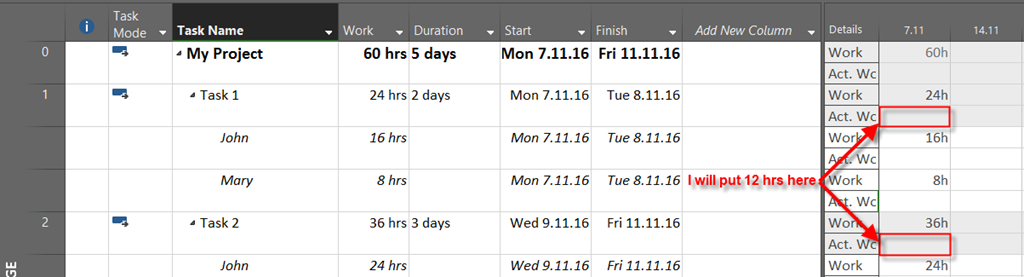
  • Task 1 has 2 days Duration, and 24 hours of Work John 2*8hrs= 16 hrs., Mary 2*4hrs = 8 hrs. (because she will work only 50%), e.g. 16 +8  = 24 hrs.
  • Task 2 has 3 days Duration, and 36 hours of Work John 3*8hrs= 24 hrs., Mary 3*4hrs = 12 hrs. (because she will work only 50%), e.g. 16 +8  = 24 hrs.

Now suppose that you, a s a Project Manager get information that it was spent 12 hours at Task 1, and 12 hours at Task 2, in a week.

firs I will change Task Usage View:

image

and then:

image

and finally:

image

So now, I’m ready to put actual work on week basis scenario:

image

and I will get:

image

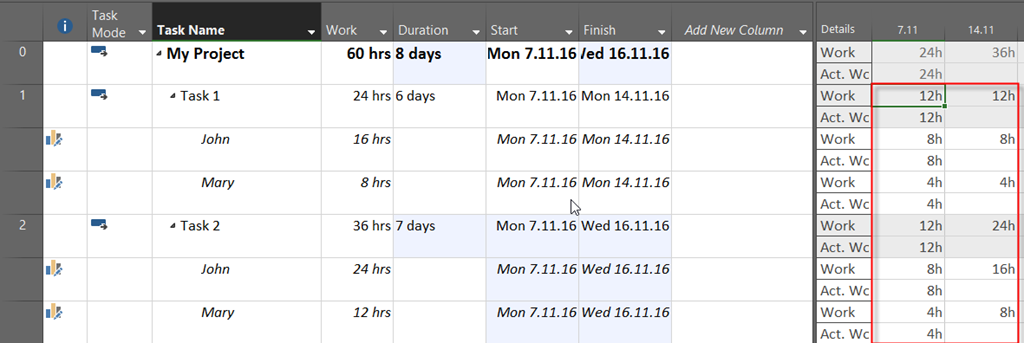
As you can see Actual Work is divided between John and Mary in a way that John spent twice time on both task than Mary, and this is because John is supposed to work 100%, and Mary only 50%. Remaining Work I pushed on next week for both Tasks, which is obvious, because Tasks were not finished as they were supposed to be – at first week.

But, let’s see how work is spread per day:

image

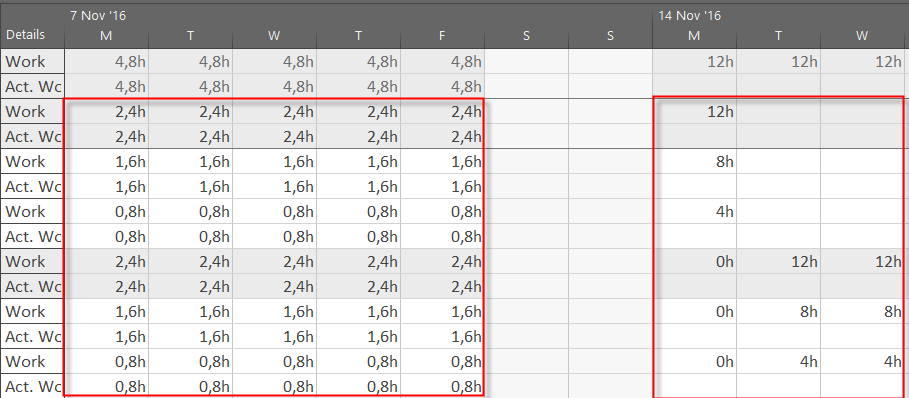
  • Task 1 and Task2: Actual work was 12 hours, e.g. 12 / 5 = 2,4 hours per day. this is per Task. John worked twice more than Mary, so it worked 2/3 per day per Task, and Mary 1/3 per day per Task, e.g., John worked 2,4 * 2/3 = 1,6 hours per day, and Mary 2,4 * 1/3 = 0,8 hours per day
  • Remaining work for Task 1 is 24 – 12  = 12 hours. It means that it can be finished at next Monday. John has to work 2/3 per day per Task, and Mary 1/3 per day per Task, e.g., John will work 12 * 2/3 = 8 hours, and Mary 12 * 1/3 = 4 hours.
  • Remaining work for Task 2 is 36 – 12  = 24 hours. It means that it can be finished at next Tuesday. John has to work 2/3 per day per Task, and Mary 1/3 per day per Task, e.g., John will work 12 * 2/3 = 8 hours per day, and Mary 12 * 1/3 = 4 hours per day. So they both will work  12 hours per day, and since Task 2 has Remaining work = 24 hours they should work two days.

Is it complicated? YES! Why am I explaining this. To warn you that this approach is not the right one.

If you use Task Usage View, and you have assigned Resources, put Actuals per Resources, not per Task. But for that, you must have information about how much hours each of your Resources has spent at each Task per week. Then MS PROJECT will spread those hours among days equally (of course if there is no calendar or other exceptions).

So, be very careful with putting Actuals per week.

Regards!

Posted in MICROSOFT PROJECT, MS PROJECT 2016, PMI, PRoject Management | Tagged , , , | Leave a comment

Replacing Resources on partial done Tasks–Microsoft Project 2016

Hi,

I have a question from my Blog reader:

“Hi Nenad and thank you very much for your blog. I have a question for you. Suppose you have a 10d task with a generic resource assigned to it ( total work 80h ). After 5 days you have to track the progress and enter these actuals: work done 48h, remaining again 48h and 2 resources to use in the second week.

What is the best way to manage this situation ?

Thank you”

OK, I will explain this, step by step with MS PROJECT 2016.

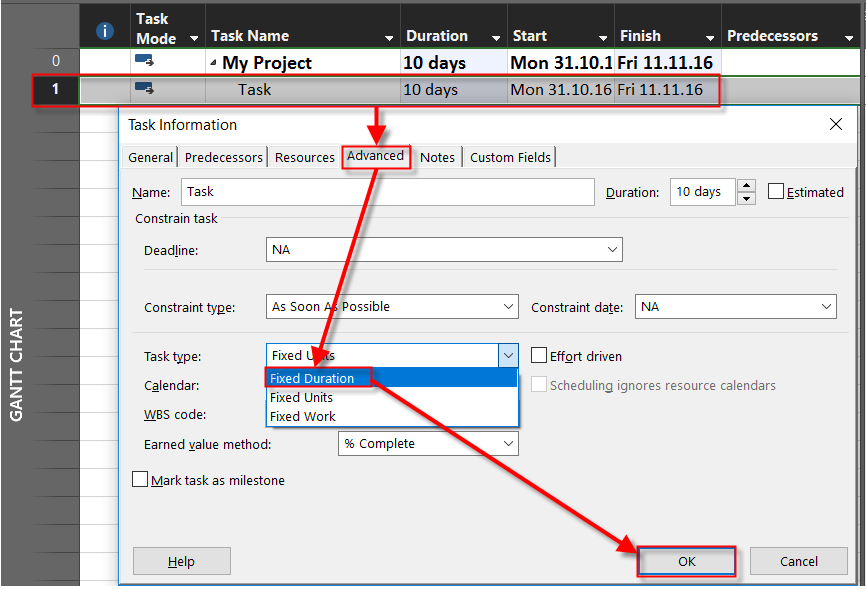
first I will create new Project with one single Task, duration = 10 days. As you can see from the question, this Task should last 10 days (2 weeks), so I have to make it Fixed Duration:

image

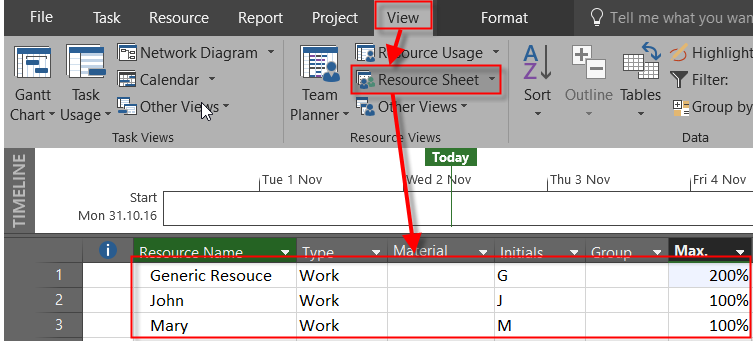
I will create three Resources: Generic Resource, John, and Mary. Notice that Generic Resource will have 200% Max Units (just for example):

image

Now, I will assign Generic Resource to the Task:

image

Now I will switch to Task Usage View:

image

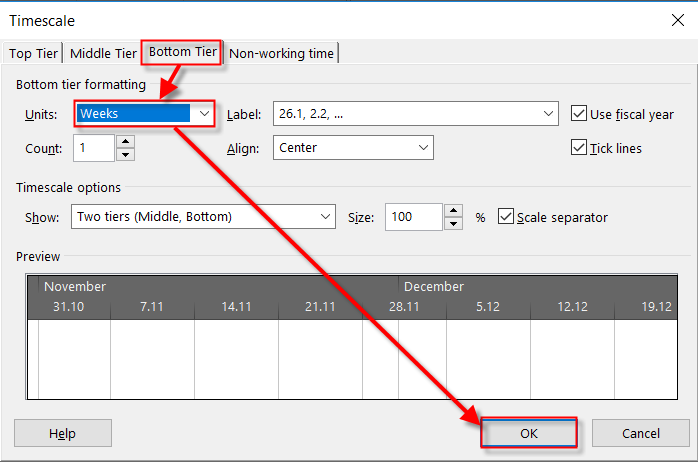
I will adjust Timescale to weeks, so I can see work per week in the right part of the screen:

image

and:

image

and then:

image

and I will get (notice that I added Actual work to be displayed):

image

Now, due to example, my Generic Resource was working 48 hours at first week:

image

As you can see, when I put 48 hours in Actual Work field, and Work field is changed to 32 (80h of Total work – 48h Actual work = 32h). I will put 48 h in that field so I will get:

image

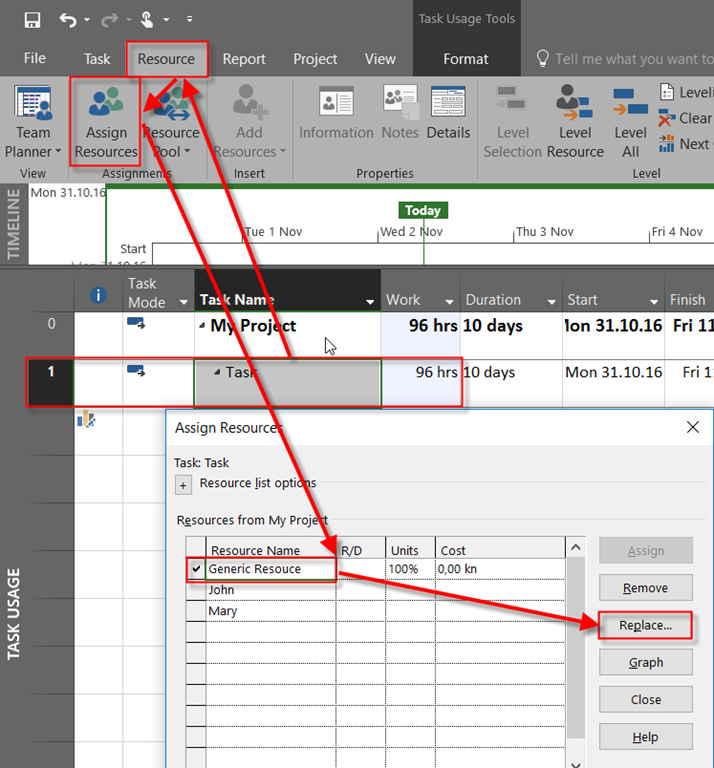
Now I am going to replace Generic Resource with John, and Mary:

image

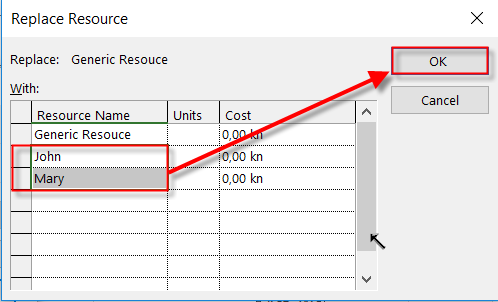
and:

image

I will get:

image

As you can see, because I have two resources now, MS PROJECT calculates 48 hours for John (as a replacement for Generic Resource), and 40 hours for Mary (as a new added resource).

Now, since you know that you need 48 hours to finish that Task, you should assign proper work to each Resource. So, for this example, let’s say that both, John and Mary will 24 hours in the second week to finish that Task:

image

And now I get what I wanted.

It is a little bit complicated, but in a such a specific case, there is no other or “auto” way, to do that.

Hope this helps!

Regards!
Posted in MICROSOFT PROJECT, Microsoft Project 2013, MS PROJECT 2016, PMI, PRoject Management | Tagged , , , , , | 1 Comment

Some leveling options in Microsoft Project 2016

Hi,

my Blog reader has a question:

“Would you please give an example with “Leveling Can Adjust Individual Assignments on a Task” and an other example with “Level Resources with the Proposed Booking Type” in MS Project 2016 resource leveling option dialog box”

To answer, I will create Very simple Project with two Tasks:

image

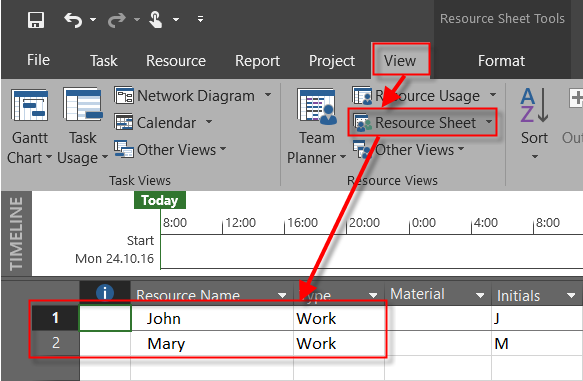
I will also Create two Resources:

image

and I will assign them to Tasks like this:

image

As you can see, because John is assigned to the Task 1, and the Task 2, he is over allocated.

Now I will show you what option: “Leveling Can Adjust Individual Assignments on a Task” mean.

image

I will get:

image

As you can see, Task 1, is moved to Start at Monday, 31.10.2016, because at that time John is available to work without any over allocation.

If I level those two  Resources but with checked option: “Leveling Can Adjust Individual Assignments on a Task”, I will get:

image

Now Task 1 is not moved to start at Monday, 31.10.2016, but it has longer duration instead. To explain that, I will show you Task Usage View, after this leveling:

image

As you can see, John will work on Task 1 from Monday to Wednesday. He can not work at the same time on Task 2. But what about Mary? She is not occupied on other Tasks from Monday to Wednesday, so she can work on Task 2. So, she will work from Monday to Friday, and she will complete her part of work on that Task, and John will start when he can, and that is at Thursday, and he will finish his part of work next Wednesday.

So, when you check that option, Tasks are leveled on Individual Assignments. On the other hand, if you deselect this option, the whole Task will be moved until all Resources are free to work. For example if you have 5 resources on one Task, and only one resource is over allocated, with this option deselected all resources will be moved along with the Task on the new dates.

What about option “Level Resources with the Proposed Booking Type“.

Now let me start for the Beginning with My Project. Again I have simple Project:

image

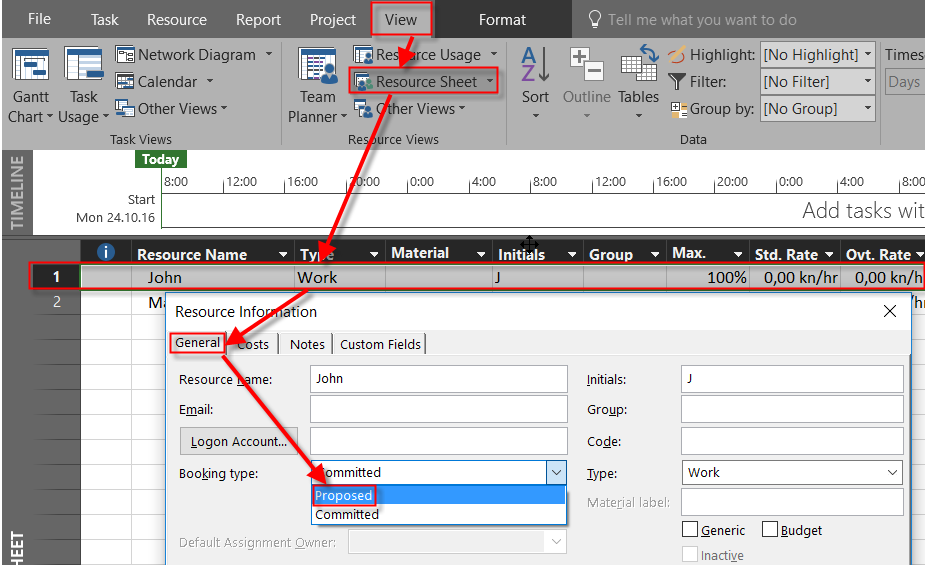
I will make John as Proposed (it mean that you are not 100% sure that he will work on this Project:

image

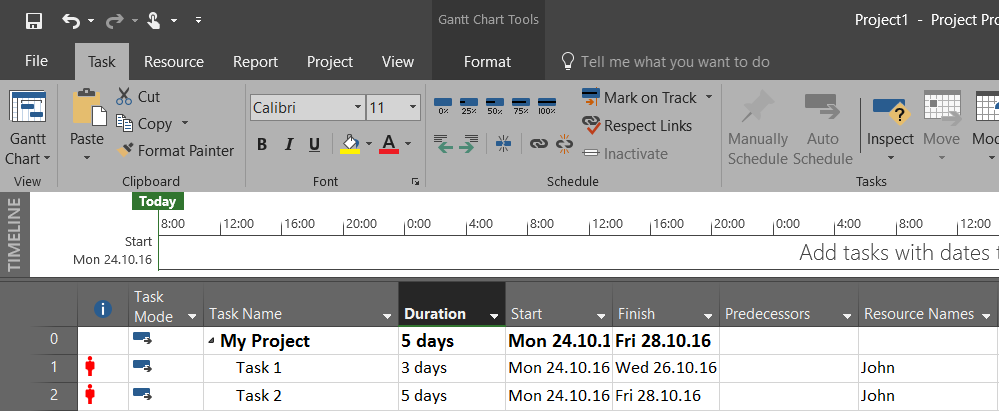
Now I will Assign John to all Tasks:

image

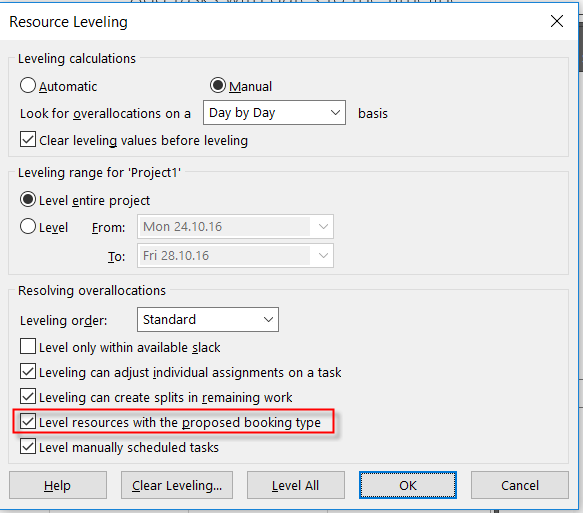
To make this story shorter, you have two possibilities:

image

If this option is selected tasks with Resources with Proposed booking type will be leveled. If this option is not selected they won’t. As simple as that.

Regards!

Posted in MICROSOFT PROJECT, MS PROJECT 2016, PMI, PRoject Management | Tagged , , , | 1 Comment