CREATING OWN BUDGET IN MS PROJECT 2010–PART 2

Hi,


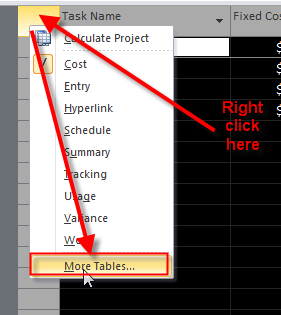
as you remember in my last post created two new custom fields: Budget for Task, and Variance from Actual.  To use this two fields I have to put them in some table. The best approach for my example is to put them into the Cost table:

image

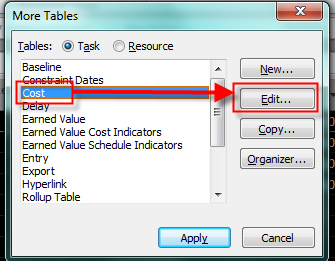
and then:

image

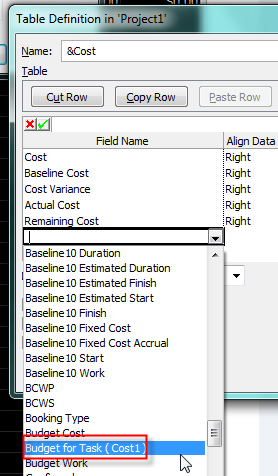
and I will get the screen with all fields in the Cost Table. I will put the cursor in the first blank row and I will pick up those two new custom fields:

image

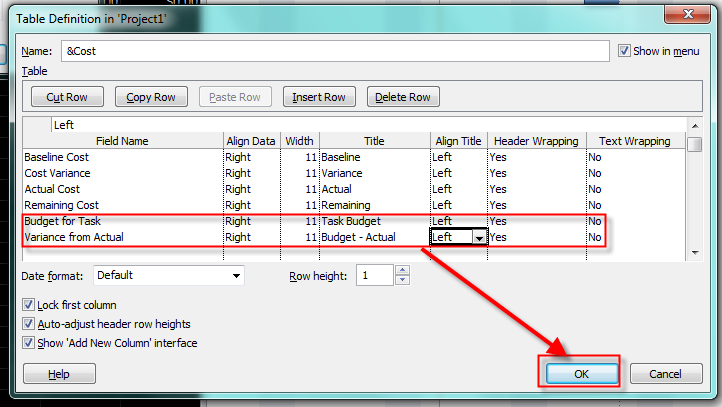
and I will fill the other field attributes, as shown in the picture below:

image

and I will get:

image

Now I will fill the Task budget field for each Task:

image

OK. I will assign Resource 1 to the Task 1, Resource 2 to the Task 2, etc! After that I will get:

image

  • Task 1 has 1 day duration, e.g. 8 hours, and Resource 1 has $100/hour and it means    8 * 100 = $800
  • Task 2 has 2 days duration, e.g. 16hours, and Resource 2 has $200/hour and it means 16 * 200 = $3.200
  • Task 3 has 3 days duration, e.g. 24 hours, and Resource 3 has $300/hour and it means 24 * 300 = $7.200
  • Task 4 has 2 days duration, e.g. 16 hours, and Resource 4 has $400/hour and it means 16 * 400 = $6.400
  • Total cost for the project is = $800 + $3.200 + $7.200 + $6.400 = $17.600

Now, suppose that work is done for all tasks. Task 1 is 100% completed, and it is on time:

image

Because budget for the Task 1 is $1000, and Actual cost is $800,  Budget – Actual = $1.000 – $800 = $200

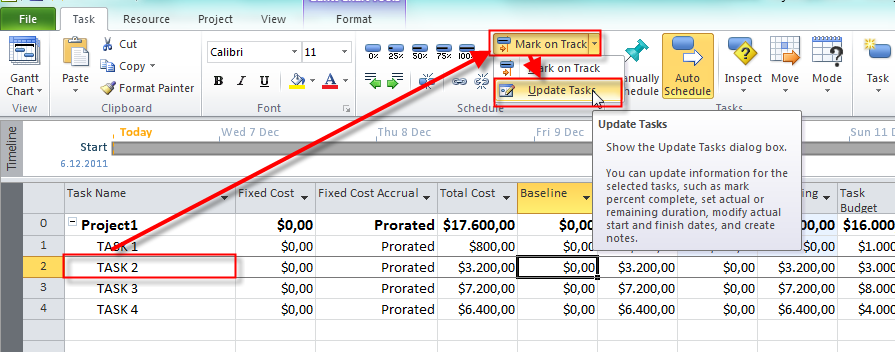
Now I will full the Actuals for the Task 2:

image

and then:

image

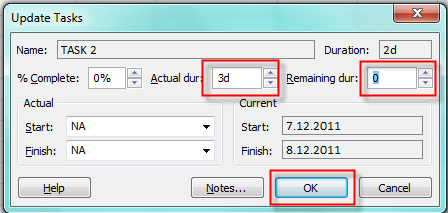
Task 2 has 3 days duration instead of 2. I will get:

image

Actual cost for the Task 2 is: 3 days (3*8=24) hours * $200/hour for Resource 2= $4.800. Budget is $3.000, and the Budget – Actual is $3.000 – $4.800 = –$4.800.

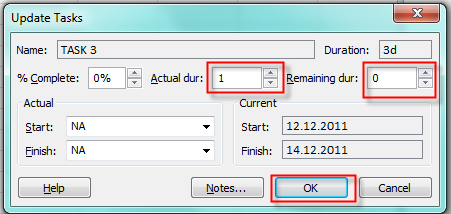
Now I will say that Task 3 was finished 2 days earlier:

image

and I will get:

image

Actual cost for the Task 3 is: 1 day1 (1*8=8) hours * $300/hour for Resource 3= $2.400. Budget is $8.000, and the Budget – Actual is $8.000 – $2.400 = $5.600.

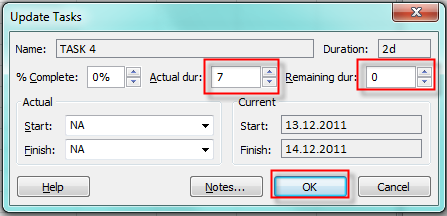
Finally, I will say that Task 4 was finished 5 days latter than planned:

image

and I will get:

image

Actual cost for the Task 4 is: 7 days (7*8=56) hours * $400/hour for Resource 4= $22.400. Budget is $4.000, and the Budget – Actual is $4.000 – $22.400 = –$18.400.

And in the Summary Task you can see the total value for the Project budget, and Project Actual cost, and the Budget – Actual = –$14.400

It wasn’t so complicated, was it?

Regards!

Posted in MICROSOFT PROJECT, Microsoft PRoject 2010, MS PROJECT 2010, PMI, PRoject Management | Tagged , , , , , | 4 Comments

CREATING OWN BUDGET IN MS PROJECT 2010–PART 1


Hi,

I will explain how to make and track your own Budget in MS PROJECT 2010!

Suppose that you want to have a budget (in money) for each task, and that you want to track variance from the actual cost! You can do it easy in MS PROJECT 2010 if you you use some custom fields.

But first let me do the setup!

I will add four Tasks on my Project:

image

and I will add four Resource on my Project:

image

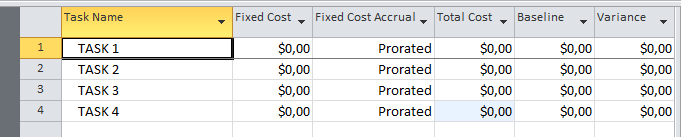
Now I will apply a Cost Table:


image

and I will get:

image

As you can see there are no costs for my Tasks, because I did not assign Resources to the Tasks.

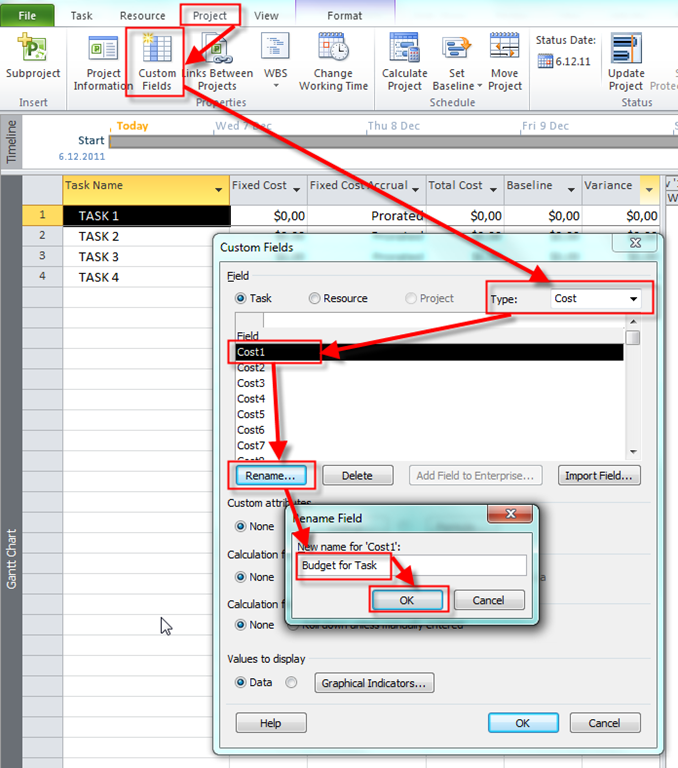
Now I will add the brand new field to MS PROJECT 2010, called Budget for Task:

image

and then:

image

I just added a new field, and that field will be summed in a summary tasks, and project summary task!

Now I need the second custom field, called Variance from Actual:

image

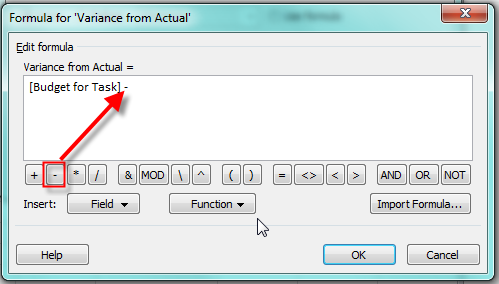
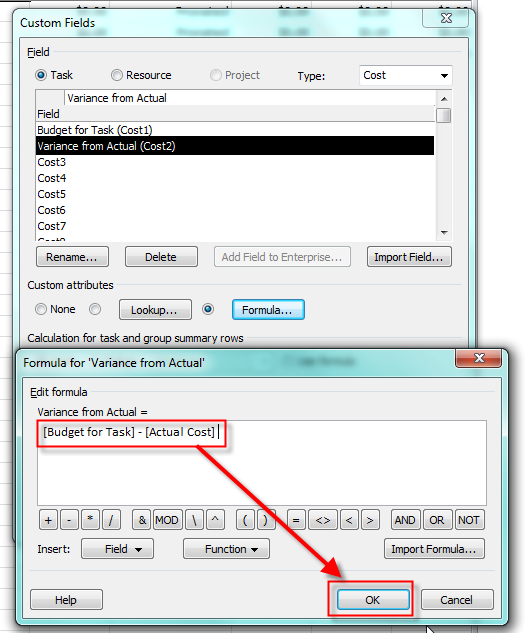
Now I have this new field. In this field I want to place difference between Budget for Task and Actual cost field. To get that I have to use formula:

image

This warning message tells that all previous values in this field will be erased. Ater I click on OK button I will get:

image

and after that I will build the formula! I want to have my Budget for Task (custom field) in my formula:

image

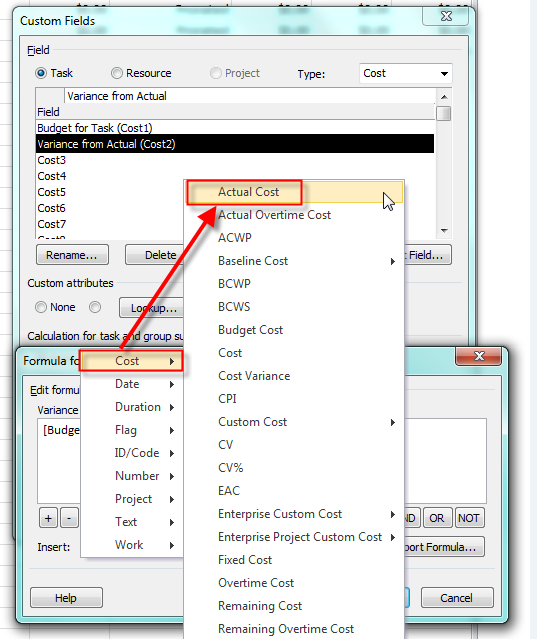
and I want to substract Actual Cost from Budget for Task:

image

and then:

image

and I will get:

image

When I click on the OK button I will get:

image

Finally when I click on OK button I have two new custom fields!

Now, the question is: “How to use those fields?”.  And the answer is: Read my next post!

Until then, bye!

Posted in MICROSOFT PROJECT, Microsoft PRoject 2010, MS PROJECT 2010, PMI, PRoject Management | Tagged , , , , , | 4 Comments

Setting Up the Project Budget

Hi,

I will try to explain how to put the Budget in your Project with MS PROJECT 2010. I will repeat part of my Post from 13.10.2011!

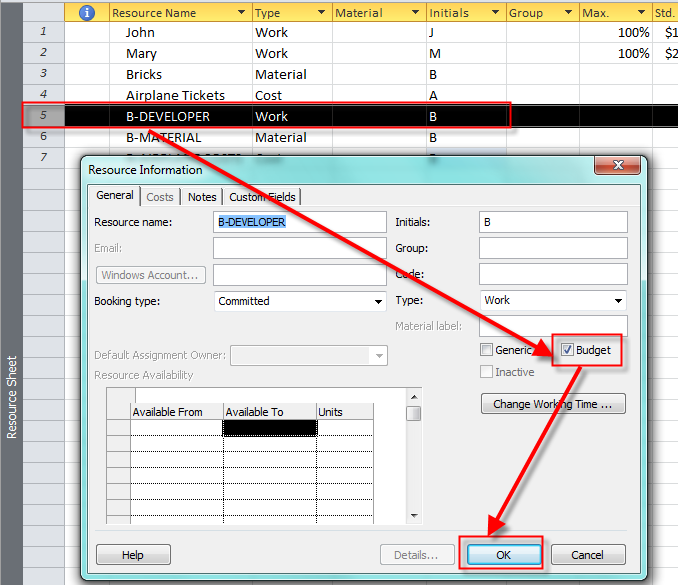
First of all, when you have a Budget Resource, make sure that you put the different name convention to that resource (use UPER CASE, or prefix like B-). Let say that we have three budgeted Resources for our Project:

image

Do not forget that if you want to make a Resource as a Budgeted Resource you must double click on the Resource and fill the check mark:

image

Now I will ad few Tasks on my Project:

image

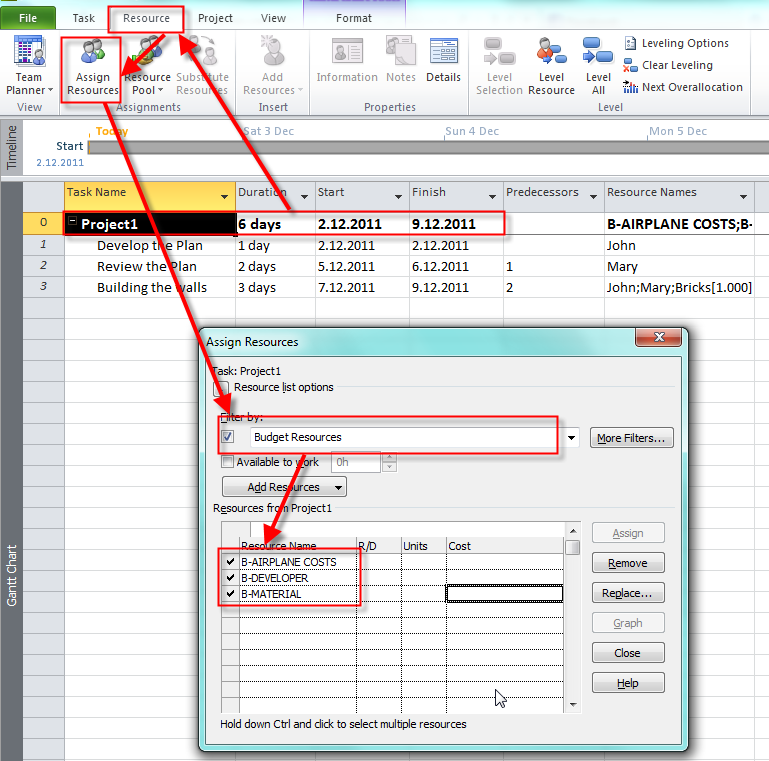
Now I want to assign Budgeted Resource to the Project. Those resources can be assigned only to the Project Summary Task, so I have to turn it on:

image

Now, I will assign all Budgeted Resources to this Task:

image

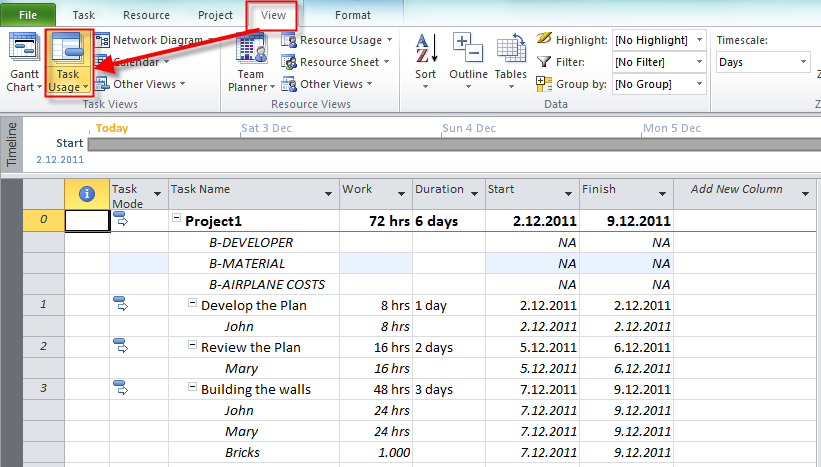
Now what??? Firs I will apply the Task Usage View!

image

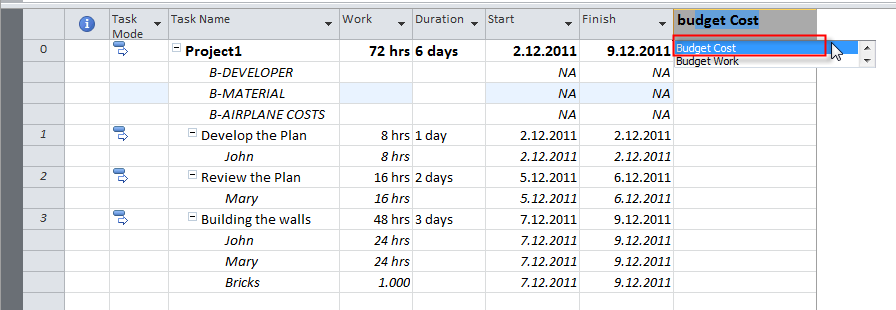
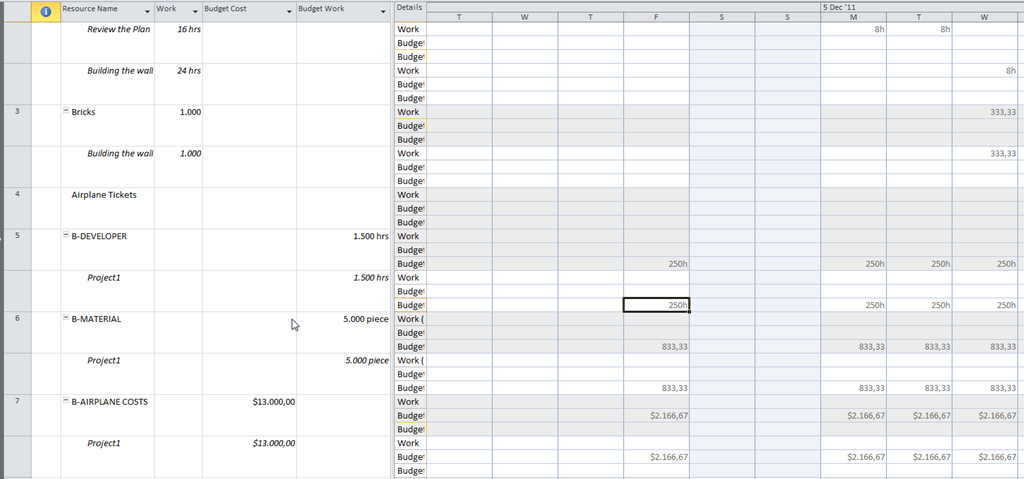
Now, I will add two new fields: Budgeted Cost, and Budgeted Work:

image

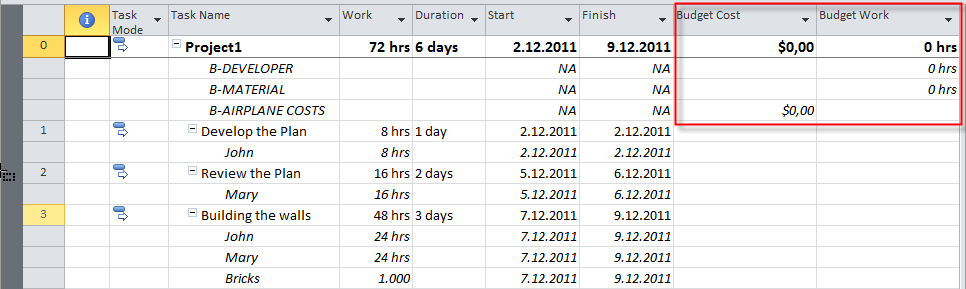
and I will get:

image

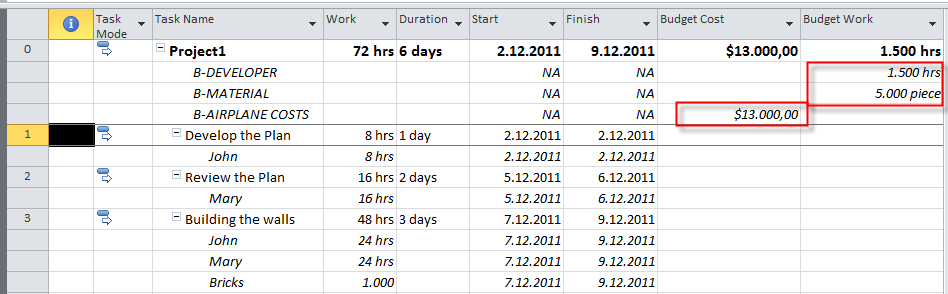
For Work Resources, I can put the Budgeted value for Budgeted Resources in hours/days/weeks etc. For Material Resources, I can put Budgeted value in Pieces, Gallons etc. and for the Cost Resources in money!

image

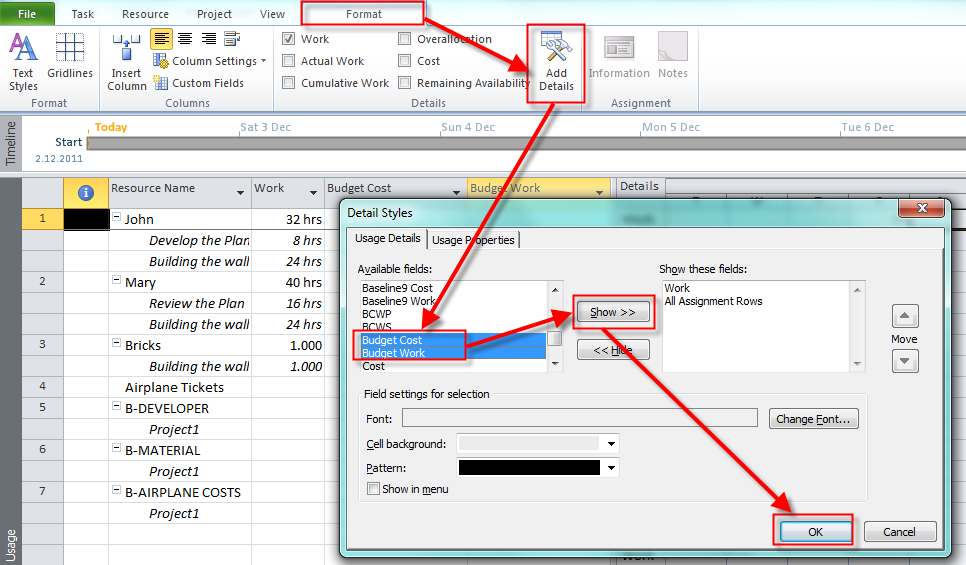
But what if you want to designate Budget within a specific period of time? You should use Resource Usage view:

image

I will add two new rows on the right side of this View:

image

and I will get:

image

Now I can put those Budgeted Values on a day by day (or week by week, etc.) basis:

image

In my next post, I will explain how to make your own budget for each Task, and how to control it, because this kind of budgeting is not good enough (from my point of view).


Regards,

Posted in MICROSOFT PROJECT, Microsoft PRoject 2010, MS PROJECT 2010, PMI, PRoject Management | Tagged , , , , , | 4 Comments

Task Types and how they affect the Schedule–Part 4


Hi,

If you red my last posts, you have noticed that one part is missing. That is: “What does it has to do with effort, and non-effort driven tasks”.

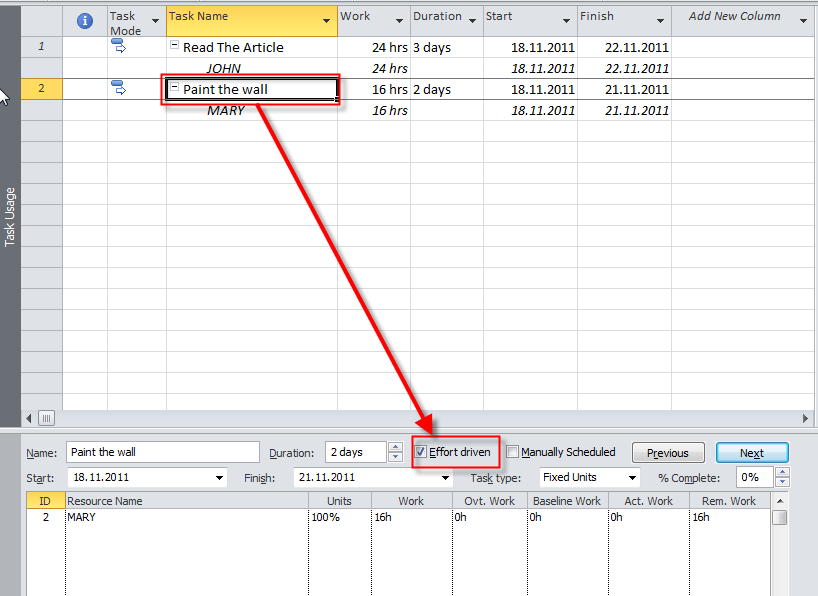
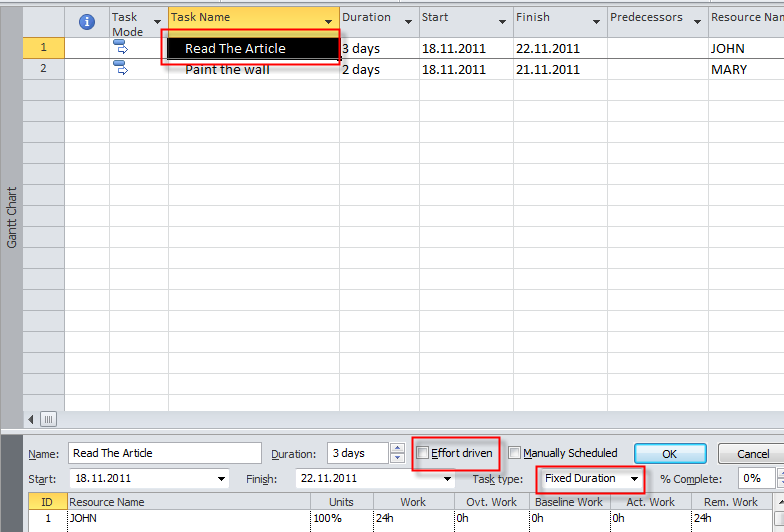
Well it does, when you add additional resources to those tasks. I have two Tasks in my example: Read The Article, which is non-effort driven task, and Paint the wall, which is effort driven task.

image

and

image

Notice that both task are Fixed Units.

Now I will add Mary to the Read The Article Task, and I will get:

image

Because this is Non effort driven task, John and Mary must work 3 days, and that means 8 hour per day, which is 24 hours. So the total work for this task will take 48 hours (24 from Mary, and 24 from John). So, when you have a Fixed units, non effort driven Task, and you assign new resource to the task, Work is changed, and Duration and Units are unchanged.

Now I will add John to the Paint the wall Task, and I will get:

image

Because this task is effort driven, and the Task type is Fixed units, both Duration and work are changed, and Units are unchanged. That means, that when I assign additional resource (John) to the Task, both John and Mary will have to work less hours in total, and Duration will be shorter.


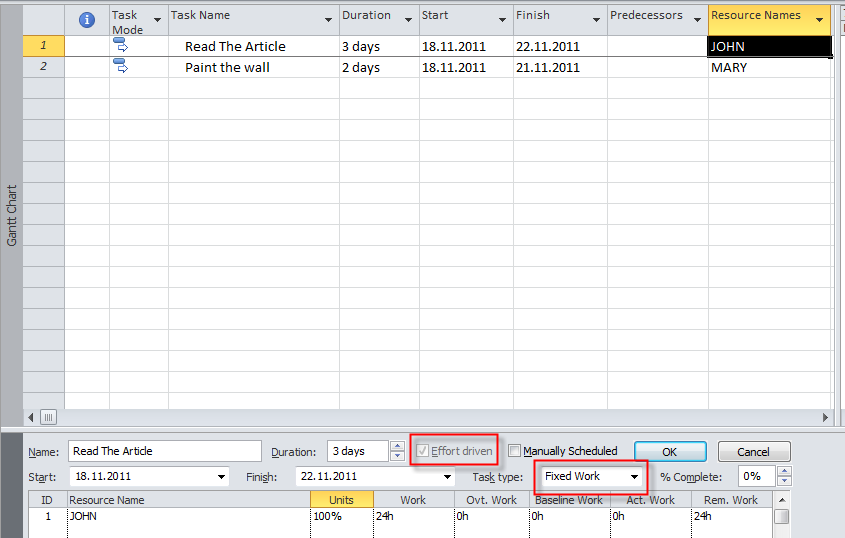
Now I will undo those changes to get the initial setup, with one resource per task, but I will change both tasks to the Fixed Work type. And, because Fixed work is always effort driven I will give you just one example:

image

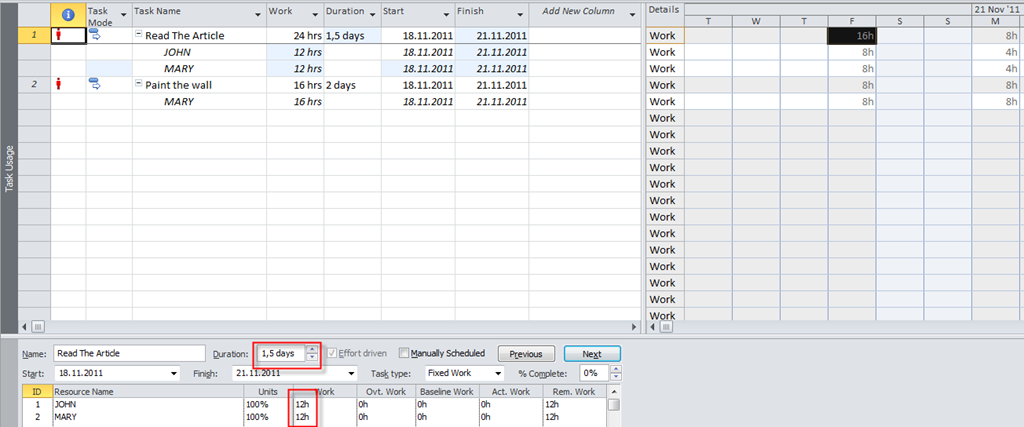
I will assign Mary to the Read The Article Task, and I will get:

image

Because this task is effort driven, and the Task type is Fixed work, Duration is changed, and Units are unchanged. Why? Work is fixed, and it means that we have to spend 24 hours for it. When I assign Mary to the Task, it means that Both, Mary and John have to work 12 hours in total, to fulfill those 24 hours. And because Units are unchanged, it means that they can work max 8 hours per day. So, they will work 8 hours at first day, and 4 hours at second day to achieve 12 hours. The Magic Formula is: Work = Duration * Units, so it means, 12 = Duration (8 hours per day) * 100 = 12/8 = 1,5 day per each person (John and Mary).

That means, that when I assign additional resource (Mary) to the Task, both John and Mary will have to work less hours in total, and Duration will be shorter.


Now I will undo those changes to get the initial setup, with one resource per task, but I will change both tasks to the Fixed Duration type.

image

I will assign Mary to the Read The Article task, which is non effort driven, and I will get:

image

Because this is Non effort driven task, John and Mary must work 3 days, and that means 8 hour per day, which is 24 hours. So the total work for this task will take 48 hours (24 from Mary, and 24 from John). So, when you have a Fixed duration, non effort driven Task, and you assign new resource to the task, Work is changed, and Duration and Units are unchanged.

Now I will add John to the Paint the wall Task, and I will get:

image

Because this task is effort driven, and the Task type is Fixed duration, Work is changed, and Units, and Duration are unchanged. That means, that when I assign additional resource (John) to the Task, both John and Mary will have to work less hours per day , and Duration will be the same.

That is it.

In my next post I will explain the costs!

Regards,

Posted in MICROSOFT PROJECT, Microsoft PRoject 2010, MS PROJECT 2010, PMI, PRoject Management | Tagged , , , , | Leave a comment

Task Types and how they affect the Schedule–Part 3


Hi,

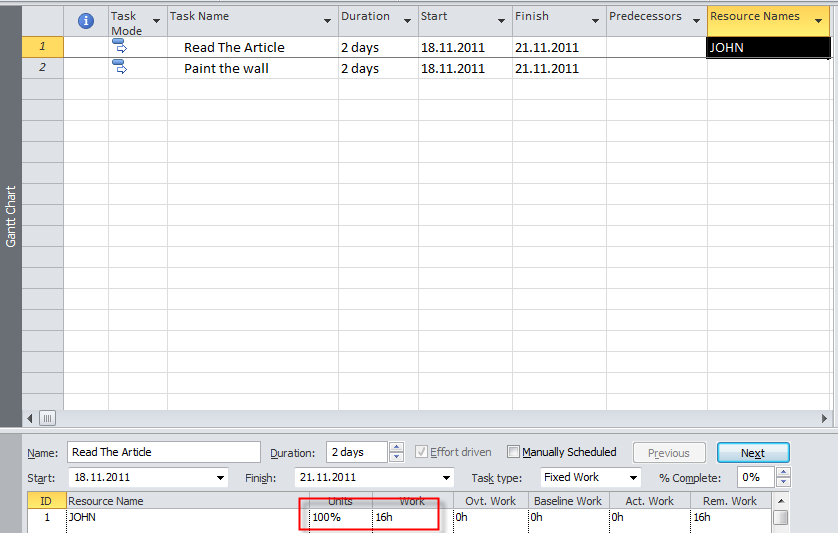
I am going on with Task Types. I will make both Task: Read the Article as Fixed work:

image

As you can see, this task type is always Effort driven. I will assign John to this Task, and I will get:

image

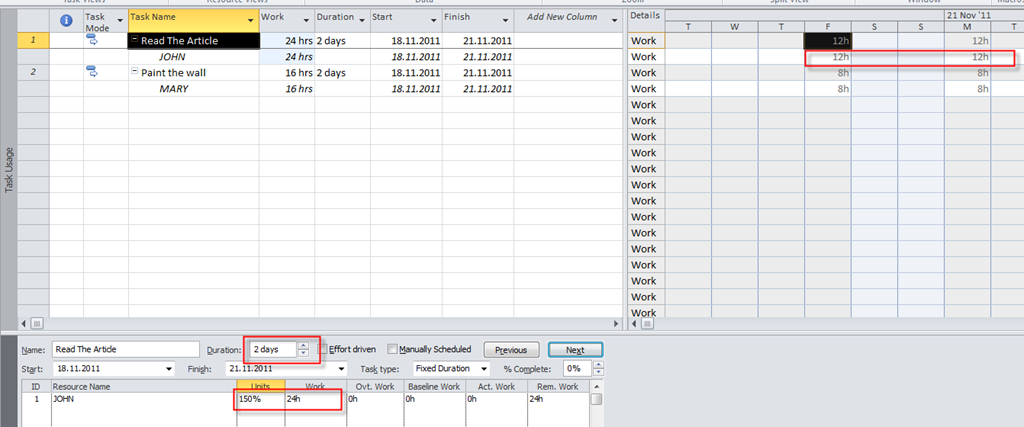
First I will change the Units field from 100% to 150%, and I will get:

image

Work is same = 16 hours! Because John can work with 150% capacity, he will work 8 * 150% = 12 hours at first day, and remaining 4 hours at second day, to fulfill 16 hours! But why is Duration=1,33 days? It seem it should be 1,5 day (because John will work only 4 hours at second day, instead of 8)! Well here is the explanation! Because I put 150% in Unit, MS PROJECT assumes that John has to work 12 hours / day (150% * 8 hours= 12 hours). And the Duration is calculated: 12 hours on first day = 1 day! 4 hours on second day (4/12)= 0,33, and total is = 1 + 0,33 = 1,33

OK. Now I will go back to initially Setup:

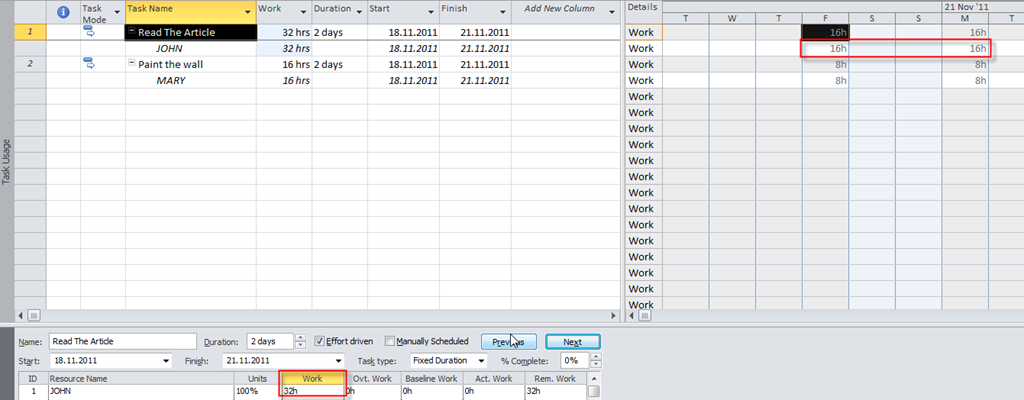
image

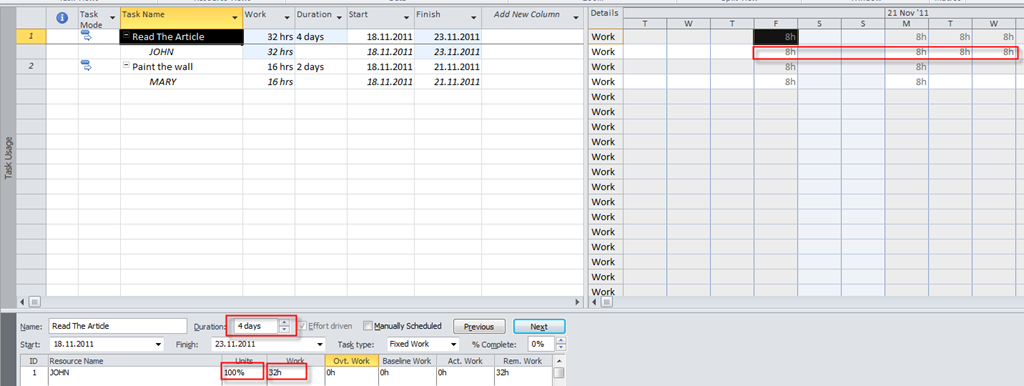
and I will change Work to 32 hours, click on OK button, and I will get:

image

Work is 32 hours!  The Magic Formula is Work = Duration * Units, and that means 32 = Duration * 100%. Because 1 day has 8 working hours It will be 32/8 = 4 days in the Duration field.

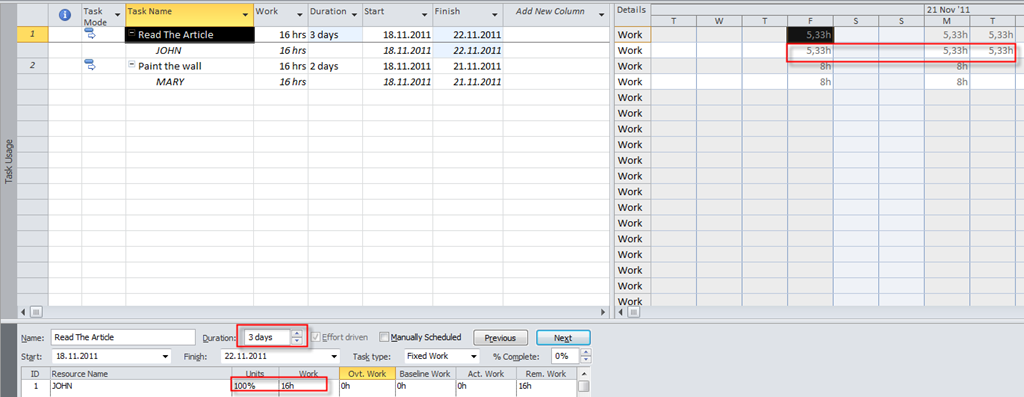
Finally I will (from initial setup) change the Duration from 2 to 3 days, click on the OK button, and I will get:

image

Because we have Fixed work, and the Duration is 3 days instead of 2, MS PROJECT 2010 will divide 16 hours (Fixed work) with 3 days and, 16/3 = 5,33 hours per day.

Now I will make a Task as a Fixed Duration type:

image

I will now change Units from 100% to 150% and I will get:

image

Because the Magic Formula is: Work = Duration * Units, and Duration is Fixed, it means: Work = 2 days * 150%= 16 hours * 1,5 = 24 hours in two days!

Now I will change Work from to 32 hours, and I will get:

image

As you can see, because Duration is fixed, John will have to work 32 hours in 2 days, and it means 16 hours per day! Finally I will change the Duration field from 2 to 3 days, and I will get:

image

The Work is now 24 hours, because 3 days duration mean 3 * 8 hours = 24 hours.

In my next post I will explain what happens when I assign additional resource with different type of resource on effort and non effort driven Tasks.


Regards,

Posted in MICROSOFT PROJECT, Microsoft PRoject 2010, MS PROJECT 2010, PMI, PRoject Management | Tagged , , , , | Leave a comment

Task Types and how they affect the Schedule–Part 1


Hi,

In next few posts I will explain task types and how do they reflect on Schedule in MS PROJECT 2010.

Basically, there art three Task Types:

  1. Fixed Units (Default)
  2. Fixed Work
  3. Fixed Units

What are those?

  1. Units or Assignment units. It reflects Resource availability on the Task. 100% means full time, 50% means half time etc.
  2. Work.  This is amount of time (hours, days, weeks…) that resource will work on the Task
  3. Duration. This is the time span from the start to the finish date of the Task.

Above this three Task type, all of them can be Effort or Non effort driven! Where is the difference? Suppose that you have two Tasks on your Project.

  • Task 1 = Reading the book. If one person is assigned on that Task and it needs 2 days (for example), and you assign another resource to that Task, it will still take 2 days for each person to read that book. You can not reduce the Task duration on that Task with adding more resources on it. This is Non effort driven Task.
  • Task 2 = Painting the wall. If one person is assigned on that Task and it needs 2 days(for example), and you assign another resource to that Task, it will take shorter duration for completing that task . You reduce the Task duration on that Task with adding more resources on it. This is Effort driven Task.

Now, you MUST REMEMBER THE MAGIC FORMULA

DURATION * UNITS = WORK

In MS PROJECT 2010 when you add new Task to the Project, and/or assign new Resource to it, the default type is: Non effort driven, fixed Units Task!

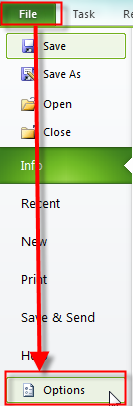
You can change this default settings for your Project:

image

and then:

image

I will leave everything “AS IS”!

Now I will describe what will happens if I change something in the Magic Formula:

TASK TYPE If you change: ASSIGNMENT UNITS If you change: WORK If you change: DURATION
FIXED UNITS Changed: DURATION
Unchanged: WORK
Changed: DURATION
Unchanged: UNITS
Changed: WORK
Unchanged: UNITS
FIXED WORK Changed: DURATION
Unchanged: WORK
Changed: DURATION
Unchanged: UNITS
Changed: DURATION
FIXED DURATION Changed: WORK
Unchanged:
DURATION
Changed: WORK
Unchanged:
DURATION
Changed: WORK

FIXED WORK is always EFFORT DRIVEN!

Where does Effort or Non effort driven task comes “in action”? When you assign or remove  additional resource to the Task:

TASK TYPE ADD OR REMOVE RESOURCES (UNITS)
FIXED UNITS – non effort driven Changed: WORK
Unchanged:
DURATION, and UNITS
FIXED UNITS – effort driven Changed: WORK and DURATION
Unchanged:
UNITS
FIXED WORK – effort driven Changed: DURATION
Unchanged:
WORK, and UNITS
FIXED DURATION – non effort driven Unchanged:
DURATION, WORK, and UNITS
FIXED DURATION – effort driven Changed: WORK
Unchanged:
DURATION, and UNITS

When Should a Task  HAVE Fixed Units? This is default type and protect your resource to work more than he or she should. If resource is assigned to the Task 50%, whatever you change this resource will work only 50% of his capacity on that Task!

When Should a Task HAVE Fixed Work? When you assign a resource to the Task, , the task’s duration is translated to the work. If you want (know) to remain those hours constant when you change duration or work for the Task, choose this Task type!

When Should a Task HAVE Fixed Duration? Very simple! If you want that work on the task should be conducted with fixed duration, you will choose this task type, and it will be no change on that duration when you change units or work on it.

From my next post on, I will show you those tasks types in the real examples!


Regards,

Posted in MICROSOFT PROJECT, Microsoft PRoject 2010, MS PROJECT 2010, PMI, PRoject Management | Tagged , , , , , , | 15 Comments

Assigning Resources to the Tasks, Step by Step!!! – Part 2


Hi,

I will continue with my last Post.

I will add John to the Task1.

image

As you can see, in the Work field there is 16 hours (2 days X 8 hours per day).

I will now assign Mary with 50% units, and that means that she is only 50% available for the Task 1.

image

and I will get:

image

As you can see I have two possibilities. If I choose “Increase total work because the task requires more person-hours. Keep duration constant”!  I will get 24 hours in the Work field, and I in the Task Usage View I will get:

image

As you can see John will work 8 hours per day, and Mary 4 hours per day. So it makes 24 hours in total.

If I choose another option: “Reduce duration so the task end sooner, but requires same amount of work (person-hours)”! I will get:

image

As you can see, Task Duration is now 1,33 days, and in the Work field I got 16 hours. Now let’s see Task Usage View:

image

Since I add Mary with 50% on the task and I want to keep same amount of work (that is 16 hours) those hours has to be split between John and Mary. On the first day, John and Mary will work their full time (e.g. John 100% and it mean 8 hours, and Mary 4 hours per day). That is 12 hours. And now MS PROJECT 2010 has to split remaining work and that is 16-12 hours = 4 hours! John will work 2/3 (e.g. 66,67%), and Mary 1/3 (e.g. 33,33%), and that is 2,67 hours for John, and 1,33 hours for Mary!

Now suppose that I assign both John and Mary to the Task 2.

image

Duration is three days, both John and Mary will work 8 hours per day and that make 8 hours per day X 3 days X 2 persons = 48 hours!

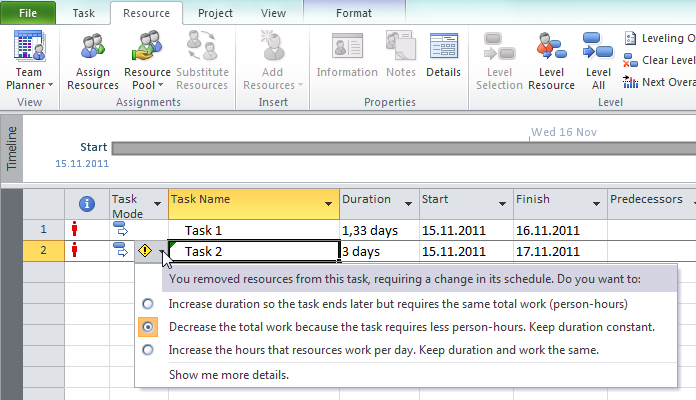
OK! Now I will remove John from the Task!

image

and I will get:

image

First, I will choose: “Decrease the total work because the task requires less person-hours. Keep duration constant”, and I will get:

image

As you can see, task have same duration (3 days), but it will take only 24 hours, instead of 48!

Now, I will choose the second option: “Increase duration so the task ends later but requires the same total work (person hours)”, and I will get:

image

As you can see, Mary will work 8 hours per day, and to fulfill 48 hours she has to work 48/8 = 6 days.

Finally, I will choose: “Increase the hours that resources work per day. Keep duration the same”, and I will get:

image

As you can see, Duration is the same (3 days), Work is the same (48 hours), but Mary has to work with 200% of her capacity per day. Let’s look at the Task Usage View:

image


That is all for today!

Best Regards!

Posted in MICROSOFT PROJECT, Microsoft PRoject 2010, MS PROJECT 2010, PMI, PRoject Management | Tagged , , , , , | 3 Comments

Assigning Resources to Tasks! What are we talking about!?


Hi,

this one will be about Resources, but without MS PROJECT 2010! I promise that I will continue with MS PROJECT 2010 and resources tomorrow!

Before I start I have to say:

  1. I have received more than 100 compliments during this weekend. You like my post, and I am glad to hear this. Thank you guys!
  2. I am writing this post alone. There is no team. Just me!
  3. I am writing this post for fun. I am do it for free of charge. There is no money here!
  4. Someone is following post with RSS, but for someone else it is mission impossible. Help is needed!
  5. I love you Smile


Now, about resources! As you can see, we are talking about scope (what do we have to do), time (when we have to do it), and resources (who will do it), and budget (how much money do we need)?

You can usually hear that “PROJECT is successful or unsuccessful”! And that is wrong!People are successful or unsuccessful, not a Project!

I will tell you a short fairy-tale!

Long, long time ago there was a Project with clear defined scope, unlimited budget and time, with wonderful people. Project Manager had a resource pool with hundreds of experts and he could choose whoever he wanted. He could take as much resources as he needed! Suddenly he woke up! And the fairy-tale was gone. He was back in real life with the same Project, lousy scope, extremely aggressive timeline, and low budget. And resources were bad, and he had only few of them. The organizational scheme in his company was:

ExplanationofManagementpyramid_thumb

Let be honest! Everything about Project and Project Management is about people.

In MS PROJECT 2010 you have to define the Scope! If you have a bad resource you will get a bad scope!

In MS PROJECT 2010 you have to estimate the Task duration! Who will do it? People, of course! Are they experienced? Are the overly optimistic or pessimistic?

In MS PROJECT 2010 you have to assign resources to the task! Do you have them? Are they available? Do they know what they have to do? Are they aware about Project Goals and Objectives?

In MS PROJECT 2010 you have to estimate the budget! Do you know cost of your resources? Is it a secret? How will you do the estimation?

You get the point! I will continue tomorrow with the story about MS PROJECT 2010! But, be aware of this: “MS PROJECT 2010 is powerful tool, but if you do not have a proper resources, data in MS PROJECT will be wrong, and the result will be wrong!” Do NOT BLAME MS PROJECT! In that case it will act like: “GARBAGE IN – GARBAGE OUT”

Remember this: “A FOOL WITH A TOOL IS STILL A FOOL!”

And for the end, the picture which says more than 1000 words:

management


Tomorrow I will start with painful part of task and resources!

Best wishes!

Posted in MICROSOFT PROJECT, Microsoft PRoject 2010, MS PROJECT 2010, PMI, PRoject Management | Tagged , , , , , | 1 Comment

How to split the Tasks in MS PROJECT 2010, and why!


Hi,

it is Friday, and this post will be a short one!

Suppose that you have a project with 5 tasks as is shown in the picture:

Primjer 1 26.04.2011

Task 3 has a 3-day duration, and will start on Monday, 25.04.2011 and finish on Wednesday, 27.04.2011. What if your task can be done in 3 days but it must (for any reason) be scheduled on Monday 25.04.2011 then Thursday 28.04.2011 and finally on Tuesday, 03.05.2011.? You can make three different tasks but this is not a good idea. A better approach is to split the task. Here is how con you do it:

Primjer 2 26.04.2011

After you click on Split button move the cursor on the Gantt chart and click on Tuesday, 26.04.2011 and drag the task on Thursday 28.04.2011:

Primjer 3 26.04.2011

and you will get:

Primjer 4 26.04.2011

You can see that duration of task 3 is unchanged but the start date and end date was changed for Task 4 and 5 because Task 3 is predecessor of Task 4 and Task 4 is predecessor of Task 5.

Now I will split the same task so the last day is Tuesday 03.05.2011 and I will get:

Primjer 5 26.04.2011

Again, duration of task 3 is unchanged but the start date and end date was changed for Task 4 and 5 because Task 3 is predecessor of Task 4 and Task 4 is predecessor of Task 5

What if you change your mind? You can “resplit” the task in the same way. Click on the split task back until it is connected again (drag from right to the left):

Primjer 6 26.04.2011

And the task is joined again.

Remember that a dotted line does not represent duration. Nothing is happening in the dotted line period. If you want to remove dotted line you can do it like this:

Primjer 7 26.04.2011

and you will get:

Primjer 8 26.04.2011


You can see that a dotted line is removed. This picture on the Gantt chart is little confusing because you have a task with a 3-day duration that will start on Monday 25.04.2011 and finish on Friday 29.04.2011. Without a dotted line you can think that this is an error, so I strongly suggest: Leave a dotted line in your Gantt chart.

I have got a question: “Is it possible, for example, Link Predecessor Task, as Finish to Start relationship, with second, or third part of Task has s Slip?”. The answer is NO! Why, because it is ONE TASK, not two or three of them. If you have to do that, you should create two of three different tasks!

From my next post I will start to examine what would happen if I add or remove additional resources to the same task, different Task types, and how to understand this.

You should expect the Headache!

Have a nice weekend!

Posted in MICROSOFT PROJECT, Microsoft PRoject 2010, MS PROJECT 2010, MS PROJECT 20101, PMI, PRoject Management | Tagged , , , , | 6 Comments

Assigning Material and Cost Resources in MS PROJECT 2010


Hi,

In this post I will explain how to set up, and assign material resources in MS PROJECT 2010.

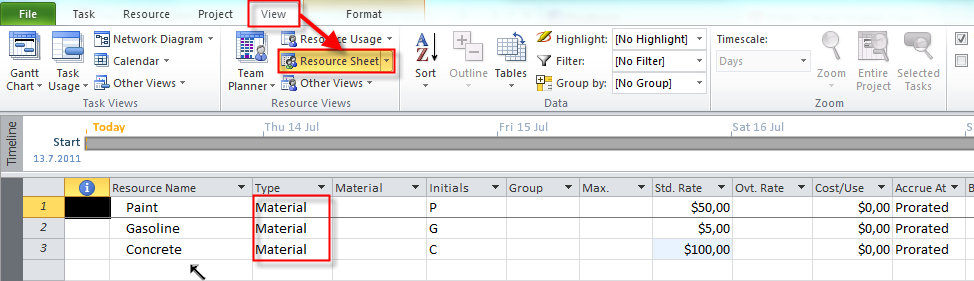
First I will add three material resources in Resource Sheet:
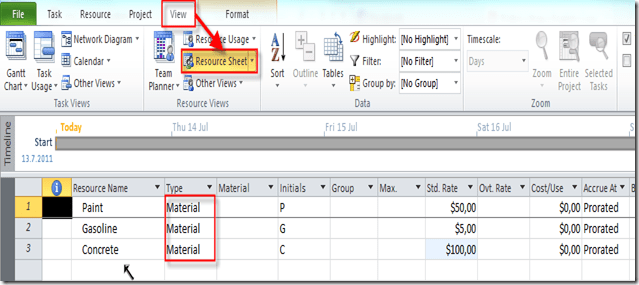
image

Now I will add two Tasks:

image

O.K. Now, I will assign Paint to the Painting the wall task, and Gasoline, and Concrete to the Pouring the concrete Task:

image

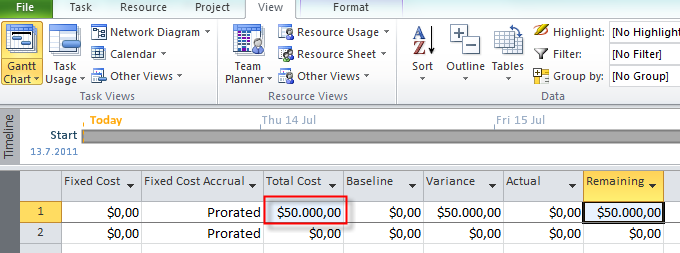
I put 1000 in the Unit field, because I assume that I will need 1000 liters of paint for painting the wall. MS PROJECT 2010 has calculated that the cost is $50.000 (1.000 units X $50 per Unit = $50.000). Remember that this cost remains the same, no matter how long will take you to pain the wall. I will show it to you. First I will choose the Cost table:

image

and I will get:

image

Now I will change duration for task Painting the wall from 3 to 10 days:

image

I will choose the Cost table again, and I will get:

image

The Total Cost remains the same.

O.K. Now, I will assign Gasoline and Concrete to the Task Pouring the concrete:
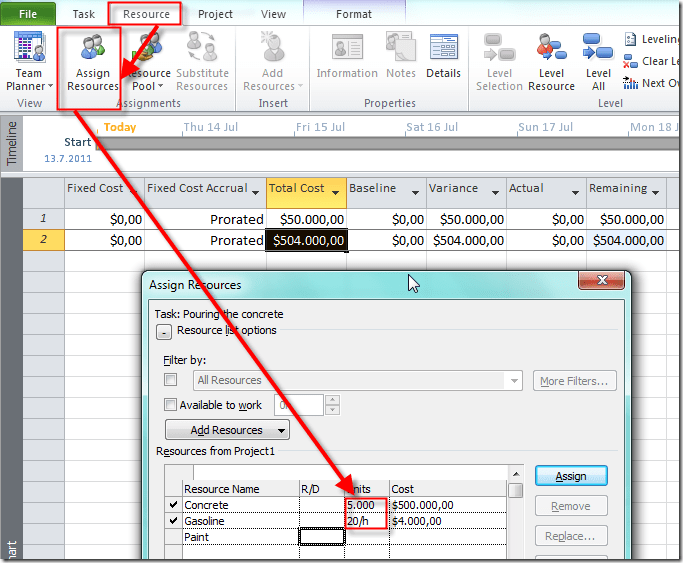
image

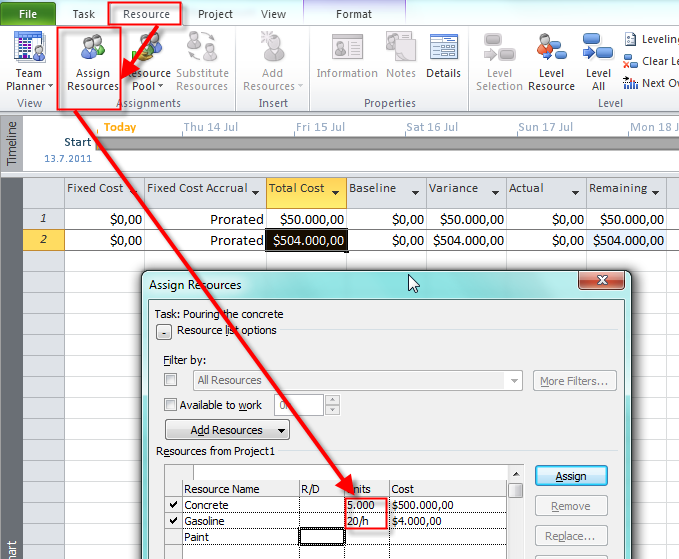
I need 5.000 units (tons, liters or whatever) of Concrete and I need 20 liters (or gallons) of Gasoline per hour. MS PROJECT 2010 has calculated that the cost for the Concrete is $500.000 (5.000 units X $100 per Unit = $500.000). For the Gasoline I put in the Unit field 20/h and that means that I will spend 20 liters (or gallons) per hour. MS PROJECT 2010 has calculated that the cost for the Gasoline is $4.000 (20 liters per hour X $5 per Unit X 5 days X 8 hour per day = 20 X $5 X 5 X 8 = $4.000).

What will happen if I change duration of the task Pouring the concrete from 5 to 10 days? Let’s see.

image

I will choose the Cost table again and I will get:

image

The Total cost is now $508.000. Why? MS PROJECT 2010 has calculated that the cost for the Concrete is $500.000 (5.000 units X $100 / Unit = $500.000), and it does not depend of the Task duration, since I put in the Unit field 5.000. For the Gasoline I put in the Unit field 20/h and that means that I will spend 20 liters (or gallons) per hour. MS PROJECT 2010 has calculated that the cost for the Gasoline is now $8.000 (20 lites per hour X $5 per Unit X 10 days X 8 hour per day = 20 X $5 X 10 X 8 = $8.000), and the Total cost for this task is $508.000.

So, if you have a Material resource which doesn’t depends of the Task duration you should put the number in the Unit field when you are assigning Material Resource to the Task.

If have a Material resource which does depends of the Task duration you should put the number in the Unit field and how much do you spend per time (hour, day, week, etc.). This is time depending Material resource.


Now I will show you how to work with Cost Resources

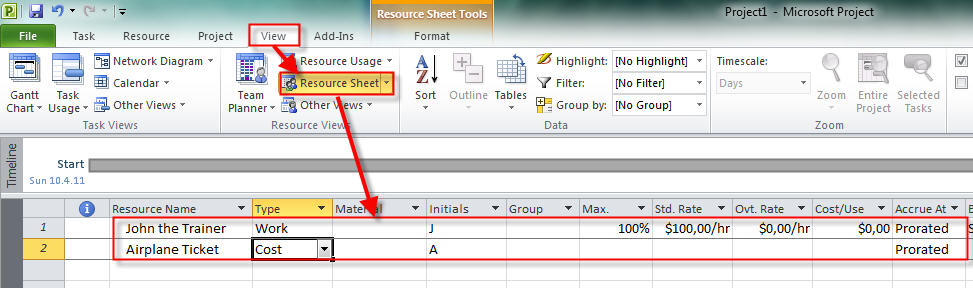
First I will define resources needed for my task.

John the Trainer is Work resource and his standard rate is $100 per hour.
Airplane ticket is Cost resource and it does not have the defined price yet.

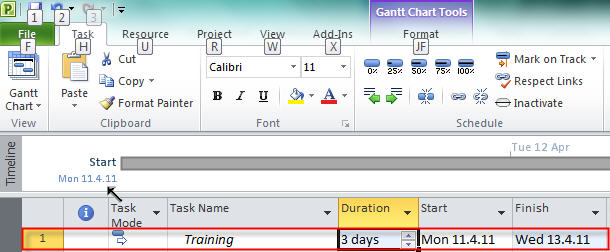
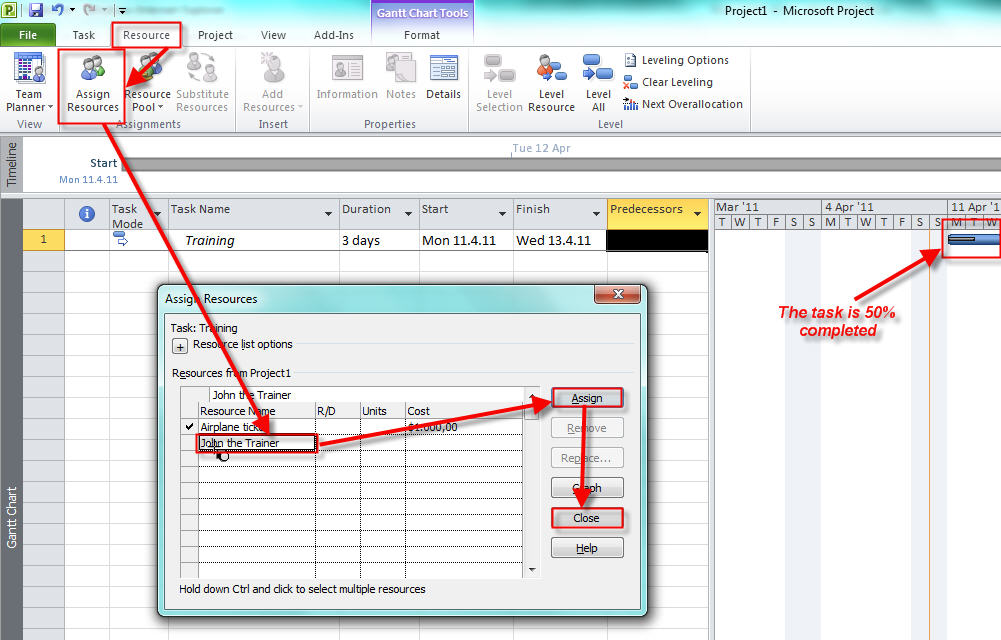
Now I will define task called Training

In the first example I will assign only cost resource to the task.
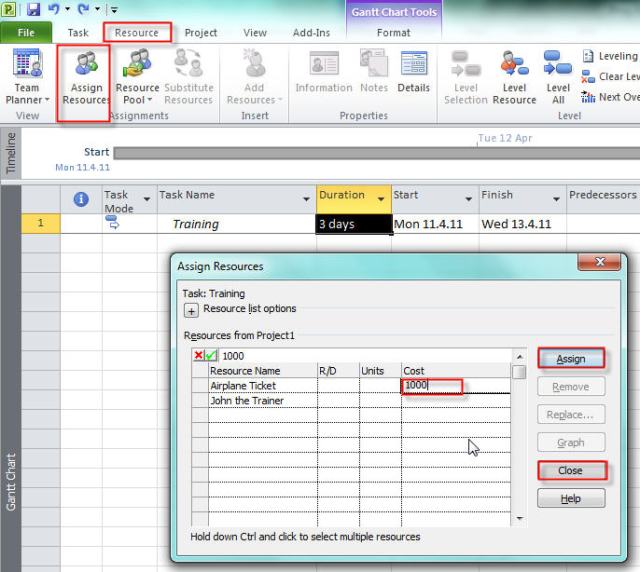
I assign Airplane ticket to the task and I told the MS project that it costs $1000.

I will now assign John the Trainer to the task.
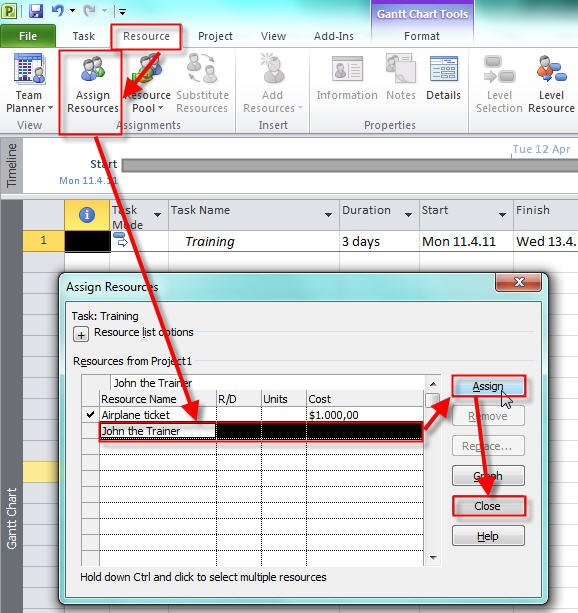
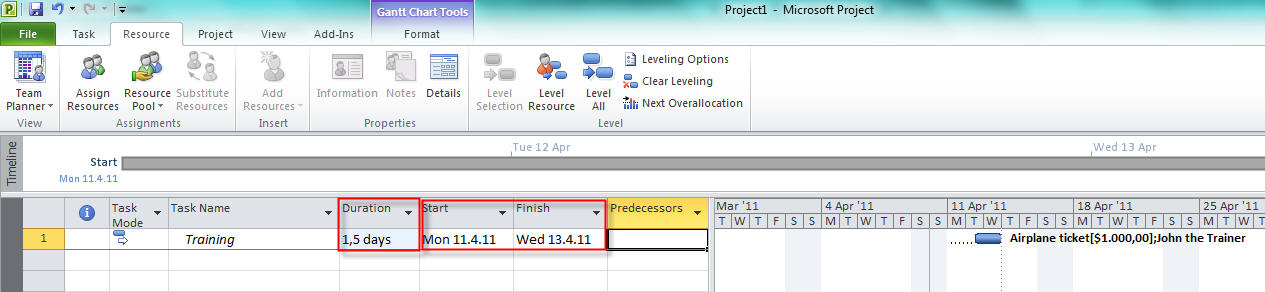
And I got:

Duration, Start and Finish date are the same, so everything seems O.K

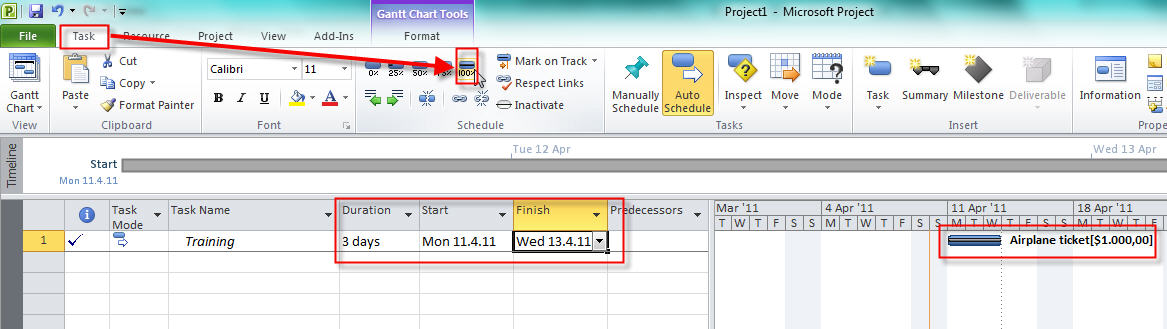
Here is another example. Suppose that I assigned only cost resource (Airplane ticket) to the Task (as it is shown in 3rd picture above). Now I will mark the task as 100% completed.

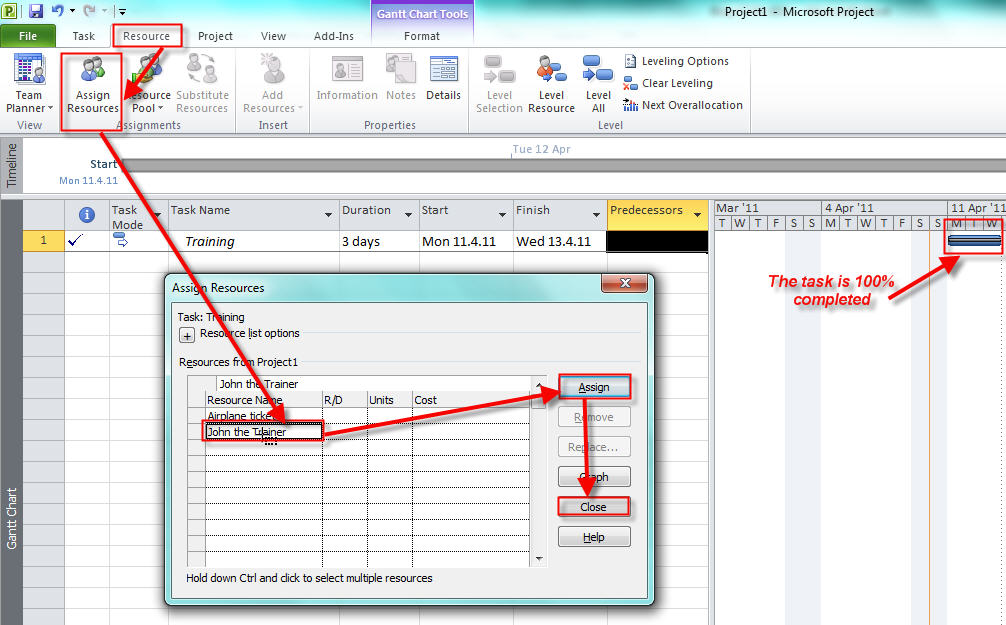
Everything looks fine! But, suppose that you forgot to assign John the Trainer to the task AFTER you marked the task 100% completed. I will assign John now:
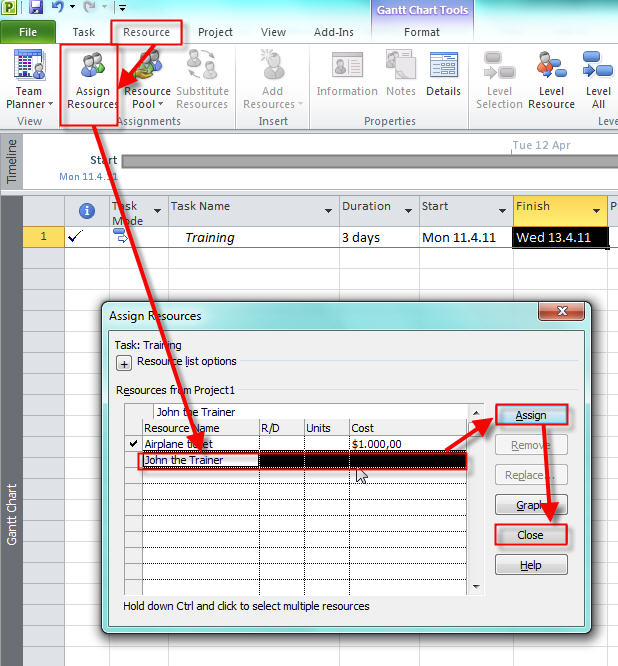
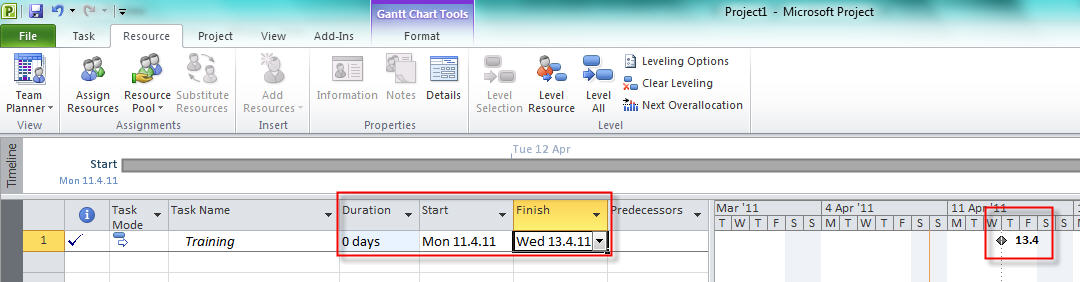
Now look what happens:

Duration is now 0 days (milestone???) with unchanged Start and End date?
It seems like a bug. And you will get the same thing if you assign both resources (Airplane
ticket and John the Trainer) to the task and then, after you mark the task as
100% completed, you remove John the Trainer.

What will happen if you do not have cost resource (airplane ticket) assigned with
the task, and you assign Work resource (John the Trainer) with the task AFTER you
mark the task 100% completed? I will assign John now:
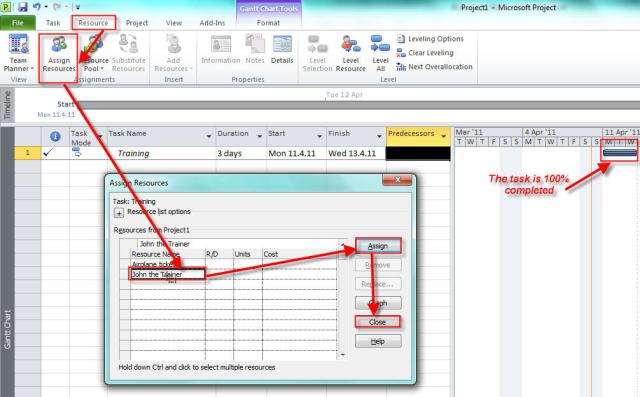
and I will get:
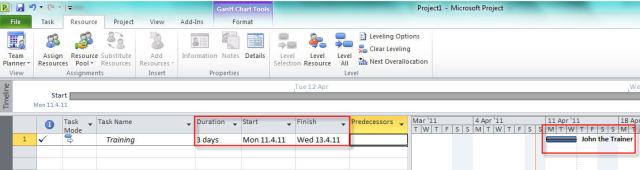
So, obviously the problem is with the cost resource type (in our example the Airplane ticket).

What is the solution? If you have to add or remove work resource to the task after it is completed (25%, 50%, 75%, or 100%) first mark the task as 0% completed, then add or remove the resource to the task and after that mark task as completed again.

I will show to you what happens if I add Work resource (John the Trainer) with the task AFTER I marked it as 50% completed and I already have work resource assigned to the Task. I will assign John now:

and I will get:

Duration is only 50% of expected (1,5 day instead of 3 days) and this is bug.

So, once again, first mark the task as 0% completed, and then add or remove the resource to the task and after that mark task as completed again.


Bye!

Posted in MICROSOFT PROJECT, Microsoft PRoject 2010, MS PROJECT 2010, PMI, PRoject Management | Tagged , , , , | 29 Comments