New Tasks and saved Baseline in MS PRIOJECT 2016


Hi,

I have a reader who is novice in MS PROJECT 2016, and he has a problem;

“Hi,

I hope you are in good health.

I have some quires about cost tracking in MS Project. I had previously saved a baseline and updated the progress for tasks in it…. then I had to make some changes and added another task. Now I had to save a new baseline for it. but this time cost table show actual cost of completed tasks for new baseline cost.How can we explain this? It is going to affect the planned cost for sure! is this the right method for cost control.?

I shall be waiting for your response. “

OK! I will show you that with simple Example in MS PROJECT 2016!

First, I’m going to create brand new Project:

image

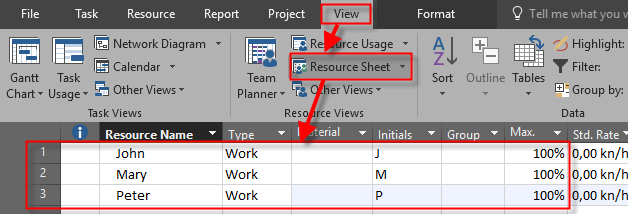
and three Resources.

image

Finally, I’m going to assign Resources to Tasks:

image

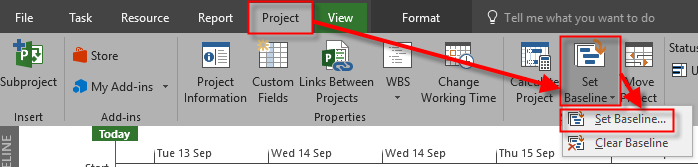
Now I’m going to save the Baseline:

image

and:

image

Now I will show you Gantt Chart with some additional Columns:

image

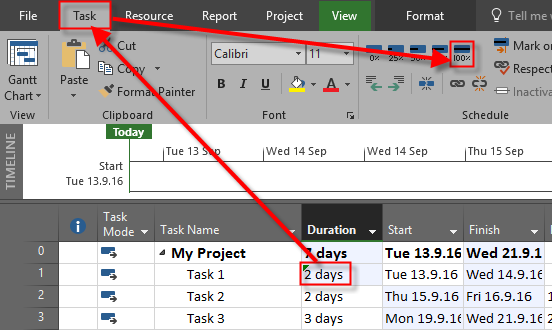
OK! Let’s say that Task1 took 2 days instead of 1 day, and it is finished:
image

I will get:

image

As you can see, Cost, and Actual cost is larger that Baseline cost, because Duration is extended for 1 day.

Now let’s say, that we need additional Task for my Project:

image

As you can see, this Task is not in a Baseline. If I now save the Baseline again I will get:

image

I will get:

image

and then:

image

As you can see, now the Baseline Cost is the same and Actual Cost for Task 1, and it is $1600, which is not what I wanted.

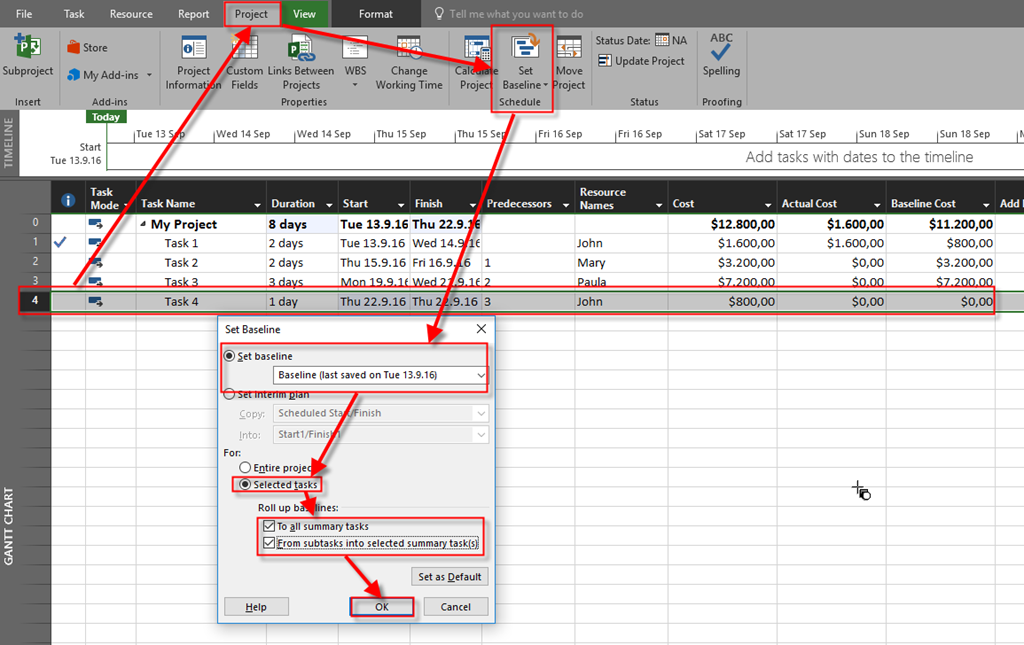
So, to avoid that I will save the Baseline (of, course I have to make undo for previous saving before!), like this:
image

  and I will get:

image

And that is exact what I wanted. So, when you have some Actuals, and you want to save some changes, especially for new Tasks, in the Baseline, use firs Select those new Tasks, and then choose, Select tasks option.

Regards!

Posted in Microsoft Project 2013, Micsrosoft Project 2016, MS PROJECT 2016, PMI, PRoject Management | Tagged , , , | 1 Comment

Resource capacity in Hours with MS PROJECT 2016 – is it possible?

Hi,

my Blog Reader has a question:

“I have a project plan with certain milestones which are to be completed on specific dates and I have resources assigned. But as per plan, the resource allocation hours are reduced whereas in my estimation they are way higher. Is there a way where I can fix hours to the resources and then they get allocated accordingly for the tasks I assign those resources to. Let me know if there’s any other turnaround for the same”

Where is problem here? If you have, for example, John as Resource in your Project, can you have his capacity in hours? And, on the other hand, how to put exact number of hours per Task which are needed to fulfill the Task?

Let me answer to the first question. Simply – NO! You can not have capacity in MS  PROJECT 2016 (or other versions) in hours. You can have them only in Units%.

Let me create very Simple Project:

image

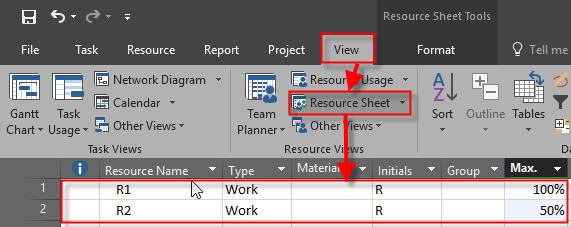
Now, let me create two resources for this Project:

image

As you can see John has 100% Max units. That mean that if he assigned 100% for Task he is able to work, for example, 8 hours per day (according to working calendar). On the other hand, Mary has only 50% Max units for this Project, so she can work only half of his working hours (again, according to her Calendar). If I assign John to the Task with more than 100%, and Mary with more than 50%, then they will became over allocated. Of course if I assign John with 100% to the Task, and again to another Task with, for example, 20%, and those Tasks are supposed to be executed on the same time, he will also became over allocated.

But there is no field in which I can put capacity in hours. That lead me to another question: “How to put exact number of hours per Task which are needed to fulfill the Task?

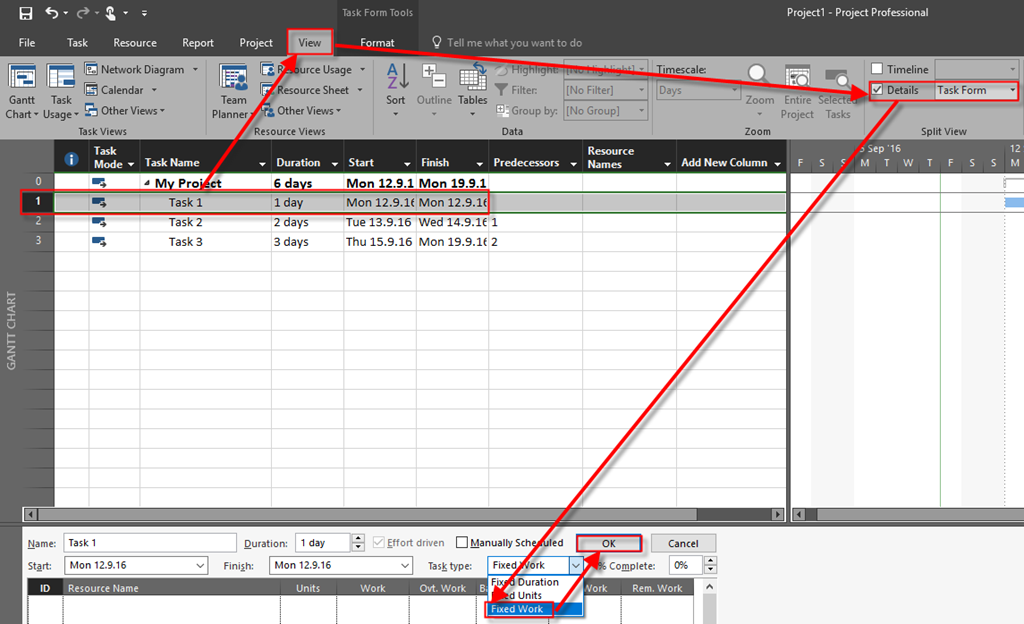
Here I have an easy answer. If you know exact number of hours for the Task must be spent by John and Mary to complete it, simple make this Tasks as Fixed work type, and assign number of hours to John and Mary. Let’s say that John need 40 hours to complete Task 1, and Mary 32.

image

and then:

image

and I will get (I will use Task usage View):

image

As you can see, Duration is now 8 days, because Mary has to work 32 hours, and she will work only 4 hours per day (because 50% of her Units), so the Task will have 4 hours per day * 8 days = 32 hours

To conclude, if you know exact number of hours that Resources must spend to complete the Task, always use FIXED WORK, and assign those hours for each resources.

Regards!

Posted in MICROSOFT PROJECT, Microsoft PRoject 2010, Microsoft Project 2013, MS PROJECT 2016, PMI, PRoject Management | Tagged , , | Leave a comment

Actual Duration, Actual work and Fixed work Tasks in MS PROJECT 2016

Hi,

here is one problem that my Blog Reader has (I will go step by step, and I will use MS PROJECT 2016)

“When multiple resources are assigned to the task, for a given Total Work we can  calculates the   Duration either as Work divided by  Total Assignment Units   OR  by calculating the Duration for each individual resource  as Duration (Ri) = Work (Ri) / Units (Ri))  and then selecting the longest duration of the driver resource to be a task Duration. For example, let’s say we have a 3d, 36 hr task for 2 resources R1(100%)  and R2(50%)”

image

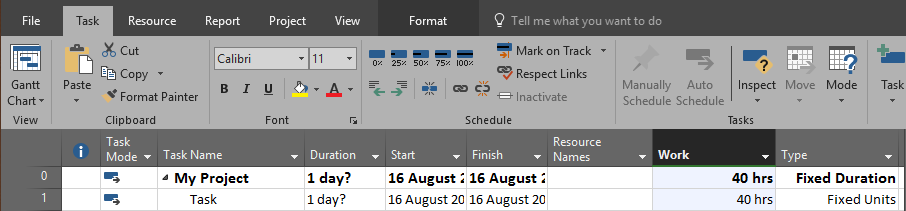
As you can see task is Fixed work type, and I put 3 days in the Duration.

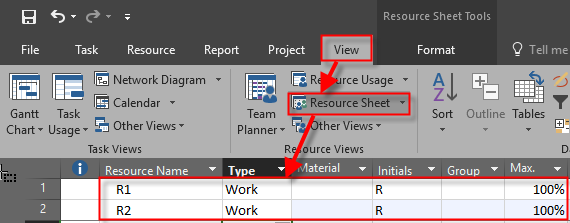
Now I am going to create two Resources, one with 100% units, and other with 50%:

image

and I’m going to assign both Resource to Task:

image

What is wrong with this Scenario. Technically nothing, but logically, if you have Fixed Work Task, it means that work is fixed, and that you know how much work you need for the Task. An, in this scenario, you should not put Duration, but Work. But, let’’ me continue with scenario from my Blog reader, and I’m going to show you Task Usage View:

image

As you can see R1 should work 3 days and 8 hours per day which is 100%, and it equals 24 hours. On the other hand, R2 should work 3 days and 4 hours per day which is 50%, and it equals 12 hours.

My Blog reader continues with: “Now I enter Actual Work of 10h into resource R1  and we get:”

image

The question from my Blog reader is:

“So we can’t anymore use the same approach to calculate Actual Duration using the Actual Work and Units of individual assigned resources. That is, if we calculate the Actual  Duration using the only Actual Work R1 we will get:
Actual Duration = Actual Work (R1) / Units (R1) = 10h / 100% = 1.25d which is not what shown on the screenshot above (0.83d).
So the only way to get Actual Duration right is to calculate it as:
Actual Duration =  Sum of Actual Work of each resource /  Total Units =( 10h + 0h) / (100% + 50%) = 10h/150% = 0.83d

So why is  the method of calculating the task  Duration based on the individual resource Work and Units  with subsequent selection of the longest duration doesn’t work for an Actual Duration calculations?“

Well, Microsoft Project does not calculate Actual Duration in that way. Let’s take a look on the right side of the Task Usage View:

image

As you can see:

  • At Monday Work was 12 hours, and Actual Work is 8 hours (Because R1 works only 8 hours per day). Actual Duration is: Actual work / Work = 8 /12 = 0,66666
  • At Tuesday Work was 12 hours, and Actual Work is 2 hours (Because R1 works remaining 2 hours of 10 hours assigned as Actual work). Actual Duration is: Actual work / Work = 2 /12 = 0,16666
  • So Actual Duration is 0,6666 + 0,16666 = 0,83 Days!

So that is Actual Duration for the Task. And it is always calculated with work and Actual work of all Resources, not one by one!

Regards!
Posted in MICROSOFT PROJECT, Microsoft Project 2013, MS PROJECT 2010, MS PROJECT 2016, PMI, PRoject Management | Tagged , | 1 Comment

Effect of initial resource assignment on calculation of Individual resource’s work in MS PROJECT 2016

Hi,

I’ve got very good question form one of my Blog readers:

“The effect  of initial resource assignment on  calculation  of  Individual resource’s work. Suppose we want have two resources R1 (100%) and R2(50%) to work on a 20h fixed unit task.  When we enter 40h of Work first,  BEFORE simultaneously assigning the resources. After we assign, for example, two resources (one with 100%, an another with 50%), total work for the Task has been changed.

Why does Project disregard each resource’s assignment units and assigns  total work of 40h to each resource so that the total work increases twofold?

So what is the best way to initially assign several resources to a Fixed Unit task for a given Work : that is, if I want 2 resources R1 and R2 to be assigned together to as task of 40h? Only make the task fixed work type?”

OK! I will follow the question step by step!

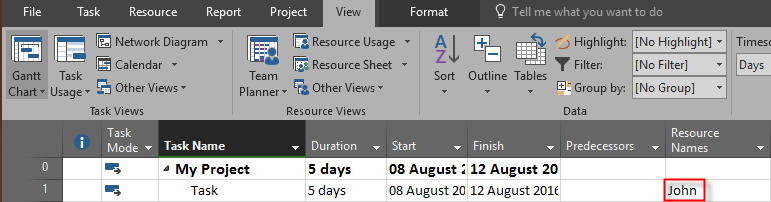
First I’m going to create brand new Project with one Task, and I am going to put 40 hours in the Work field

image

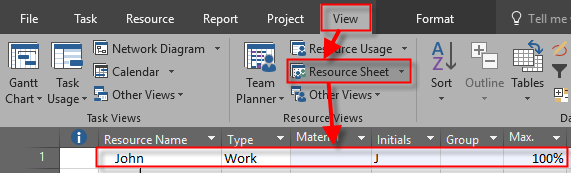
Now I’m going to create two Resources, and I will say that R1 has 100% Max Units, and R2 has 50% Max Units:

image

Now, I will assign them to the Task:

image

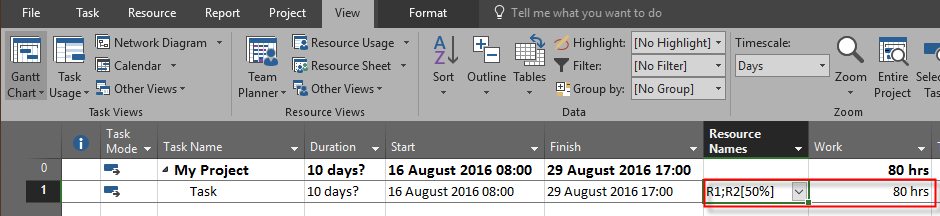
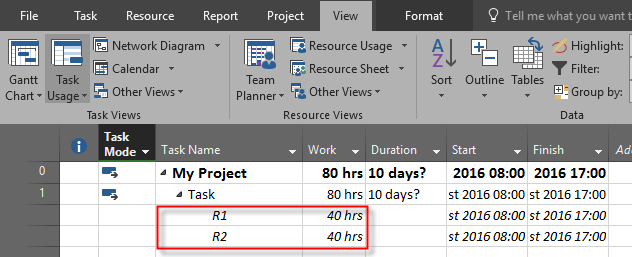
As you can see, work is now 80 hrs. Let’s see Task Usage View:

image

Q: Why does Project disregard each resource’s assignment units and assigns  total work of 40h to each resource so that the total work increases twofold?
A: Because, in MS PROJECT, if you put Work for Task, for example 40 hours, it means that every Resource should spend 40 hours for completing that Task. That’s how it works!

Q: So what is the best way to initially assign several resources to a Fixed Unit task for a given Work : that is, if I want 2 resources R1 and R2 to be assigned together to as task of 40h? Only make the task fixed work type?”
A: You should do it manually. See the example below:

Let’s say that you want for your Task that Each Resource should work 20 hours for that Task.

image

Here I will put 20 hours for each Resource,. and II ‘will click on OK button:

image

In Fixed Units Task Type, if you want to assign different work for the Task, you must specify exact work for each resource. Otherwise, if you put work amount for the Task, and then assign Resources, each Resource will have same amount of work!

Hope this helps,

Regards!

Posted in Microsoft Project 2013, MS PROJECT 2010, MS PROJECT 2016, PMI, PRoject Management | Tagged , , , | 4 Comments

A question for my Blog readers!

Hi,

I got a suggestion, and I want to hear what do you think about it: “Have you considered doing videos instead of screenshots, it would be easier for us to understand and I guess you would save time.”

I can do that as well, but I want to know what do you prefer?

Thanks for your answer!!! Smile

Posted in MS PROJECT 2016 | Tagged | 15 Comments

Relation between Overtime and Duration in MS PROJECT 2016

Hi,

I have a question from oen of my Blog readers:

“Every time I allocate the whole work hours to overtime hours the Duration column turns into 0 and the start and finish dates and time are the same. Why?”

OK! I have to explain how MS PROJECT 2016

image

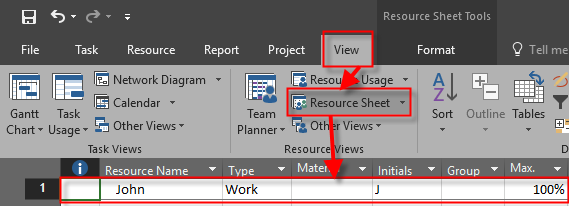
and I will create John, as Resource, and I will assign him to the Task:

image

and:

image

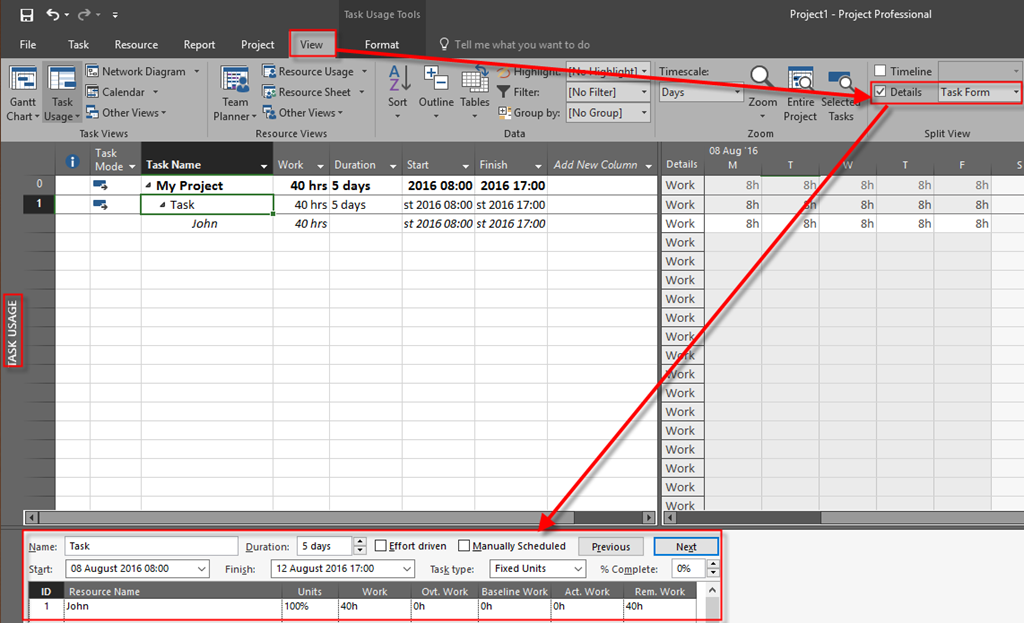
Now I will switch to the Task Usage View, and I will show Task Form, as well.

image

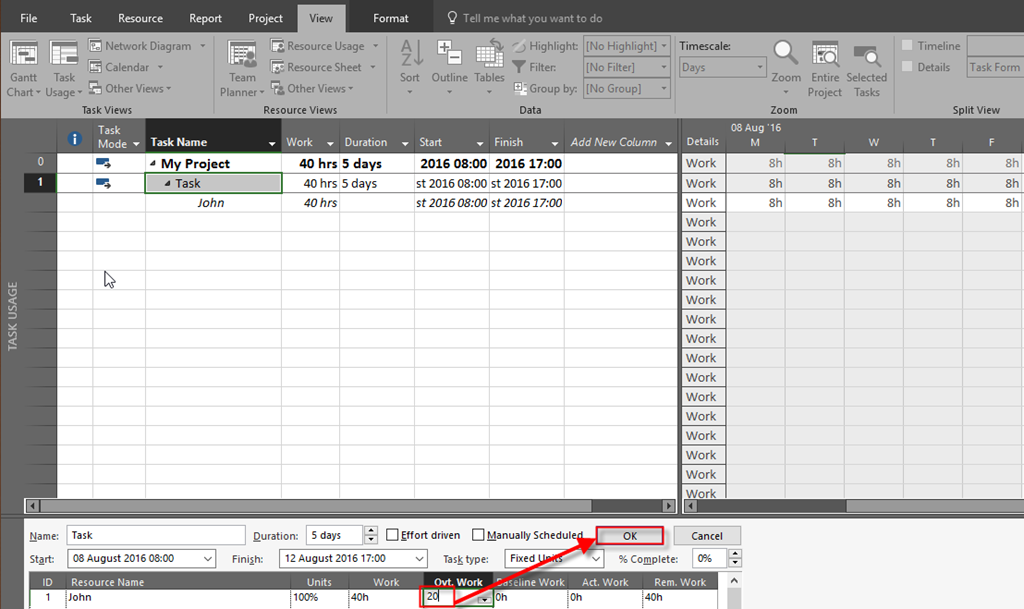
As you can see, John is supposed to work 40 hours, 8 hours per day, during 5 days of Duration. Now, suppose, that John will work more than 8 hours per day, and you want to put those hours as Overtime work. Suppose that 20 hours will be overtime work:

image

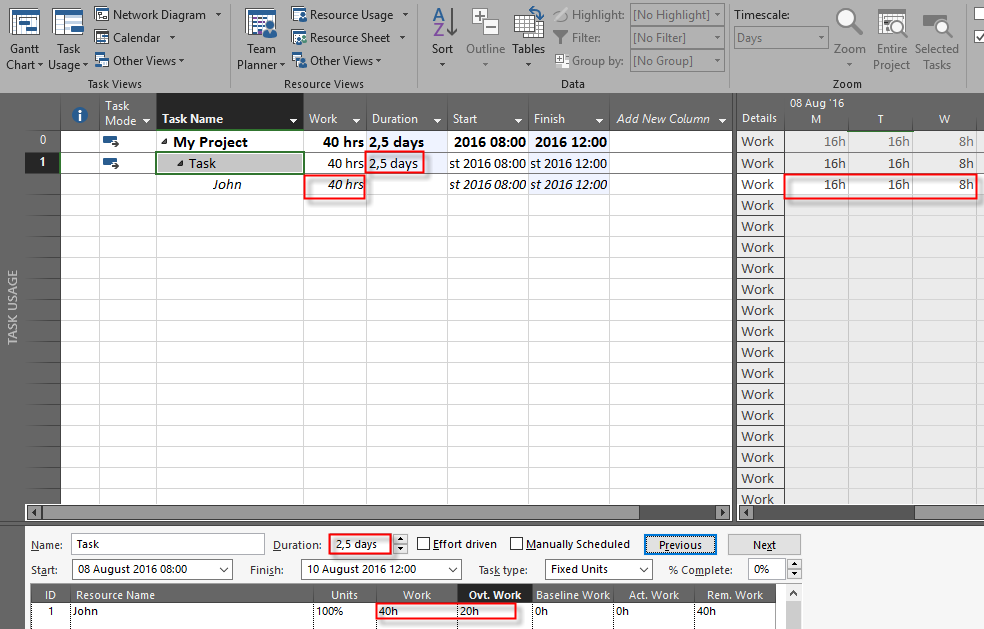
After I click on OK button I will get:

image

As you can see, Duration is 2,5 days now. Why? MS Project calculates Duration according to next formula:

DURATION = (Work – Overtime Work) / Hours per day. In this case it is: DUARTION = (40-20)/8 = 20/ 8 = 2,5 days.

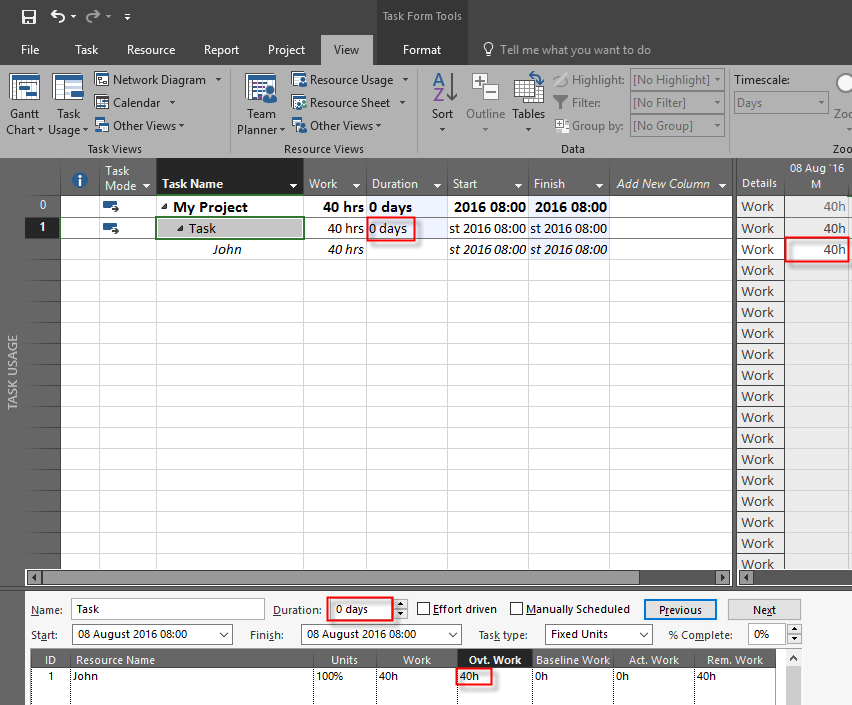
Now suppose that all 40 hours are overtime work:

image

As you can see, Duration is 0 days, according to formula Duration = (40-40) / 8 = 0 Days. This make no sense but you should consider that Overtime work is something like “off the Calendar). If you consider this option you should ask yourself: “Do I understand overtime work?” Overtime work has to be smaller than total work (Work field). Overtime work is something like: “How many hours of regular work, will be over it?”. If overtime work is same as regular work, than it is regular work, not overtime!

Hope this helps!

Posted in Microsoft Project 2013, MS PROJECT 2010, MS PROJECT 2016, PMI, PRoject Management | Tagged , , | Leave a comment

How to setup complex Graphical Indicators with MS PROJECT 2016

Hi,

I can see on the forums that lot of MS PROJECT 2016 user have problem with graphical indicators. For example, they want to see Actual Work compared with base lined work, and see the status. OK, that is not so complicated. Let’s say that you want to compare Actual work with Baseline work in a way that:

  • If Actual work is equal or lower than Baseline work – you want a Green indicator
  • If Actual work is up to 20% higher than Baseline work – you want a Yellow indicator
  • If Actual work is more than 20% higher than Baseline work – you want a Red indicator


    Firs of all I am going to create Simple Project with three Tasks and three Resources:

    image

    and:

    image

    Finally I’m going to assign them to Tasks:

    image

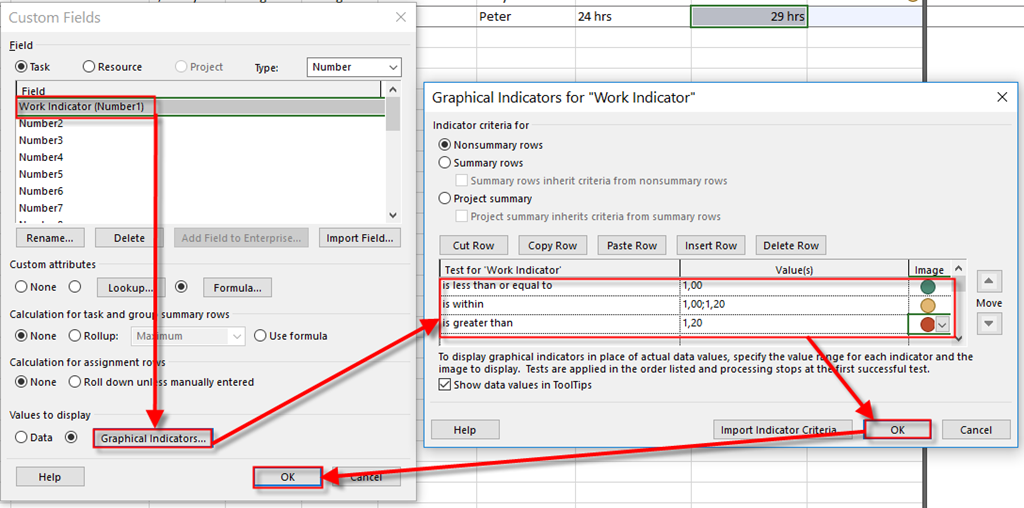
    Now I’m going to create one Custom field – Number:

    image

    and then:

    image

    and then:

    image

    Now I’m going to save the Baseline:

    image

    and, finally I am going to include all relevant fields in Gantt Chart:

    image

  • Now I’m going to put some Actual work:

    image

    As you can see, I’ve got what I want. Notice this little tip. If you put checkmark here:

    image

    and you hoover your mouse on the Graphic Indicator, you will se Value:

    image

    With this you can see actual value of this custom field, and you can check if your formula works properly!

    Regards!

    Posted in MICROSOFT PROJECT, Microsoft Project 2013, MS PROJECT 2016, PMI, PRoject Management | Tagged , | 1 Comment

    How to change Resource Assignments for Multiple Tasks in MS PROJECT 2016

    Hi,

    Here is a problem that one of my Blog Readers have:

    “Is there a way to have the same resource – Team A work on multiple tasks and a place where I can change the “Units %” from 300% to 500% (or any other number) one in the project instead of changing it at EVERY task ?”

    The answer is: “Yes, you can do it very easy, and I will show you how in MS PROJECT 2016!

    First I’m going to create simple Project:

    image

    and Team A as a Generic Resource:

    image

    Now, let’s say that I want to assign Team A to all Tasks, and I want to assign only 300% per Each Task. Of, course I can do it Task by Task, but I want to do that all in once.

    Steps are:

    image

    I will get:

    image

    If I want now change Units from 300% to 350% for all Tasks, I will follow same steps.

    simple, isn’t it?

    Regards!

    Posted in MICROSOFT PROJECT, Microsoft PRoject 2010, Microsoft Project 2013, MS PROJECT 2016, PMI, PRoject Management | Tagged , , | 3 Comments

    Extended Duration with Fixed working hours–MS PROJECT 2016

    Hi,

    I have very interesting question from one of my Blog readers:

    “Hi Nenad,

    I would appreciate if you could advise on the following two  topics:

    1. How to handle the situation when a task is delayed due to some unforeseen circumstances, but the actual work performed by several assigned resources remains unchanged

    For example:

    Task A  = 3d with Resources R1 and R2 assigned at 100% each. Work is 48h . R1 work = 24h, R2 work = 24h

    Let’s assume that this task is delayed 2 days. So we enter the  Actual Duration of  5d or instead enter the Actual Finish day for the task to correspond to day 5.

    So how and  where should we enter value  for each resource so the 5d task is 100% and the actual work for each resource is planned 24h?

    Note: Please explain this for each task type!

    2. Same situation as above, but the Actual Duration of the task is shorter than planned, while the Actual Works for resources are same as planned.”

    OK! Let me show you that with MS PROJECT 2016!

    First I am going to create brand new Project with one Task with 3 days Duration:

    image

    No I am going to create two resources:

    image

    and finally, I’m going to assign those resources to Task:

    image

    Now I’m going to switch to the Task Usage View:

    image

    For my example, I added three more Columns: Actual work, Remaining work, and Task Type.

    I will now change duration from 3 to 5 days, for:

    Fixed Units and Fixed Duration

    image

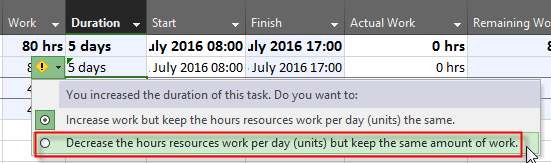
    As you can see, Work is extended as well, from 24 hours to 40 hours per Resource. But, if I click on the Yellow sign, I can choose:

    image

    In this case I will get what I want, e.g. work will remain the same for each Resource, but they will work less per day:

    image

    Fixed Work

    If I change Duration on that Task Type, I will not have to choose anything to get the same result, because by default, Fixed work means that if I change Duration, work will remain the same (e.g. 24 hours per Resource), and it will be spread among 5 days (e.g. each Resource will have to work less per day on that Task).

    The same thing will happen if I short Duration. But, in that case for Fixed Units, and Fixed Duration I will have to choose that I want to Increase the hours work per day, and with fixed Work it will be automatically done for me.

    Hope this helps.

    Regards!

    Posted in MICROSOFT PROJECT, Microsoft Project 2013, MS PROJECT 2016, PMI, PRoject Management | Tagged , | 2 Comments

    Duration vs. Manually entered actual work in MS PROJECT 2016

    Hi,

    I’ve got a question form one of my Blog readers:

    “Hi Nenad,
    Based on the example in your previous post please answer the following questions:
    1) When you manually updated the actual work in each of the 3 days for Resource in Task to 4, 12 and 20 hrs, Project calculated actual duration as 3 days. As the default is that one working day is 8h, how did Project calculate the Actual Duration to be 3 days instead of 4+12+20 =36h/8h = 4,5d ?

    2) How in this case does Project uses the scheduling formula Work = Duration * Units to calculate the total task Duration of 5.5 days?”

    OK. I’ll show you that in MS PROJECT 2016!

    I will first create a Project with one Task, 7 days Duration:

    image

    I am also going to create John as Resource:

    image

    Finally, I’m going to assign John to the Task:

    image

    Now I am going to Switch the View to Task Usage, and I’m going to add Actual Duration to it:

    image

    On the right size of this View, I’m going to show Actual Work field:

    image

    and I will get:

    image

    I will put in Actual Work:

    • 4 hours for Monday
    • 12 Hours for Tuesday
    • 20 Hours for Wednesday

    and I will get:

    image

    As you can see there is a special mark on the Right side of the Task:

    image

    Now, why is Actual Duration 3 Days instead of 36/8 = 4,5 days? 36 hours were spent to the Task, that is true. Default is 8 hours per day. That is also true. And 36/8 = 4,5. BUT! Once when you decide to put Actual work manually, formula work=Duration * Unit) will not work any more for this specific Task. Why? Because you can put any value in Actual work. So, Microsoft Project does not use formula any more. Instead it recognized that has been some (ANY) Actual Work in Monday, Tuesday and Wednesday, and no matter how much work was spend it says that Actual Duration is 3 days! That is it!

    And what about Duration field? It is now 5,5 days. Here Microsoft Project use formula, but partially. Here is explanation how:

    1. Actual Duration is 3 days
    2. At Thursday and Friday, John is supposed to work 8 hours per day. It is 2 days!
    3. At next Monday, John is supposed to work 4 hours. It is 0,5 days
    4. Total is 3 days (Actual) + 2 days (Thursday and Friday) + 0,5 day (Monday) = 5,5 days

    To conclude, if you are going to manually put Actual work to the Task, be very careful.

    Best Regards!

    Posted in MICROSOFT PROJECT, MS PROJECT 2016, PMI, PRoject Management | Tagged , , | 2 Comments